
A well-lit motor speedway doesn’t just look impressive at night. It sets the stage for sharper reactions, smoother racing lines, and a viewing experience that actually lets fans see what’s going on at 300 km/h without squinting into the darkness. A lot of people assume lighting is simply a matter of “more is better,” but the truth is a little more layered than that. Speedways need brightness that works with the speed of the vehicles, the size and curvature of the track, the weather patterns, the camera requirements, and the way spectators’ eyes actually respond to fast movement.
Here’s a closer look at how to figure out how bright a motor speedway should be and what shapes lighting choices behind the scenes.
Why Lighting Matters in Motor Speedway Lighting Design
The Way Light Shapes Speed
When you settle into a night race, there’s this almost electric clarity in the air. Cars slicing through the dark at 250 to 350 km/h don’t just rely on engines and aerodynamics. They lean heavily on consistent lighting to keep their rhythm steady. Even a tiny dip of about 100 to 150 lux in a corner can shift how a driver reads the surface texture, braking markers, or the edge of the racing line. Human eyes need roughly 0.2 to 0.3 seconds to adapt to sudden changes in brightness, and on a speedway, that micro-delay can translate into 20 meters of travel at racing speed. That’s more than enough space for a botched apex or a slide that wasn’t meant to happen.
Lighting also affects depth perception, especially on circuits with elevation changes or banked turns. When the illumination doesn’t match the speed profile of each section, shadows stretch in weird ways, and the track starts to feel “off.” Drivers talk about it more often than people think: when lighting is uneven, their brains work overtime to interpret visual cues at full throttle.
What Spectators and Cameras See
Spectators rely on a different but equally demanding kind of clarity. A single broadcast camera might cover a 150 to 300 meter stretch, depending on the lens and angle. If half of that appears bright and crisp while the next chunk dips into muddy tones, the broadcast loses its polish. Racing series that film in high frame rates or slow-motion replays need stable vertical illuminance; if the vertical values drop below around 300 to 400 lux, cars blur into shadow instead of standing out.
Modern UHD broadcasts also amplify inconsistencies. A patch that seems “fine” to the naked eye suddenly pops out on a 4K feed. That’s why leagues keep raising illumination standards every few years. The sport has become a visual product as much as a live event.
People Working Trackside
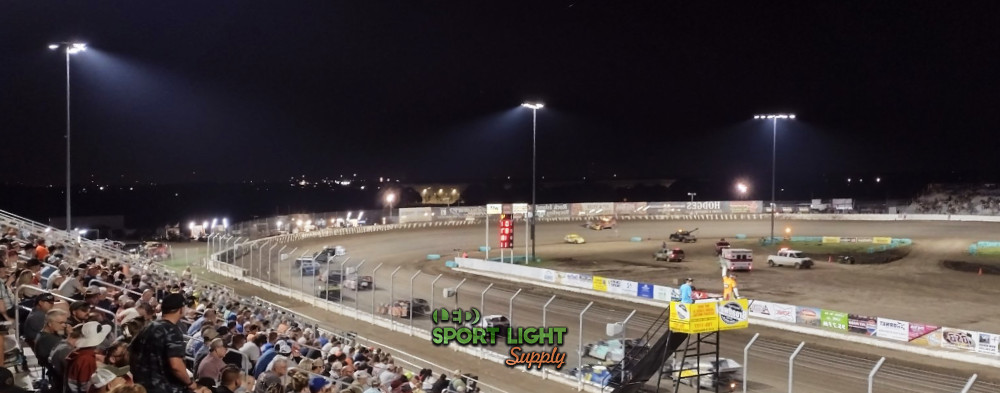
There’s also the crew who keep races running smoothly. Marshals, pit teams, safety car drivers, and track photographers all depend on lighting that behaves predictably. When shadows fall in the same place every lap, marshals make quicker calls and teams react faster to flags or incidents. Pit lanes often use lighting in the 600 to 900 lux range to keep tool shadows minimal and communication clear.
A lot of people forget that nighttime maintenance crews check barriers, sweep debris, and repair fencing under the same lighting system. When an entire crew is working under even, steady illumination, tasks that should take 10 minutes don’t suddenly stretch into 20 because somebody is squinting through uneven glare.
Lighting That Works Instead of Distracts
Good speedway lighting doesn’t try to blind the night into submission. It sets a visual rhythm that matches the sport itself. Evenness and steadiness matter more than sheer wattage. If the light is too intense, surfaces glare and reflect in all the wrong directions. If it’s too soft, detail disappears exactly where drivers need it most.
Most modern tracks aim for a sweet spot where the horizontal illuminance stays within roughly 800 to 1200 lux for high-speed sections and slightly lower in slow technical zones, but the key is that the shifts are controlled, not sudden. Lighting engineers often talk about “visual flow,” which basically means the light lets the race breathe naturally without calling attention to itself.
When all of these elements line up — uniformity, angle, color temperature, and brightness — the track feels alive. The cars glow just enough to showcase their movement, shadows behave like they’re choreographed, and the whole event feels sharper, smoother, and more cinematic.
Technical Standards and Recommended Brightness Level
Governing Body Guidelines
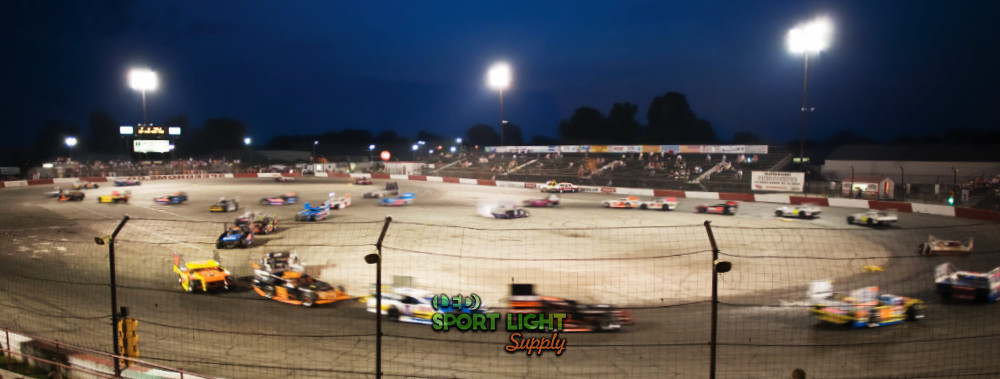
Most motorsport organizations release lighting guidelines that evolve every few years as racing speeds, camera technology, and LED systems get better. FIA-grade circuits, for instance, usually target a minimum horizontal illuminance of around 1000 lux for high-speed night races. That number isn’t random; it’s tied to how fast cars travel, how much distance drivers need to read braking zones, and how clearly track features need to appear on broadcast feeds.
Some oval speedways in North America go even brighter, nudging into the 1200 to 1600 lux range, especially when they’re hosting televised events with multi-camera rigs and slow-motion replays. Once TV producers start working with 4K and 8K sensors at 120 frames per second, the lighting system suddenly becomes part of the show’s technical backbone.
These guidelines usually outline plenty beyond brightness. They talk about uniformity, glare management, fixture height, aiming angles, and even mounting patterns. Uniformity is the quiet hero here. A track hitting 1500 lux on the main straight but dropping to 500 lux at a blind corner feels like two different worlds stitched together. Drivers need the light to behave predictably, not spike and crash as they rip through a lap at 300 km/h.
| Metric | Typical Range / Value |
|---|---|
| Horizontal illuminance (FIA-grade) | ~1000 lux (~93 fc) |
| Horizontal illuminance (oval TV events) | 1200–1600 lux (112–149 fc) |
| General night-race range | 900–1500 lux |
| Vertical illuminance | 300–600 lux (28–56 fc) |
| Color temperature | 5000–6000 K |
| Uniformity ratio | 0.4–0.6 |
Measurable Lighting Metrics
Lighting engineers rely on a handful of technical metrics to keep everything grounded and measurable. Horizontal illuminance is the one people talk about most often, because it’s basically the number that tells you how bright the track surface is. For context, a normal office environment sits around 300 to 500 lux. A serious night race can easily triple or quadruple that to hit the 900 to 1500 lux zone.
Vertical illuminance becomes crucial for cameras. When a car angles into a corner or leans under braking, vertical light catches the surfaces that horizontal light doesn’t reach well. Without enough vertical illuminance — usually in the ballpark of 300 to 600 lux — fast-moving cars smear into dark bands on camera, especially in long broadcast shots.
Color temperature shapes the vibe. Speedway lighting commonly falls between 5000 and 6000 Kelvin, where things look crisp and neutral without washing into icy blue. That range helps curbs, sponsor logos, pit boards, and safety flags stand out cleanly at a glance.
Then there’s uniformity ratio, which makes a track feel visually smooth. If one patch is clocking in at 1200 lux and another nearby area is only hitting 400, the eye senses the imbalance instantly. Many pro circuits aim for a uniformity ratio around 0.4 to 0.6, which keeps the visual flow steady enough for both drivers and cameras.
Typical Brightness Ranges for Speedway
How Track Size Shapes the Numbers
Brightness levels on a speedway don’t come from guesswork. They grow out of the track’s size, layout, and the way cars interact with the surface at speed. A compact 1-km club circuit might get away with 500 to 800 lux, but once you stretch a layout into the 3-km or 4-km range, the lighting demands jump fast. A long international-grade circuit often pushes toward 1000 to 1500 lux simply because cars hold top speed for longer stretches. When a driver is covering 90 to 100 meters per second, the lighting needs enough reach and consistency to keep the visuals smooth from corner entry to corner exit.
Long straights especially demand stronger coverage. If illumination drops even slightly in the middle of a 700-meter straight, drivers barely have time to let their eyes adjust before hitting the next braking zone. The lighting has to bridge that whole distance cleanly, without pockets of dimness hiding surface details or reference markers.
| Factor | Typical Values |
|---|---|
| Small track (1 km) | 500–800 lux (≈ 46–74 fc) |
| Large track (3–4 km) | 1000–1500 lux (≈ 93–139 fc) |
| Extra for long straights | Maintain full target range; avoid illuminance troughs |
| Extra vertical illuminance for banked ovals | +200–300 lux (≈ 19–28 fc) |
| Fresh asphalt reflectance boost | +50–100 lux apparent (≈ 5–9 fc) |
| Humidity reduction | 10–20 percent perceived loss |
| Desert brightness increase | 5–10 percent perceived gain |
Shape, Banking, and How Light Behaves
Track geometry adds another layer to the equation. Circuits packed with 90-degree corners or technical S-sections need extra attention on the apex areas where shadows tend to pool. Engineers often aim additional luminaires into the inner edges so you don’t get a dark pocket right where a driver needs to judge steering input.
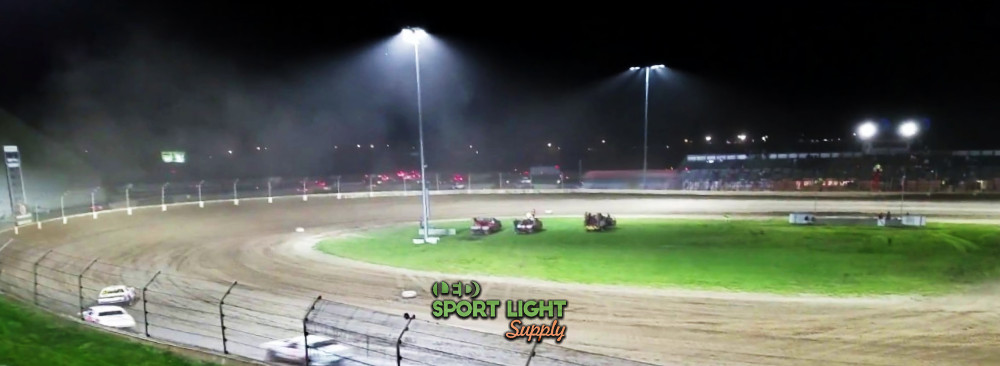
Oval speedways bring their own challenges. When you add 20 to 33 degrees of banking, the surface isn’t just flat asphalt anymore. It tilts upward, catching and reflecting light differently. If the lighting relies too heavily on horizontal throw, the upper lanes can disappear into murky tones. To fix that, lighting designers dial in higher vertical illuminance, sometimes another 200 to 300 lux compared to the flat sections, to keep the high line from vanishing into the background.
Track Surface and How It Affects Brightness
The asphalt itself can change how bright a track “feels.” Older, darker surfaces soak up more light, reducing the reflected illuminance that drivers rely on. A freshly laid surface reflects light a bit better, which means the same set of fixtures might deliver what looks like an extra 50 to 100 lux on the surface.
Since a track ages every season, engineers often do reflectance tests before major upgrades. If the surface has lost too much reflectivity, they might raise the luminance slightly or adjust aiming angles to make up for the darker tone. It’s one of those behind-the-scenes tweaks that most people never notice, but drivers feel immediately.
Weather, Humidity, and the Mood of the Air
Climate shifts the whole lighting picture. In humid regions, water vapor scatters light and softens the perceived brightness. Coastal circuits sometimes lose 10 to 20 percent of what should’ve been a crisp beam because mist hangs in the air at night. The light doesn’t disappear, but it spreads and diffuses, which dulls contrast on the asphalt.
Dry desert circuits have the opposite problem. With almost no moisture in the air, lighting feels sharper, sometimes borderline harsh. Under the same lumen rating, a desert track can look 5 to 10 percent brighter than a tropical circuit. Because of that, engineers study long-term weather data to choose brightness ranges that feel steady year-round instead of perfect on one night and jarring on the next.
Altitude and Atmospheric Clarity
Even altitude gets a tiny vote in the lighting discussion. Higher elevations have thinner air, which can make illumination appear a bit clearer. The difference isn’t massive, but when you’re dealing with world-class events where every detail matters, that extra clarity nudges designers to fine-tune angles and adjust throw distances so the light spreads evenly across the banking and straights.
The Blend That Creates a Speedway’s Nighttime Glow
All of these details — size, banking, surface tone, climate, and even altitude — feed into the final number. That’s why no two speedways share the exact same brightness recipe. One track might look perfect at 900 lux because the air is humid and the asphalt is bright, while another needs 1300 lux to achieve the same feel under desert skies. At its core, the right lighting makes the speedway look and feel alive, giving it that signature nighttime glow that racers and spectators instantly recognize.
Common Mistakes to Avoid When Determining the Brightness
Thinking “Brighter Is Always Better”
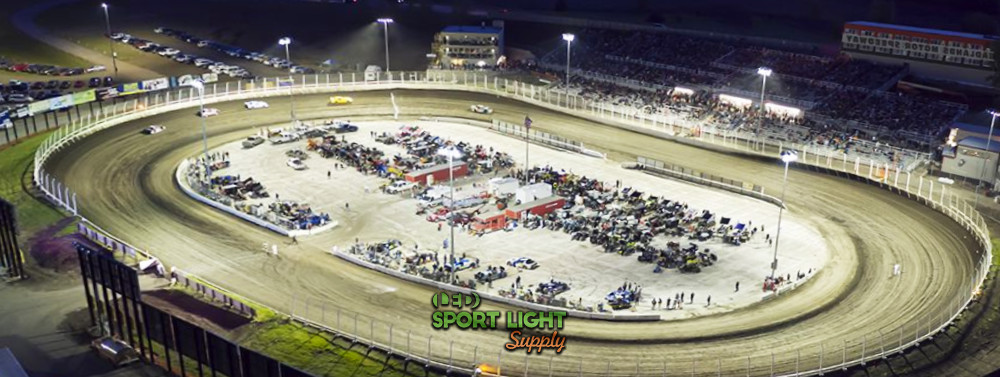
One of the most common traps is assuming that more light automatically means better visibility. It sounds logical, but once you pass a certain point, the extra brightness starts working against you. When illumination jumps too high, painted reference points begin to wash out, and the glare bouncing off windshields becomes a real distraction. A few tracks have pushed past 1800 lux in some sections, only to discover that drivers felt more strain because their eyes had to constantly fight glare and reflection. Lighting should guide, not overpower.
Brightness without proper direction also creates chaos along the edges of the speedway. The outer zones are lined with signage, marshals, timing loops, fences, and sometimes pit entry lanes. If the lighting spills too aggressively into these areas, shadows become unpredictable, and teams lose the clean contrast they need to read boards or spot hand signals.
Focusing on Lumens Instead of Uniformity
A lot of lighting mistakes come from chasing raw lumen output instead of focusing on uniformity. You can hit 1600 lux on the main straight, but if the next section drops to 600 lux, the entire lap feels visually uneven. Drivers depend on rhythm; they want to know that every braking zone and every mid-corner view arrives with the same visual stability. A sudden brightness swing of 500 to 700 lux forces the eyes to recalibrate, which is the last thing you want when running flat-out at 300 km/h.
Uniformity also matters for marshals and safety crews. Patchy lighting can hide debris, distort surface texture, or delay reaction time during incidents. A well-planned lighting system keeps transitions smooth so the whole track feels cohesive, not stitched together from random bright and dim spots.
Ignoring Camera Requirements
Some speedways still design lighting with only drivers in mind, forgetting that modern broadcasts rely heavily on high-frame-rate, high-resolution footage. Cameras react differently to light than the human eye. If you don’t offer enough vertical illuminance, especially in corners where cars tilt and change angles, the broadcast can show flicker, dull coloring, or exposure dips.
When camera teams report that cars “lose detail” in a certain turn, the culprit is almost always a corner that looked fine in person but didn’t deliver enough light to the lens. As broadcast tech climbs into the 4K and 8K range, lighting systems need to be built with both humans and sensors in mind.
Misjudging Light Angles and Orientation
Another issue appears when tracks rely on old-style pole layouts that aim light straight down. Racing doesn’t happen in a downward plane. Drivers read the track at an angle, cameras shoot from the sides, and spectators watch from raised stands. Proper speedway lighting should be angled so it wraps across the surface, revealing texture, camber, and tire marks. If the aiming angle is wrong, shiny patches appear in the worst spots, or shadows shift in odd directions as cars move through the beam.
Some older circuits even produce a “hotspot” effect where a section glows overly bright for 20 meters before dropping off again. Those bright spots might only be 200 lux stronger than the rest of the track, but at racing speed, that feels like someone is flicking a light switch mid-corner.
Misjudging Color Temperature
Color temperature seems simple, but it can dramatically shape how a track “feels.” If the lighting is too warm, the track surface looks muddy on camera and loses contrast, especially in areas with painted curbs. If it’s too cool, drivers develop eye strain because the light feels overly sharp. Most modern circuits stay within 5000 to 6000 Kelvin, which gives the asphalt a clean, neutral tone and keeps both the human eye and broadcast sensors comfortable.
When tracks ignore color temperature altogether, the result is a visual mismatch: spectators see one thing, cameras capture something else, and drivers get a third version entirely. The right tone keeps everything aligned.
A Few Words Before We Roll Down the Pit Lane
Figuring out how bright a motor speedway should be isn’t as dramatic as tuning an engine or redesigning a turn, but it shapes every moment of a night race. When brightness, uniformity, angle, and color temperature line up, everything flows. Drivers trust their instincts, spectators get a clear view, and the broadcast captures every detail without hunting for exposure. Good lighting turns the track into a kind of nighttime stage, where motion stays crisp and the rhythm of the race feels natural instead of forced.
The magic isn’t in overpowering the darkness, but in creating steady, balanced illumination that lets the sport breathe. With the right brightness, a motor speedway becomes more than just a loop of asphalt. It comes alive, glowing just enough to keep the night racing spirit sharp and unmistakable.