
Good lighting can quietly decide whether a lacrosse game feels sharp and energetic or awkward and hard to follow. Players need to track a fast-moving ball, referees need to make clean calls, and spectators expect to actually see what they came for. Whether the field is used by a local school or a college program, lighting standards exist to make sure the game flows the way it should. Below is a practical look at how those standards work, what the numbers really mean, and how smart lighting choices support better play and long-term value.
Not every lacrosse field is built for Friday night lights. Practice and training fields are usually designed with function in mind rather than spectacle. The goal here is simple: players need to see the ball, their teammates, and field markings clearly enough to run drills without strain. Lighting levels for these fields often sit around 30 to 50 foot-candles, which is more than enough for passing, shooting practice, and conditioning work.
Uniformity still matters, even at this level. A practice field with uneven lighting can feel distracting, especially during evening sessions that run two or three hours at a time. Many schools and clubs also use these fields more frequently than game fields, sometimes logging 1,500 to 2,000 hours per year, so energy efficiency and fixture lifespan tend to be bigger priorities here.
High school lacrosse fields usually have to wear more than one hat. They host practices during the week and official matches under league rules, often with spectators on the sidelines. Because of that, lighting standards step up a notch. Typical maintained light levels land in the 50 to 75 foot-candle range, giving referees a clear view of stick checks, offsides, and crease activity.
These fields also benefit from better uniformity and basic vertical lighting, especially for longer passes and shots taken from distance. While broadcast-level lighting isn’t expected, clear visibility across the entire field helps games feel fair and well-paced, which matters just as much at the high school level as it does anywhere else.
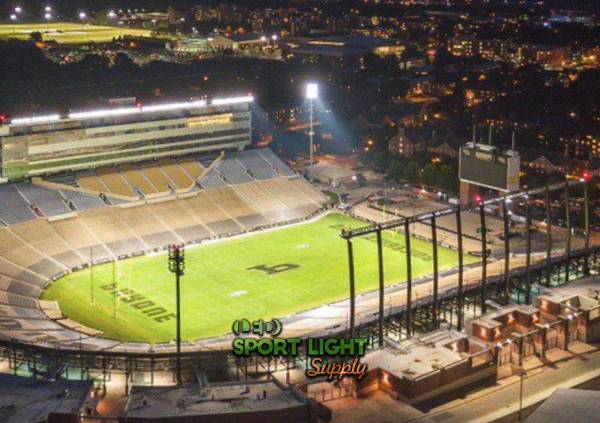 College lacrosse brings faster play, stronger athletes, and larger crowds. Lighting systems have to keep up. Collegiate fields commonly target 75 to 100 foot-candles of maintained horizontal illuminance, paired with tighter uniformity ratios to reduce shadows during quick transitions.
Vertical illuminance becomes more noticeable here as well. Players release shots faster, passes travel higher, and defensive reads happen in a split second. Many college programs also record games for review or live streaming, so lighting quality affects video clarity. Strong color rendering and consistent brightness across the field help jerseys, numbers, and the ball stand out naturally.
Fields used for professional play or televised events sit at the top of the classification ladder. These venues often exceed 100 foot-candles and place heavy emphasis on vertical lighting, sometimes matching or exceeding horizontal levels. Camera angles, slow-motion replay, and facial recognition all rely on balanced light from multiple directions.
Color quality is another step up. Higher CRI values, often 80 or above, help cameras capture accurate team colors and skin tones. Flicker control is also part of the conversation, especially with high-speed cameras running at hundreds or even thousands of frames per second. At this level, lighting isn’t just about the game on the field, it’s also about how the game looks on screen.
Before a single pole is placed or a fixture is selected, field classification needs to be clearly defined. A system designed for casual training will struggle under competitive demands, while an overbuilt broadcast-style system can waste energy and budget if it’s never fully used. Matching lighting design to how the field is actually used keeps performance, cost, and long-term operation in balance, which is why classification is always the first box designers check.
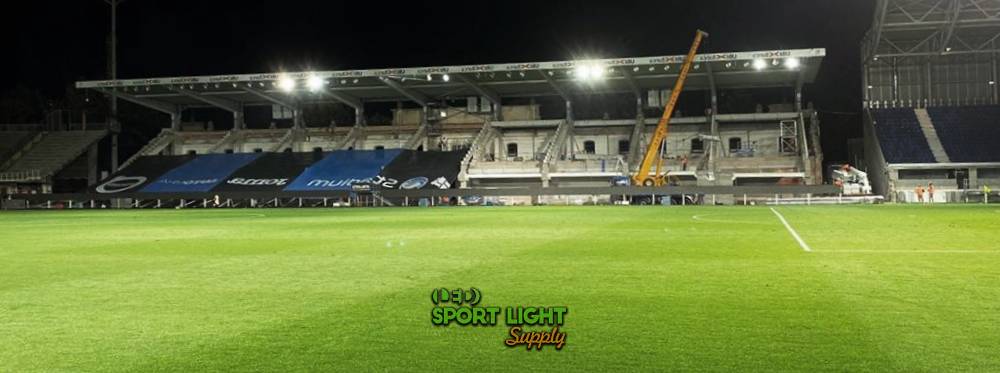
When people talk about how bright a lacrosse field is, they’re usually referring to horizontal illuminance, which measures how much light actually reaches the playing surface. This value is typically expressed in foot-candles in the U.S., or lux in many other regions, with 1 foot-candle equal to about 10.8 lux. Horizontal illuminance directly affects how clearly players see field lines, ground balls, and foot placement during fast cuts, especially in tight spaces near the crease.
For recreational or training fields, maintained light levels commonly fall between 30 and 50 foot-candles. At this range, players can run drills comfortably without eye strain, and coaches can observe technique without missing details. These fields are often in use several nights a week, so designers aim to balance brightness with efficiency to keep operating costs under control.
Once competition enters the picture, brightness expectations rise quickly. High school lacrosse typically operates in the 50 to 75 foot-candle range. This added light supports quicker reaction times and gives officials clearer views of stick contact, offsides, and crease activity from multiple angles.
College-level play pushes the pace even further. Many collegiate fields target 75 to 100 foot-candles, creating a sharper visual environment for both players and spectators. At this level, passes travel faster, shots are released quicker, and play stretches across the full width of the field. Stronger lighting helps the action stay readable, even during night games with large crowds.
Professional and broadcast-ready venues often exceed 100 foot-candles, especially when high-definition cameras are involved. These systems are designed to deliver consistent brightness across the entire field, not just the center of play, so every angle looks clean on screen.
One detail that often gets overlooked is the difference between initial and maintained brightness. Lighting systems don’t stay at peak output forever. Over time, LED fixtures experience gradual lumen depreciation, and dust or environmental buildup can slightly reduce light output. Because of this, lighting designs are based on maintained light levels, not day-one performance.
To compensate, designers usually specify systems that start about 10 to 20 percent brighter than the target level. That way, even after years of use, the field still meets its intended brightness range without constant adjustments or early replacements. This approach keeps performance consistent and helps facilities plan long-term maintenance more predictably.
Brightness isn’t just about seeing the field, it shapes how players react. Higher light levels improve contrast between the ball, turf, and uniforms, which helps players process visual information faster. This is especially noticeable during quick ground ball pickups and rapid passing sequences near midfield.
That said, more light only helps when it’s paired with good uniformity and glare control. Well-calibrated brightness supports sharper reactions, while poorly distributed light can feel distracting, even at higher levels.
Modern LED systems give facilities more flexibility than ever before. Instead of running lights at full output all the time, fields can adjust brightness based on usage. A competition field might operate at 100 percent for games, then drop to 70 percent for practice without sacrificing visibility.
This kind of balance reduces energy consumption and extends fixture lifespan. Over the course of a year, smart brightness management can cut electricity use by 25 to 40 percent, while still delivering the light levels players expect when it matters most.
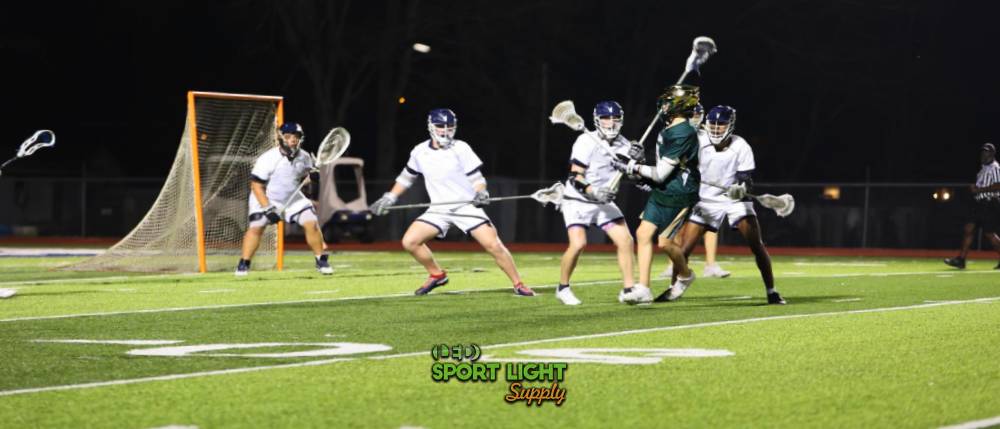
Brightness alone doesn’t guarantee a good playing experience. Uniformity describes how evenly light is distributed across the field, and it has a big influence on how natural the game feels once play starts. A field with bright hotspots near the center and dim corners along the sidelines can be distracting, forcing players’ eyes to constantly adjust as they move.
Uneven lighting also affects depth perception. When players sprint from a brighter zone into a darker one, judging distance and ball speed becomes harder, especially during fast breaks or long passes. That visual inconsistency can quietly disrupt rhythm and timing. This is why uniformity is treated as a core performance metric alongside raw brightness in lacrosse field design.
Most lacrosse fields are designed with a maximum-to-minimum uniformity ratio between 2.0:1 and 2.5:1, depending on the level of play. In simple terms, the brightest area of the field should be no more than about twice as bright as the darkest playable area.
Higher-level fields usually aim closer to 2.0:1, supporting faster gameplay and more demanding visual conditions. Practice fields may allow slightly looser ratios, but even then, excessive contrast can feel uncomfortable during longer sessions. Good uniformity helps players read the game more smoothly, especially during quick transitions, long passes, and shots taken on the move.
Uniformity doesn’t happen by accident. It’s shaped by a combination of pole placement, mounting height, fixture optics, and aiming angles. Taller poles allow light to spread over wider areas, creating more overlap between beams. Well-designed optics help direct light precisely where it’s needed without creating harsh falloff at the edges.
Modern LED systems make achieving uniformity easier than ever. Precise optical control reduces the need to over-light certain areas just to compensate for dark spots elsewhere.
Consistent lighting does more than improve visibility, it builds confidence. When players trust that the field looks the same from end line to end line, they move more decisively and react more naturally. There’s less hesitation on long passes and fewer surprises when chasing loose balls near the sidelines.
For referees and coaches, uniform lighting also means fewer blind spots and cleaner sightlines. When everyone on the field sees the same visual picture, the game flows better and feels more controlled from start to finish.
Horizontal lighting usually gets most of the attention, but lacrosse is very much a three-dimensional sport. Long outlet passes, high shots on goal, and quick stick work all happen above ground level. Vertical illuminance measures how much light reaches players and objects standing upright, and it plays a huge role in how well athletes track the ball and read each other’s movements.
When vertical light levels are too low, the ball can fade into the background during high arcs, especially on long clears or cross-field passes. Players may still see the turf clearly, yet struggle to judge timing on catches or releases. That disconnect is why vertical lighting is treated as its own metric in higher-level field designs rather than being lumped in with horizontal brightness.
Vertical illuminance is typically measured at about 5 to 6 feet above the playing surface, roughly face height for most players. For high school and standard collegiate fields, vertical light levels usually fall between 30 and 50 foot-candles. This range supports clear visibility during fast sequences without overloading the field with unnecessary light.
For college championships, professional matches, or fields that regularly record or stream games, vertical levels often rise to 60 to 75 foot-candles or more. These higher values help cameras capture facial expressions, jersey numbers, and ball movement cleanly. Strong vertical lighting makes the game feel sharper, whether you’re standing on the sideline or watching on a screen.
Vertical lighting isn’t just about turning up the brightness. Balance matters. If most of the light comes from one side of the field, players can look bright from one angle and heavily shadowed from another. That unevenness affects depth perception and makes quick reads harder during play.
Good lighting designs spread vertical light from multiple directions, reducing harsh contrast and softening shadows on faces and upper bodies. This balance also helps referees. Clear views of stick checks, body positioning, and contact around the crease depend heavily on light hitting players from the front and sides, not only from above. When vertical illuminance is well balanced, the game simply looks and feels more natural under the lights.
| Level of Play | Horizontal Illuminance (fc) | Vertical Illuminance (fc) | Uniformity Ratio (Max:Min) |
|---|---|---|---|
| Practice / Training | 30–50 | 20–30 | 2.5:1 |
| High School Competition | 50–75 | 30–50 | 2.5:1 |
| Collegiate Competition | 75–100 | 40–60 | 2.0:1 |
| Professional / Broadcast | 100+ | 60–75+ | 2.0:1 |
A field can meet every brightness requirement on paper and still feel uncomfortable once play starts. Glare is usually the culprit. When light hits a player’s eyes directly, especially during a high pass or a shot on goal, reaction time drops almost instantly. In a fast sport like lacrosse, even a brief moment of visual disruption can throw off timing and decision-making.
Glare often comes from poorly aimed fixtures, low mounting heights, or older lighting systems that rely on wide, uncontrolled beams. Modern LED sports lighting takes a much more precise approach. Tightly focused optics direct light exactly where it’s needed, keeping the playing surface bright without flooding players’ sightlines or creating harsh hot spots.
Glare control starts with choosing the right fixtures. LED sports lights come with beam patterns designed for specific pole heights and field dimensions. When optics and mounting height are properly matched, light reaches the field efficiently instead of spilling into unwanted areas.
Aiming angles are just as influential. Even high-quality fixtures can create glare if they’re aimed too low or overlap awkwardly with neighboring beams. Designers usually establish minimum aiming angles to keep light out of common sightlines, especially near midfield and goal areas where players spend a lot of time looking upward. Shielding and visors can also be added to block stray light without reducing useful illumination on the field.
Glare doesn’t stop at the sidelines. Spectators, referees, and nearby residents all experience the lighting system differently. Fields located close to homes often rely on optics that limit backlight and side spill, keeping illumination within the field boundary and reducing unwanted brightness beyond it.
For players, reduced glare means less eye strain over the course of a two-hour game or a long evening practice. Visual comfort supports sharper focus, smoother execution, and a more enjoyable experience once the sun goes down.
Glare management isn’t a one-time decision. Over time, fixtures can shift slightly due to wind, weather, or maintenance work. Regular inspections and occasional re-aiming help keep glare in check as the system ages.
Well-maintained LED systems hold their aiming more reliably than older technologies, but periodic checks still make a difference. Consistent glare control helps the field feel the same night after night, allowing players to focus on the game rather than the lights above it.
Color temperature plays a surprisingly big role in how a lacrosse field feels at night. Most modern fields use lighting in the 4000K to 5700K range. This cooler white light creates a crisp, alert atmosphere that matches the pace of competitive play.
Lower color temperatures can feel softer, but they may not provide the same level of contrast between the ball, field markings, and players. That’s why many schools and clubs settle around 5000K, a middle ground that looks bright without feeling harsh.
Color rendering index, or CRI, measures how accurately colors appear under a light source. For basic recreational play, a CRI around 65 is usually acceptable. As the level of competition rises, so do expectations. High school championship fields and college venues often aim for CRI values of 80 or higher.
Better color rendering helps officials see stick checks, glove contact, and jersey pulls more clearly. It also makes team colors look natural, which matters to players, fans, and anyone watching from the stands.
Flicker is another light characteristic that’s become more relevant in recent years. While it’s not always noticeable to the naked eye, flicker can show up clearly on video, especially with high-speed cameras used for replay or streaming. Quality LED sports lights are designed with low-flicker drivers, ensuring smooth performance both on the field and on screen.
When color temperature, CRI, and flicker control work together, the lighting fades into the background. Players focus on the game, cameras capture clean footage, and the field looks the way it’s supposed to under the lights.
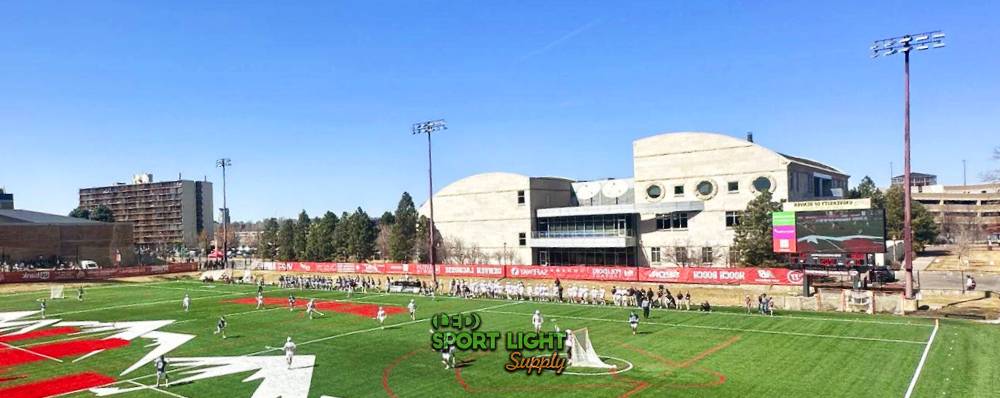
Pole layout is where lighting design becomes part science, part geometry. A full-size lacrosse field typically uses four to eight poles, depending on brightness targets, field dimensions, and surrounding site conditions. Lower-level or practice fields can sometimes perform well with fewer poles, while higher-level competition fields often benefit from additional poles to improve both uniformity and vertical coverage.
Pole placement directly affects how light overlaps across the field. Poles set too close to the sidelines can create overly bright edges with darker zones through the middle, while poles placed too far back may limit effective aiming angles. Because of this, designers usually model multiple layouts digitally, adjusting pole spacing and fixture angles until coverage feels balanced before anything is installed on site.
Mounting height plays a big role in how comfortable the lighting feels to players and officials. Most lacrosse field poles range from 60 to 100 feet in height. Taller poles allow fixtures to aim downward at wider angles, which helps light spread more evenly and reduces direct glare in players’ line of sight during passes and shots.
Shorter poles can still work, especially for practice fields or sites with height restrictions, but they require much more precise aiming. The lower the pole, the narrower the margin for error. Well-chosen mounting height allows light to fall more naturally, reducing the need to increase brightness just to compensate for coverage gaps.
Beyond on-field performance, pole layout and height also influence how the facility looks from the outside. Taller poles often reduce the total number of fixtures needed, but they can raise concerns about visual impact in residential or community settings. Shorter poles tend to blend in more easily, yet may require more fixtures to achieve the same coverage.
Good lighting design weighs all of these factors together. Coverage, player comfort, neighborhood considerations, and long-term maintenance all matter. When pole layout and mounting height are planned carefully, the lighting fades into the background and simply does its job, night after night.
Every field comes with its own challenges. Nearby buildings, trees, parking lots, or existing infrastructure can limit where poles are placed. In these cases, designers often adjust pole heights or fixture optics to work around obstacles without sacrificing performance.
Creative layouts might use slightly taller poles on one side of the field or adjust spacing to avoid shadows cast by structures. Flexibility in pole design helps fields meet lighting standards even when the site isn’t perfectly symmetrical.
Proper installation is just as important as layout and height. Pole foundations must be engineered for soil conditions, wind loads, and fixture weight to ensure long-term stability. A well-installed system stays aligned year after year, reducing the need for frequent re-aiming or repairs.
Lacrosse field lighting doesn’t follow a single master rulebook. Instead, it’s shaped by a handful of sports organizations that focus on how the game should be played and viewed. In the U.S., the NCAA and NFHS set the tone for competitive environments at the college and high school levels. While they don’t publish lighting layouts line by line, their competition manuals strongly influence what’s considered acceptable for game play, safety, and visibility.
For example, NCAA-level games are generally played under lighting systems delivering 75 to 100 foot-candles of maintained horizontal illuminance, which supports faster ball speeds and wider fields of vision. High school competition usually operates at slightly lower levels, often in the 50 to 75 foot-candle range. These benchmarks are widely recognized across the industry, so designers and facility managers often treat them as the baseline when planning new installations or upgrades.
While sports organizations describe how the game should look and feel, the technical side of lighting usually comes from the Illuminating Engineering Society. IES sports lighting standards translate the needs of lacrosse into measurable targets like horizontal illuminance, vertical illuminance, uniformity ratios, glare ratings, and color rendering. This is where lighting plans move from general expectations into real-world numbers.
For lacrosse fields, IES guidance typically recommends uniformity ratios around 2.0:1 to 2.5:1, depending on the level of play. That means the brightest area of the field should not be more than about twice as bright as the darkest playable zone. Designers rely on these ratios because they directly affect how players track the ball in the air and judge distance during fast breaks. IES standards are often the backbone of professional lighting calculations, especially for LED systems that need precise aiming and optics.
Even when a lighting system meets NCAA or IES recommendations, the job isn’t done. Local building codes and zoning ordinances can heavily influence the final design. Many cities limit pole heights to around 60 to 90 feet, especially near residential areas. Others set strict caps on light trespass, often measured in lux or foot-candles at the property line, with common limits falling below 0.5 foot-candles.
Operating hours are another factor. Some municipalities require automatic shutoff after 10 or 11 p.m., regardless of field brightness. Because of these rules, lighting designers often adjust beam angles, fixture wattage, and control systems to balance performance with compliance. It’s common for lighting plans to go through multiple rounds of review involving athletic directors, facility engineers, and local planning departments before a permit is issued.
One thing experienced facility owners learn quickly is that lighting standards work best when everyone is on the same page from the start. A field designed only around competition brightness can run into trouble if it ignores zoning limits or neighborhood concerns. On the other hand, a design driven only by local restrictions may fall short for sanctioned games.
That’s why early coordination between sports governing expectations, IES technical standards, and local regulations saves time and money. When these pieces align, the result is a field that plays well, passes inspection smoothly, and avoids costly adjustments after installation.