
Installing baseball field lighting is one of the biggest upgrades a sports facility can make. Whether it’s for a school, local community park, sports club, or professional venue, a well-designed lighting system creates more opportunities for evening games, extends practice hours, and helps maximize the use of the field throughout the year.
That said, lighting projects involve much more than purchasing a few LED fixtures. The overall investment often includes lighting poles, electrical upgrades, engineering, permits, installation, and long-term maintenance. Depending on the size of the field and the level of competition, the total cost can range from $100,000 to well over $1 million. Without a clear financial plan, it’s easy for expenses to grow beyond the original budget.
Planning ahead gives facility owners a better understanding of where the money goes, what factors influence costs, and how to balance upfront spending with long-term savings. A thoughtful budget also makes it easier to compare proposals from contractors, evaluate financing options, and choose a lighting system that delivers value for many years instead of simply looking at the lowest purchase price.
Understand the Total Cost of Baseball Field Lighting
At first glance, many people focus on the price of the light fixtures themselves. In reality, the fixtures usually represent only part of the overall investment. A complete baseball field lighting project involves several different components, each contributing to the total project cost.
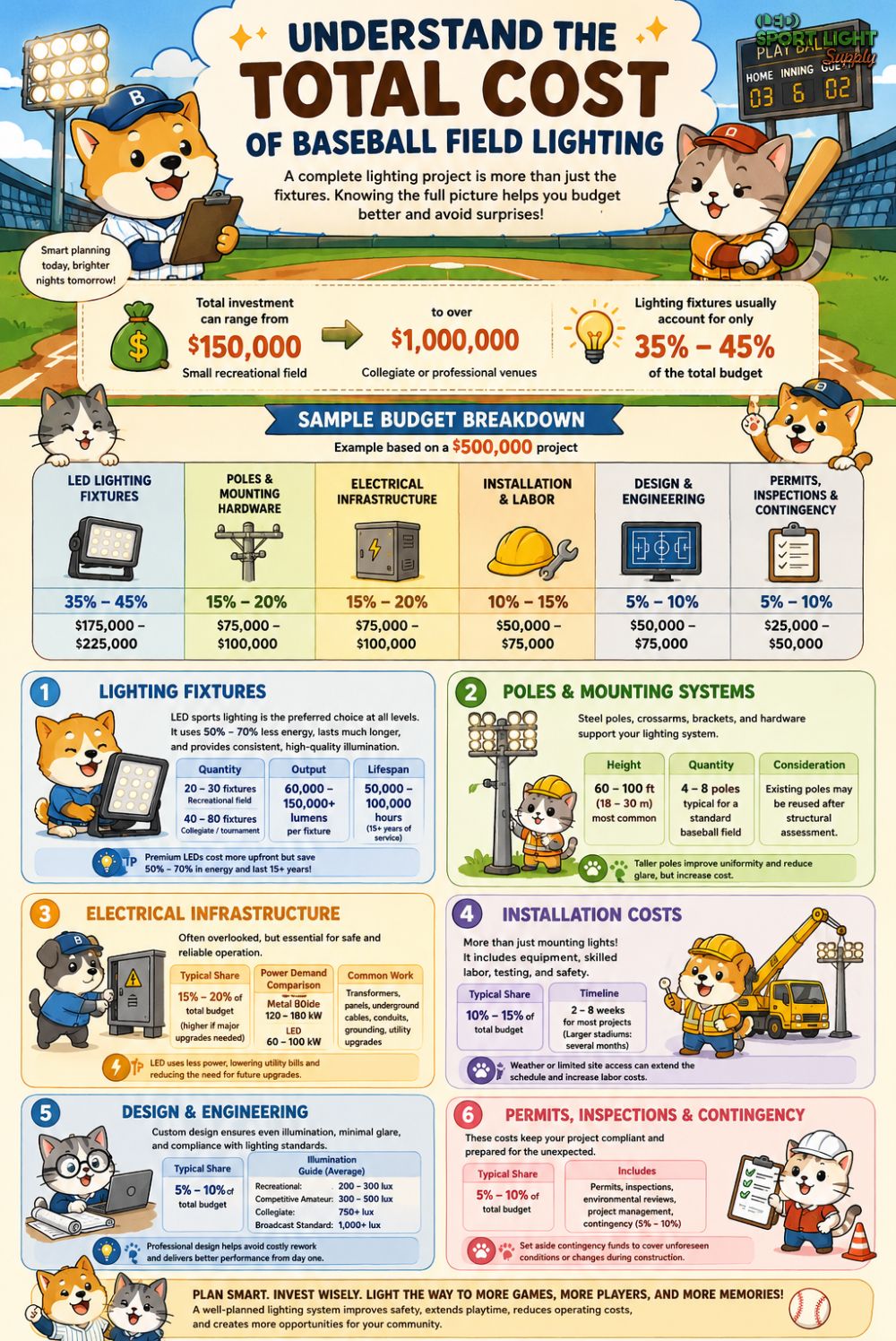
For a typical baseball field, the total investment can range from around $150,000 for a small recreational field to more than $1 million for collegiate or professional venues. In many projects, the lighting fixtures account for only 35% to 45% of the total budget, while the remaining costs are allocated to poles, electrical infrastructure, engineering, installation, permits, and commissioning.
Having a clear picture of these expenses early on helps prevent unexpected costs from appearing halfway through the installation process.
Lighting Fixtures
LED sports lighting has become the preferred choice for baseball fields of all levels. Compared with older metal halide systems, LED technology consumes less electricity, lasts much longer, and provides more consistent illumination across the field.
The price of the fixtures depends on several factors, including brightness, beam angles, optical design, glare control, and lighting quality. A recreational baseball field may require 20 to 30 LED fixtures, while larger collegiate or tournament-level facilities often install 40 to 80 fixtures, depending on the lighting design and target illumination levels.
Fixture output also varies considerably. Modern sports lighting fixtures typically produce 60,000 to over 150,000 lumens per fixture, allowing designers to tailor the system to the field’s specific requirements.
While premium LED fixtures may have a higher upfront cost, they often produce energy savings of 50% to 70% compared with traditional metal halide systems. Many LED fixtures are also rated for 50,000 to 100,000 operating hours, meaning they can provide well over 15 years of service under normal usage conditions before requiring replacement.
Poles and Mounting Systems
Lighting fixtures need properly engineered support structures. Steel poles, crossarms, brackets, and mounting hardware all add to the project budget.
Most baseball field lighting poles range from 60 to 100 feet (18 to 30 meters) in height. Youth and recreational fields generally use shorter poles, while collegiate and professional facilities often require taller structures to improve light uniformity and reduce glare for players.
A standard baseball field typically uses 4 to 8 lighting poles, although larger stadiums may require additional structures depending on the lighting layout.
If an existing facility already has lighting poles in good condition, it may be possible to reuse them after a structural assessment. However, older poles aren’t always suitable for heavier or differently configured LED fixtures. Investing in a structural evaluation can help determine whether retrofitting is feasible or whether replacing the poles offers better long-term value.
Electrical Infrastructure
One of the most overlooked expenses in a lighting project is the electrical system behind it.
Some older facilities simply don’t have enough electrical capacity to support a modern LED lighting system. Additional work may include upgrading transformers, installing new electrical panels, replacing underground cables, or expanding the site’s power supply.
Electrical infrastructure typically represents 15% to 20% of the total project budget, although this percentage can be higher if extensive utility upgrades are required.
While a traditional metal halide system may demand 120 to 180 kilowatts (kW) during operation, an equivalent LED system often reduces power consumption to 60 to 100 kW, depending on the lighting level and fixture efficiency. Lower electrical demand not only reduces operating costs but can also lessen the need for future utility upgrades.
Even when the lighting fixtures themselves fit comfortably within the budget, electrical improvements can account for a sizeable portion of the total project cost. Understanding these requirements before construction begins helps reduce the chances of costly surprises later.
Installation Costs
Professional installation involves much more than mounting lights on poles.
Contractors need specialized lifting equipment, certified electricians, safety personnel, testing equipment, and experienced technicians to complete the project properly. Site accessibility can also influence labor costs. Fields located in remote areas or those with limited equipment access often require additional planning and resources.
Installation and labor generally account for 10% to 15% of the overall project budget. Depending on the project size, construction may take anywhere from two to eight weeks, while larger stadium installations can require several months from groundbreaking to final commissioning.
Weather conditions may also affect installation schedules. Heavy rain, strong winds, or frozen ground can delay construction, leading to longer project timelines and additional labor expenses.
Design and Engineering
Every baseball field has its own layout, dimensions, and performance requirements. Because of this, lighting systems should never rely on a one-size-fits-all design.
Professional lighting designers perform photometric calculations to determine fixture placement, aiming angles, mounting heights, and light levels across the entire playing area. Their goal is to provide even illumination while minimizing glare, light spill, and dark spots.
Engineering and lighting design services generally account for around 5% to 10% of the total project cost. While they add to the upfront investment, they often help avoid expensive corrections after installation.
For reference, recreational baseball fields typically require average illumination levels of 200 to 300 lux, while competitive amateur facilities may require 300 to 500 lux. Collegiate or broadcast-standard venues often exceed 750 lux, with television-ready stadiums reaching 1,000 lux or more depending on governing body requirements.
A well-designed lighting system usually performs better from day one and reduces the likelihood of future modifications.
To put everything into perspective, a baseball field lighting project with a $500,000 budget might be distributed like this:
| Cost Category | Typical Percentage | Estimated Cost (Based on $500,000 Budget) |
|---|---|---|
| LED Lighting Fixtures | 35% to 45% | $175,000 to $225,000 |
| Poles & Mounting Hardware | 15% to 20% | $75,000 to $100,000 |
| Electrical Infrastructure | 15% to 20% | $75,000 to $100,000 |
| Installation & Labor | 10% to 15% | $50,000 to $75,000 |
| Design & Engineering | 5% to 10% | $25,000 to $50,000 |
| Permits, Inspections & Contingency | 5% to 10% | $25,000 to $50,000 |
Compare Financing Options
Not every organization has the budget to pay for a baseball field lighting project upfront. Schools, municipalities, sports clubs, and private facility owners often explore different financing solutions to spread the investment over several years while still moving forward with the project.
For projects costing anywhere from $150,000 to more than $1 million, financing can make the investment much more manageable. Rather than delaying the project for several years while funds accumulate, many organizations choose a financing strategy that allows them to start benefiting from the upgraded facility immediately.
Choosing the right funding approach depends on the organization’s financial position, long-term goals, projected cash flow, and expected return from the upgraded facility.
Capital Budget Allocation
For organizations that regularly invest in infrastructure, using funds from an annual capital improvement budget is often the most straightforward option. This approach avoids interest charges and allows the project to be completed without taking on additional debt.
Many municipalities and educational institutions prepare 3- to 10-year capital improvement plans, allowing large projects like sports lighting to be scheduled alongside other facility upgrades.
However, lighting projects often compete with other priorities, such as resurfacing fields, renovating clubhouses, replacing scoreboards, or improving spectator amenities. Planning the project 12 to 24 months in advance often increases the likelihood of receiving budget approval.
Equipment Financing
Many lighting manufacturers and financial institutions offer equipment financing programs specifically designed for sports facilities.
Instead of making one large payment, owners can spread the cost over 3 to 10 years through manageable monthly or quarterly installments. This allows facilities to benefit from new lighting sooner while maintaining healthier cash flow.
For example, a $300,000 lighting project financed over 7 years may be easier to accommodate within an annual operating budget than paying the full amount upfront.
Organizations that expect additional revenue from evening games, league rentals, tournaments, or community events often find that the increased income helps offset a portion of the financing payments over time.
Municipal Bonds
Publicly owned facilities may have access to municipal bonds for larger infrastructure improvements.
Although the approval process may take longer, bonds often provide competitive interest rates and repayment periods that can extend 10 to 30 years, making them well suited for large-scale sports facility upgrades.
Municipal funding is particularly common for community sports complexes, public schools, universities, and city-operated recreational facilities where lighting improvements are part of broader infrastructure development plans.
Leasing Programs
Some suppliers also provide leasing arrangements for sports lighting systems.
Leasing can reduce the initial financial commitment while allowing facilities to upgrade to modern LED technology. Depending on the agreement, maintenance services, software updates, or equipment replacement may even be included, making long-term budgeting more predictable.
Typical lease agreements range from 5 to 10 years, although terms vary between providers.
Before choosing a lease, it’s worth comparing the total cost over the contract period with the cost of purchasing the equipment outright. While leasing generally requires less upfront capital, ownership may provide greater value over the system’s 15- to 20-year operating life.
Grants and Community Funding
Some nonprofit organizations, schools, and community sports associations may qualify for grants that support recreational infrastructure improvements.
Regional sports development programs, local governments, charitable foundations, and corporate sponsors occasionally provide financial assistance for projects that encourage youth participation, community engagement, accessibility improvements, or energy-efficient upgrades.
Grant amounts vary considerably. Smaller community grants may provide $10,000 to $50,000, while larger government or sports development programs can contribute hundreds of thousands of dollars toward eligible projects.
Although grants rarely cover the full project cost, combining multiple funding sources can significantly reduce the financial burden and shorten the project’s payback period.
Sponsorship Opportunities
Many sports facilities partner with local businesses to offset project costs.
Companies may sponsor scoreboards, dugouts, seating areas, or even the lighting system itself in exchange for advertising opportunities or naming rights. Some facilities also offer branded banners, digital signage, or tournament sponsorship packages as part of long-term partnership agreements.
Even a handful of local sponsors contributing $10,000 to $25,000 each can help reduce the amount that needs to be financed. Larger corporations may provide even greater support when the facility hosts high-profile regional events or serves a large community.
Beyond the financial benefits, these partnerships often strengthen connections between local businesses, schools, sports organizations, and the wider community, creating value that extends well beyond the construction phase.
ment decision.
Install Smart Lighting Controls
Modern lighting control systems offer much greater flexibility than simple on-and-off switches.
Operators can schedule lighting automatically, adjust brightness for practices or games, monitor energy usage, and even control the system remotely using mobile devices or computers.
Many facilities don’t require full illumination for every activity. Training sessions may only require 50% to 70% of maximum light output, while maintenance work may require even less.
By dimming fixtures when full brightness isn’t necessary, facilities can reduce electricity consumption by an additional 20% to 40%, while also extending fixture lifespan.
Some advanced control systems can automatically detect faults, generate maintenance reports, and monitor real-time energy consumption, helping operators manage costs more effectively.
Phase the Project When Necessary
If funding is limited, completing the project in stages may be a practical option.
For example, a facility might install lighting on the primary competition field first before expanding to adjacent practice fields in future budget cycles.
Another option is to install the necessary electrical infrastructure and foundations during the first phase while adding additional poles and fixtures later. This approach can reduce future construction costs by avoiding repeated excavation work.
Phased construction allows organizations to begin enjoying the benefits of improved lighting without waiting until the full project budget becomes available.
Select Durable Components
Lighting systems are expected to perform reliably for many years, often in harsh outdoor environments.
Choosing corrosion-resistant poles, weather-resistant fixtures, marine-grade coatings, and high-quality electrical components may involve a slightly larger upfront investment, but it can reduce repair costs and improve system reliability over time.
Many premium LED sports lighting systems are designed to operate for 15 to 20 years, with manufacturer warranties commonly ranging from 5 to 10 years.
When spread across the system’s expected lifespan, investing in more durable components often represents only a small increase in annual ownership costs while reducing the likelihood of unexpected repairs.
Work with Experienced Lighting Contractors
The lowest quotation isn’t always the best value.
Contractors with experience in sports lighting understand illumination standards, local regulations, structural requirements, electrical safety, and photometric design. Their expertise often helps avoid design mistakes that could become expensive to correct later.
Requesting three to five competitive quotations allows owners to compare not only pricing but also fixture quality, warranty coverage, lighting performance, installation schedules, and after-sales support.
Reviewing previous projects, customer testimonials, warranty terms, and ongoing maintenance services provides greater confidence when selecting a contractor. In many cases, spending slightly more on an experienced team can prevent costly revisions and deliver a lighting system that performs reliably for decades.
 120
120
Calculate the Long-Term Return on Investment (ROI)
When evaluating a baseball field lighting project, focusing only on the installation cost doesn’t tell the whole story. Looking at the long-term financial return provides a much clearer picture of the investment.
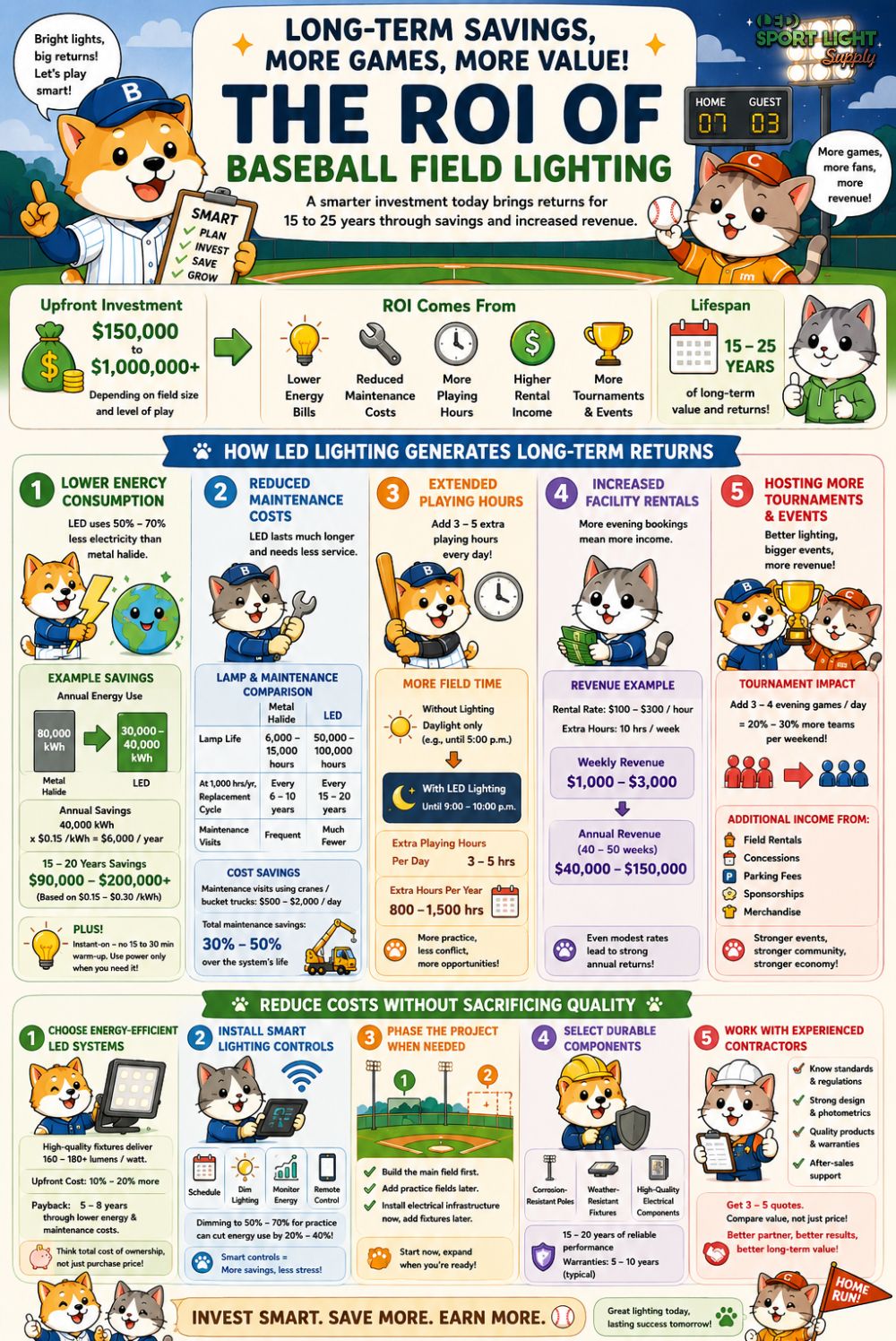
Although a new LED lighting system may require an upfront investment of $150,000 to more than $1 million, the ongoing savings and additional revenue opportunities can gradually offset a significant portion of that cost. For many facilities, the return on investment comes from a combination of lower energy bills, reduced maintenance expenses, increased field usage, and higher rental income rather than a single source.
Modern LED lighting systems continue to generate savings year after year, making them a worthwhile investment for facilities planning to operate for the next 15 to 25 years.
| ROI Factor | Key Figures |
|---|---|
| Initial Investment | $150,000 to $1,000,000+ |
| System Lifespan | 15 to 25 years |
| Energy Savings | 50% to 70% less electricity |
| Annual Energy Use | 80,000 → 30,000–40,000 kWh |
| Annual Electricity Savings | $6,000 to $12,000+ |
| Lifetime Energy Savings | $90,000 to $200,000+ |
| LED Lifespan | 50,000 to 100,000 hours |
| Metal Halide Lifespan | 6,000 to 15,000 hours |
| Maintenance Cost Reduction | 30% to 50% |
| Extra Playing Time | 3 to 5 hours/day |
| Additional Field Availability | 800 to 1,500 hours/year |
| Field Rental Rate | $100 to $300/hour |
| Additional Rental Revenue | $40,000 to $150,000/year |
| Tournament Capacity | 20% to 30% more teams |
Lower Energy Consumption
One of the biggest financial advantages of LED sports lighting is energy efficiency.
Compared with older metal halide systems, LED fixtures often use 50% to 70% less electricity while producing equal or even better illumination. Facilities that operate several nights each week may notice meaningful reductions in monthly utility bills almost immediately after installation.
For example, if an older lighting system consumes approximately 80,000 kilowatt-hours (kWh) each year, switching to LED technology could reduce annual consumption to around 30,000 to 40,000 kWh, depending on the lighting design and operating schedule.
Assuming an average electricity rate of $0.15 per kWh, reducing annual consumption by 40,000 kWh would save approximately $6,000 per year. In regions where commercial electricity rates reach $0.20 to $0.30 per kWh, annual savings could easily exceed $8,000 to $12,000.
Over a system lifespan of 15 to 20 years, total electricity savings alone may reach $90,000 to more than $200,000, depending on local energy prices and operating hours.
Another advantage is that LED fixtures provide instant-on capability, eliminating the 15 to 30-minute warm-up period commonly associated with older metal halide systems. Facilities only use electricity when lighting is actually needed, further improving overall efficiency.
Reduced Maintenance Costs
Traditional lighting systems require regular lamp replacements, ballast maintenance, and frequent servicing.
Metal halide lamps generally require replacement every 6,000 to 15,000 operating hours, while LED fixtures typically have operational lifespans exceeding 50,000 to 100,000 hours, depending on the product and usage conditions.
For a facility operating approximately 1,000 hours per year, traditional lamps may require replacement every 6 to 10 years, whereas quality LED fixtures can continue operating for 15 to 20 years before major replacement becomes necessary.
Maintenance savings go beyond simply replacing lamps.
Facilities with lighting poles standing 70 to 100 feet tall often require cranes or bucket trucks for maintenance work. Renting this equipment can cost $500 to $2,000 per day, depending on the location and equipment required. Once labor, replacement parts, and equipment rental are combined, a single maintenance visit may cost several thousand dollars.
By reducing the frequency of maintenance, many facilities save 30% to 50% on long-term maintenance expenses while minimizing interruptions to scheduled practices and games.
Extended Playing Hours
Adding reliable lighting creates opportunities that simply aren’t available during daylight hours.
Schools can schedule practices after classes finish, community leagues can host evening competitions, and clubs can organize additional training sessions throughout the week.
Without lighting, many facilities are limited to daylight hours, particularly during autumn and winter when sunset may occur as early as 5:00 p.m. Installing LED lighting can extend usable field time until 9:00 or even 10:00 p.m., effectively adding 3 to 5 extra playing hours each day.
Over the course of a year, that could translate into 800 to 1,500 additional hours of field availability, depending on the operating schedule.
For organizations with growing player participation, those extra hours often reduce scheduling conflicts while allowing more teams to practice on the same field.
Increased Facility Rentals
Many sports venues generate revenue by renting their fields to outside organizations.
With lighting installed, available booking hours increase significantly. Evening time slots are often in high demand because they accommodate players who work or attend school during the day.
For example, if a baseball field rents for $100 to $300 per hour, adding just 10 extra rental hours per week could generate between $1,000 and $3,000 in weekly revenue.
Over a full year, assuming 40 to 50 active weeks, that represents approximately $40,000 to $150,000 in additional annual income.
Even facilities charging more modest rental rates often find that evening bookings quickly become the most popular time slots, helping recover part of the lighting investment over several years.
Hosting More Tournaments and Events
Improved lighting can also make a facility more attractive for regional tournaments, charity events, corporate leagues, and community competitions.
Multi-day tournaments frequently require games to continue into the evening to accommodate large numbers of participating teams. Without sufficient lighting, facilities may struggle to host these events or may need to limit the number of participating teams.
For example, extending tournament play by three or four evening games each day could allow a venue to accommodate 20% to 30% more teams over an entire weekend.
Additional tournaments often generate income not only through field rentals but also through concession sales, parking fees, sponsorships, and merchandise.
Beyond the facility itself, local restaurants, hotels, and retail businesses also benefit from increased visitor spending, making sports lighting an investment that supports the wider community.
Reduce Costs Without Sacrificing Quality
Every project has a budget, but reducing costs shouldn’t mean compromising long-term performance. Smart planning often delivers better value than simply choosing the cheapest proposal.
Choose Energy-Efficient LED Systems
While lower-priced fixtures may seem appealing initially, premium LED systems often provide better optical performance, improved durability, and higher energy efficiency.
Some high-quality fixtures achieve luminous efficiencies exceeding 160 to 180 lumens per watt, allowing facilities to meet lighting requirements while using less electricity.
Although premium fixtures may cost 10% to 20% more upfront, lower operating expenses and reduced maintenance often allow that additional investment to be recovered within five to eight years, depending on energy prices and operating schedules.
Evaluating the total cost of ownership, rather than only the purchase price, usually leads to a more informed investment decision.
Install Smart Lighting Controls
Modern lighting control systems offer much greater flexibility than simple on-and-off switches.
Operators can schedule lighting automatically, adjust brightness for practices or games, monitor energy usage, and even control the system remotely using mobile devices or computers.
Many facilities don’t require full illumination for every activity. Training sessions may only require 50% to 70% of maximum light output, while maintenance work may require even less.
By dimming fixtures when full brightness isn’t necessary, facilities can reduce electricity consumption by an additional 20% to 40%, while also extending fixture lifespan.
Some advanced control systems can automatically detect faults, generate maintenance reports, and monitor real-time energy consumption, helping operators manage costs more effectively.
Phase the Project When Necessary
If funding is limited, completing the project in stages may be a practical option.
For example, a facility might install lighting on the primary competition field first before expanding to adjacent practice fields in future budget cycles.
Another option is to install the necessary electrical infrastructure and foundations during the first phase while adding additional poles and fixtures later. This approach can reduce future construction costs by avoiding repeated excavation work.
Phased construction allows organizations to begin enjoying the benefits of improved lighting without waiting until the full project budget becomes available.
Select Durable Components
Lighting systems are expected to perform reliably for many years, often in harsh outdoor environments.
Choosing corrosion-resistant poles, weather-resistant fixtures, marine-grade coatings, and high-quality electrical components may involve a slightly larger upfront investment, but it can reduce repair costs and improve system reliability over time.
Many premium LED sports lighting systems are designed to operate for 15 to 20 years, with manufacturer warranties commonly ranging from 5 to 10 years.
When spread across the system’s expected lifespan, investing in more durable components often represents only a small increase in annual ownership costs while reducing the likelihood of unexpected repairs.
Work with Experienced Lighting Contractors
The lowest quotation isn’t always the best value.
Contractors with experience in sports lighting understand illumination standards, local regulations, structural requirements, electrical safety, and photometric design. Their expertise often helps avoid design mistakes that could become expensive to correct later.
Requesting three to five competitive quotations allows owners to compare not only pricing but also fixture quality, warranty coverage, lighting performance, installation schedules, and after-sales support.
Reviewing previous projects, customer testimonials, warranty terms, and ongoing maintenance services provides greater confidence when selecting a contractor. In many cases, spending slightly more on an experienced team can prevent costly revisions and deliver a lighting system that performs reliably for decades.
Getting the Most Value from Your Investment
A successful baseball field lighting project isn’t simply about installing brighter lights. It’s about creating a system that supports athletes, improves the experience for spectators, reduces operating expenses, and continues performing reliably for many years.
Spending a little more time during the planning stage often leads to better financial outcomes in the long run. Comparing multiple proposals, reviewing lighting designs, understanding lifetime operating costs, and choosing products backed by strong warranties all contribute to a more rewarding investment.
As LED technology continues to evolve, facilities also benefit from improved energy efficiency, smarter control systems, and longer equipment lifespans than ever before. Taking these factors into account helps ensure today’s investment continues delivering value well into the future.
If you’re planning a baseball field lighting project and would like professional guidance, our team is here to help. From lighting design and product recommendations to budgeting advice and complete project planning, we can work with you to develop a solution that fits your facility, your goals, and your budget. Get in touch with us today for a consultation, and let’s create a lighting system that serves your players and community for years to come.