
If you are planning a new indoor horse arena or thinking about upgrading an older lighting system, one of the first questions that usually comes up is, “How much is this actually going to cost?”
There is no single price that fits every arena. A small private riding arena and a large commercial facility can have very different lighting needs, even if both use LED fixtures. The final price depends on the arena’s size, ceiling height, number of fixtures, electrical setup, installation work, controls, and the level of lighting you want.
For many indoor horse arenas, a complete lighting project can range from several thousand dollars for a relatively simple setup to tens of thousands of dollars for a larger, professionally designed system. The good news is that you do not necessarily need to spend a fortune to get good, comfortable lighting. The trick is getting the layout and equipment right from the start.
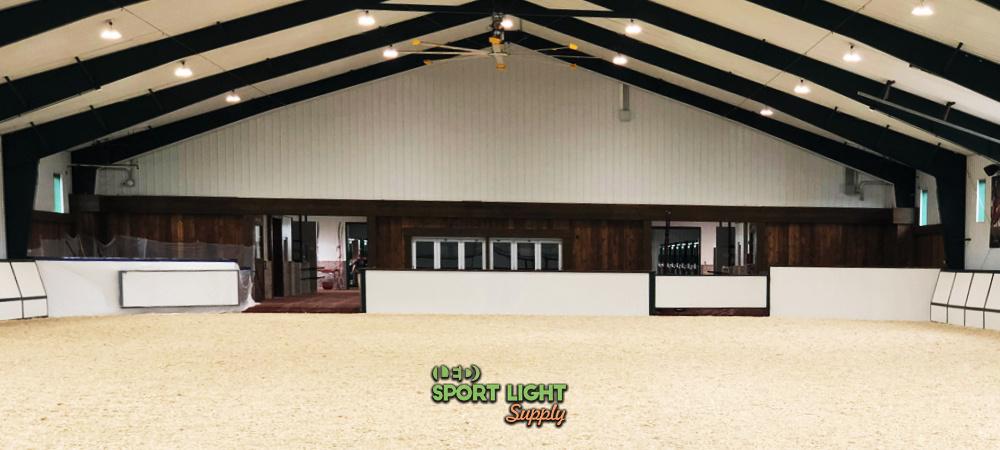
How Much Does Indoor Horse Arena Lighting Cost?
A reasonable starting point for budgeting is around $8,000 to $30,000 or more for a complete indoor arena lighting project, although smaller or more straightforward installations can fall below that range, while large competition arenas can go considerably higher.
The biggest difference comes down to what is included in the project. Buying light fixtures is only one part of the cost. You may also need wiring, electrical panels, mounting hardware, controls, lifts or other access equipment, and professional installation.
For example, a medium-sized riding arena with a relatively straightforward electrical system may require 20 to 40 high-output LED fixtures. If the fixtures cost roughly $250 to $600 each, the equipment alone could land somewhere around $5,000 to $24,000. Installation and electrical work then add to the project total.
Those figures are planning estimates rather than a universal price list. Local labor rates, product quality, arena construction, and electrical requirements can move the final number quite a bit.
A proper lighting design can also prevent a common problem: buying more fixtures than you actually need. More lights do not automatically mean better lighting. A well-designed layout can provide better coverage with fewer fixtures.
What Goes Into the Cost of Indoor Arena Lighting?
When people start pricing indoor horse arena lighting, it is easy to look at the fixture price and assume that is most of the budget. In reality, the light fixture is only one piece of the puzzle. The final cost can also include electrical work, mounting hardware, installation, lifts, lighting controls, wiring, and sometimes upgrades to the building’s existing electrical system.
There is also the question of how well the lighting actually performs inside the arena. A system with 30 inexpensive lights is not necessarily better than a system with 20 or 24 well-designed fixtures. What matters is how evenly those fixtures illuminate the riding surface, how much glare they create, how much energy they consume, and whether the lighting works properly at the arena’s ceiling height.
For a typical indoor riding arena, the project might involve anywhere from a few thousand dollars for a straightforward smaller installation to $20,000, $30,000, or more for a larger professionally designed system. Large competition arenas, new construction projects, and buildings that need electrical upgrades can go higher.
| Category | Key Number | What It Means |
|---|---|---|
| Typical project cost | $8,000–$30,000+ | General planning range for a complete indoor arena lighting project |
| LED fixture price | $250–$700+ each | Depends on output, optics, controls, warranty, and manufacturer |
| Typical fixture quantity | 20–40 fixtures | Common planning range for a medium-sized arena |
| Arena ceiling height | 20–40 ft | Helps determine fixture type, mounting height, and beam angle |
| Lighting level | 30–50 foot-candles | Example range for general riding and training applications |
| Electrical work | $5,000–$15,000+ | Potential cost for more involved retrofit electrical work |
| LED system example | 9 kW | 30 fixtures × 300 watts each |
| Potential energy reduction | ~70% | Example reduction when replacing 30 × 1,000 W fixtures with 30 × 300 W LEDs |
| Annual energy savings | ~38,325 kWh | Example yearly reduction based on 5 hours/day operation |
| Potential annual electricity savings | ~$5,750–$7,665 | Based on electricity rates of $0.15–$0.20/kWh |
Lighting Fixtures
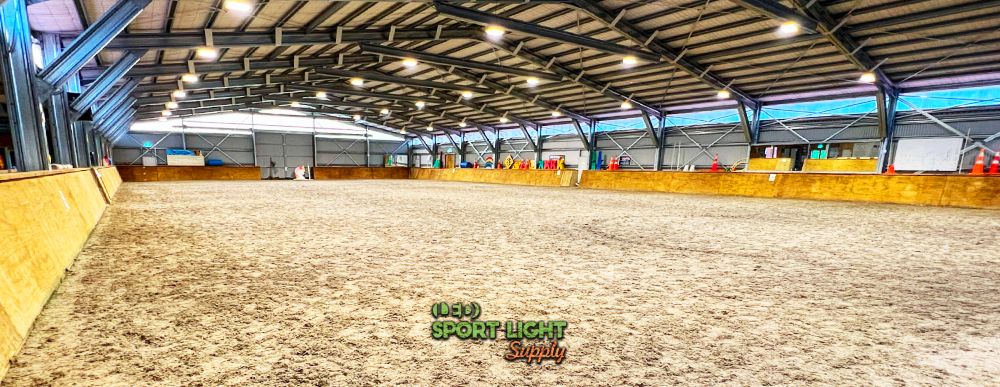
The lighting fixtures are usually the first cost people look at, and for good reason. Indoor horse arenas are large, open spaces, often with ceilings between 20 and 40 feet high. That means ordinary residential or low-output commercial lights are generally not suitable. High-bay LED lighting is commonly considered because it is designed to throw a large amount of light down from greater mounting heights.
The price of an LED high-bay fixture can vary quite a bit. Depending on the light output, optics, construction, controls, warranty, and manufacturer, you might see products priced around $250 to $700 per fixture, with higher-end commercial or specialty products costing more.
Suppose an arena requires 30 fixtures at an average equipment price of $400 each. The fixtures alone would cost about $12,000. If the design only needs 24 fixtures at the same price, the equipment cost drops to $9,600. That difference shows why getting the lighting layout right before purchasing equipment can have a noticeable effect on the project budget.
It is also worth looking beyond wattage. A 300-watt fixture is not automatically better than a 400-watt fixture, and a higher wattage does not automatically mean better illumination. Look at lumens, efficacy, beam angle, mounting height, light distribution, and photometric performance.
For example, two 300-watt LED fixtures can produce very different results if one has a narrow beam designed for a high mounting position and the other spreads light much more widely. The fixture needs to match the geometry of the arena.
Light Distribution and Photometric Design
This is one area where arena lighting can get a little more technical, but it has a very practical effect on the finished space.
A photometric lighting plan is used to predict how light will be distributed across the arena floor. Instead of simply counting fixtures, the designer can look at expected illumination levels at different points across the riding surface.
For example, a riding arena might be designed around an average illumination target of 30 to 50 foot-candles for general riding and training, while facilities with more demanding uses may target higher levels. The appropriate target depends on the type of facility, local standards, competition requirements, camera use, and the owner’s expectations.
Uniformity matters, too. Imagine an arena where the area directly underneath each fixture is very bright but the spaces between fixtures are noticeably darker. The average number might look acceptable on paper, but the riders are still dealing with uneven lighting.
A good design aims for a more consistent level of illumination across the riding area. The goal is not simply to make the arena bright. It is to make the light useful.
Color Temperature, CRI and Flicker
There are a few other specifications that can affect both the fixture price and the riding experience.
Color temperature is usually expressed in Kelvin, or K. For indoor equestrian facilities, LED products around 4,000K to 5,000K are commonly considered because they provide a relatively neutral to cool white appearance. A 4,000K light tends to look somewhat softer, while 5,000K generally appears crisper and brighter to the eye.
Color rendering index, or CRI, is another specification worth checking. A fixture with a CRI of 80 or higher can provide reasonable color rendering for general applications, while higher-CRI products may be worth considering for facilities where visual clarity, photography, or video recording matters.
Flicker also deserves attention. Some inexpensive LED fixtures can have noticeable flicker, particularly when paired with certain drivers or dimming systems. That may not be obvious when you first walk into the arena, but it can become more noticeable during video recording or under certain operating conditions.
For a horse arena that is used for training videos, competitions, livestreaming, or professional photography, it makes sense to ask about flicker performance and driver quality before making a purchase.
Electrical Work
Electrical work can make up a surprisingly large part of an indoor arena lighting budget, particularly when an existing building was not designed with a large lighting system in mind.
A new installation may require additional circuits, breakers, conduit, junction boxes, disconnects, wiring, control panels, or other electrical components. In some cases, the existing electrical service may not have enough capacity for the proposed lighting system.
For example, installing 30 LED fixtures at 300 watts each gives you a connected lighting load of 9,000 watts, or 9 kW. That is much easier on the electrical system than 30 older fixtures drawing 1,000 watts each, which would create a 30 kW lighting load.
However, the electrician still needs to consider voltage, circuit capacity, wire sizing, breaker configuration, starting current, control systems, and the distance between the electrical panel and the fixtures.
Existing Electrical Infrastructure Can Change the Price
If the arena already has suitable electrical circuits close to the fixture locations, installation may be relatively straightforward. If the building needs new wiring throughout the structure, costs can rise quickly.
For a retrofit project, electrical work might add several thousand dollars to the project. A simple installation could require only minor modifications, while a more complicated arena might need $5,000 to $15,000 or more in electrical work, depending on the building and local labor rates.
The distance from the electrical panel matters as well. Running wiring 30 feet across a convenient route is very different from running it 200 feet through a finished structure or difficult roof space.
That is why it is smart to inspect the existing electrical system before buying the fixtures. You do not want to discover halfway through the project that your new lighting plan requires a panel upgrade or extensive rewiring.
Wiring, Conduit and Mounting Hardware
The fixtures may be the visible part of the installation, but the less glamorous components still add to the cost. Wiring, conduit, junction boxes, disconnects, mounting brackets, safety cables, and other hardware all need to be included in the budget.
In an agricultural or equestrian environment, the installation may also need to account for dust, moisture, temperature changes, and the general wear associated with a barn or riding facility.
A fixture installed 30 feet above the arena floor also needs to be securely mounted. Proper mounting hardware and safety cables are not areas where cutting corners makes sense.
Installation and Access Equipment
Installing arena lights 20, 30, or even 40 feet above the riding surface is a very different job from installing lights in a garage.
Depending on the building, installers may need a scissor lift, boom lift, scaffolding, or other access equipment. Equipment rental alone can add hundreds or thousands of dollars to a project, particularly if the installation takes several days.
Labor costs also depend on how many fixtures are being installed and how easy it is to reach each location. A 20-fixture installation in an open new building may be relatively efficient, while a 40-fixture retrofit in an older arena can involve considerably more work.
For a medium-sized arena, it would not be unusual for installation and access-related costs to add several thousand dollars to the project. Larger or more complicated installations can be substantially higher.
New Construction vs. Retrofit
Timing can make a real difference here. A new arena that is still under construction gives electricians and installers much easier access to structural components, roof areas, conduit routes, and electrical panels. Wiring can often be planned before walls and other building elements are finished.
An existing arena is a different story. Installers may have to work around insulation, finished walls, roof structures, existing wiring, ventilation equipment, fans, sprinklers, and other building components.
That is one reason two arenas with exactly the same dimensions can receive very different lighting quotes.
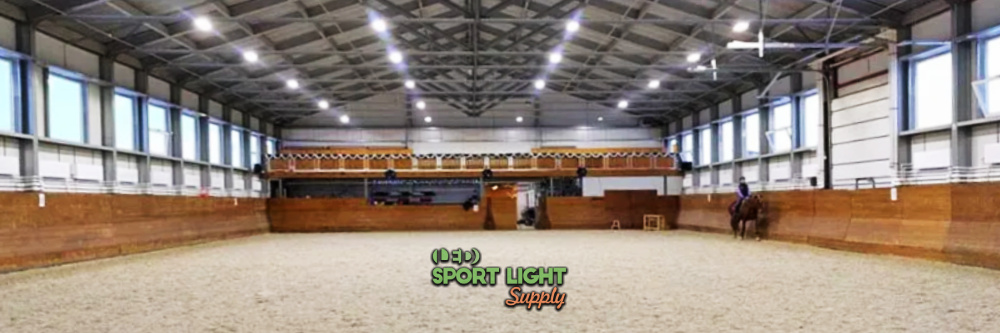
How Much Can LED Arena Lighting Save?
The potential energy savings can be substantial, particularly when replacing an older high-wattage lighting system.
Consider a simple example. Imagine an indoor arena with 30 existing fixtures, each consuming 1,000 watts. Together, they require 30,000 watts, or 30 kW, while operating.
If those lights run for five hours per day, the arena consumes about 150 kWh of lighting energy each day. Over 365 days, that works out to approximately 54,750 kWh per year.
Now imagine replacing them with 30 LED fixtures using 300 watts each. The new connected load would be 9 kW. Running for the same five hours per day would use approximately 45 kWh per day, or 16,425 kWh per year.
That is a difference of roughly 38,325 kWh per year, representing about a 70% reduction in lighting energy consumption.
At an electricity rate of $0.15 per kWh, the theoretical annual energy-cost difference would be around $5,750. At $0.20 per kWh, the difference would be closer to $7,665 per year.
Of course, real-world savings depend on the actual fixture wattage, operating schedule, electricity rate, and whether the new LED system provides the required illumination. If the arena operates only two hours per day, the savings will be much lower. If it runs eight or ten hours every day, the potential savings become much more noticeable.
Lighting Controls Can Reduce Energy Use Further
There is another way to reduce operating costs: don’t run every light at full power when you don’t need to.
A large arena might have different lighting requirements for riding lessons, casual exercise, arena maintenance, cleaning, competitions, and events. A zoned lighting system can allow different sections of the arena to be switched on independently.
Dimming can provide another layer of control. For example, a facility might use full output for an event but reduce the lighting level for routine training.
Timers, occupancy sensors, scheduling systems, and smart lighting controls can also help prevent lights from being left on unnecessarily. Even a simple habit such as reducing lighting hours by one hour per day can add up over a full year.
For example, a 9 kW LED system that operates one fewer hour each day would save approximately 3,285 kWh per year. At $0.15 per kWh, that is nearly $500 in annual energy savings without changing the fixtures themselves.
What Are the Ongoing Costs of Arena Lighting?
The purchase price gets most of the attention, but your indoor horse arena lighting costs do not stop once the installer packs up and leaves. Over the years, electricity, cleaning, inspections, repairs, replacement components, and control-system maintenance can all add to the true cost of owning an arena lighting system.
For most facilities, electricity is the biggest recurring expense. How much you spend depends on the number of fixtures, fixture wattage, how many hours the arena is used each day, and your local electricity rate.
For example, imagine an arena with a 10 kW LED lighting system. If the lights operate for five hours a day, the system would use approximately 50 kWh of electricity per day. At $0.15 per kWh, that works out to about $7.50 per day, or approximately $225 over a 30-day month. Over a full year, the same usage would cost around $2,740.
Now increase the operating schedule to eight hours a day. The system would consume about 80 kWh per day, pushing the annual electricity cost to roughly $4,380 at the same electricity rate. That is why operating hours can have a surprisingly large effect on long-term arena lighting costs.
Electricity Use Depends on More Than Fixture Wattage
It is easy to compare two LED fixtures by wattage alone, but there is more to the calculation than that. You also need to consider how many fixtures are required to provide adequate illumination across the riding surface.
Suppose one lighting design uses 24 fixtures at 400 watts each. The connected load would be 9.6 kW. Another design might use 32 fixtures at 300 watts each, resulting in a connected load of 9.6 kW as well.
Although the fixture counts are different, the total power demand is essentially the same. However, the two systems could distribute light very differently depending on the fixture optics, mounting height, beam angle, and layout.
This is why energy efficiency should be considered alongside lighting performance, rather than treated as a separate issue.
Maintenance Costs in an Equestrian Environment
LED lighting can reduce routine lamp replacement, but that does not mean an indoor arena lighting system is completely maintenance-free.
Horse arenas and barns can be dusty environments. Fine dust, dirt, bedding particles, and other airborne material can gradually collect on fixture housings and lenses. If the fixtures become heavily coated, the amount of light reaching the arena floor can decrease.
Regular cleaning can help keep the lighting system performing as intended. The exact cleaning schedule depends on the building, ventilation, dust levels, and how frequently the arena is used. A busy equestrian facility may need more frequent attention than a private arena that is used a few times a week.
It is also worth checking fixtures, mounting hardware, wiring connections, and controls periodically. A lighting system operating several feet above the arena floor is not something you want to discover has a problem only after a fixture suddenly stops working.
LED Driver and Component Replacement
The LED chips themselves may have a long service life, but an LED fixture contains other components, including the driver and electrical connections. Depending on the product and operating conditions, these components may eventually need repair or replacement.
Heat management can affect LED fixture longevity as well. A high-output fixture installed in a hot, poorly ventilated location may experience more thermal stress than the same fixture operating in a cooler environment.
For this reason, it is worth looking at the complete fixture design and warranty, rather than focusing only on the advertised LED lifespan.
A reputable commercial lighting product may come with a five-year warranty or another defined coverage period. When comparing quotations, check what the warranty actually covers and whether labor is included. A warranty that covers the fixture but leaves you paying for lift rental and installation every time a unit fails is a very different proposition from a more comprehensive service arrangement.
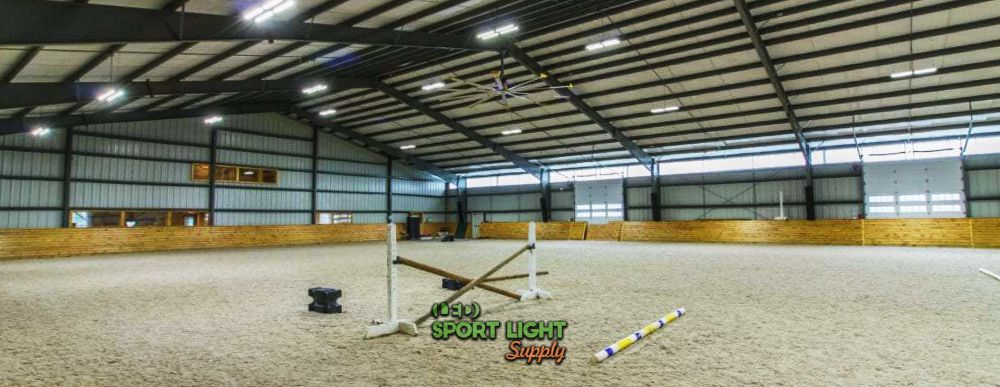
Ways to Keep Indoor Arena Lighting Costs Under Control
One of the easiest ways to spend more than necessary is to design the lighting system around fixture quantity instead of actual lighting performance.
For example, someone might decide that a 100-by-200-foot arena needs a certain number of lights simply because another arena of the same size uses that quantity. But ceiling height, fixture output, beam angle, mounting positions, wall reflectance, and intended use can all change the result.
A better approach is to begin with the arena’s dimensions and ceiling height, then establish the desired illumination level. From there, the fixture type and layout can be selected based on how much useful light needs to reach the riding surface.
Use Zoning Instead of Lighting the Whole Arena
Lighting controls can also make a noticeable difference, especially in larger facilities.
You may not need every fixture operating at full output every time someone enters the arena. A private riding lesson, routine training session, arena maintenance, cleaning, and competition can all have different lighting requirements.
A zoned lighting system allows the arena to be divided into separate sections. For example, a large facility could operate the lights over the main riding area while leaving another section switched off when it is not being used.
Even relatively simple controls can reduce unnecessary operating hours.
Imagine a 12 kW arena lighting system that operates for six hours each day. If better scheduling reduces average operation by one hour per day, the system would save approximately 4,380 kWh per year.
At an electricity rate of $0.15 per kWh, that represents around $657 in annual energy savings. At $0.20 per kWh, the same reduction would save about $876 per year.
Those savings may not sound dramatic on a single day, but over five or ten years, they can become a meaningful part of the facility’s operating budget.
Take Advantage of Dimming
Dimming can be another useful option for indoor riding arenas.
A competition or event may require higher illumination, while basic arena maintenance or casual riding may not need the same lighting level. If the LED fixtures and controls support appropriate dimming, the facility can adjust light output instead of simply switching everything between full power and completely off.
Not every arena needs an elaborate smart lighting system, though. Sometimes a straightforward multi-zone switching system is enough. The best control strategy depends on the size of the facility and how the arena is actually used.
Don’t Over-Light the Arena
It can be tempting to assume that more light is always better. In practice, over-lighting can increase equipment costs, electrical demand, glare, and operating expenses without necessarily improving the riding experience.
For example, adding 10 extra 300-watt fixtures creates another 3 kW of connected load. If those fixtures operate for five hours every day, they would consume approximately 5,475 kWh per year.
At $0.15 per kWh, those additional fixtures would cost around $821 per year in electricity alone.
The answer is not to install as few lights as possible. The goal is to install the right number of fixtures in the right locations so that the arena has good coverage and consistent illumination.
Compare Total Ownership Cost
When comparing lighting quotations, it is easy to focus on the fixture price. A contractor might quote one system at $300 per fixture and another at $450 per fixture, making the cheaper option look attractive immediately.
But what happens if the $300 fixture requires 35 units while the $450 fixture only requires 24? What happens if one system uses 400 watts per fixture and the other uses 300 watts? What about warranty coverage, controls, maintenance, and expected service life?
A better comparison considers the entire project.
Total ownership cost includes the purchase, installation, electricity, maintenance, repairs, and eventual replacement. Looking at these numbers over five, ten, or even fifteen years can give you a much clearer picture of which system offers better value.
Is Professional Arena Lighting Worth the Investment?
For a private arena that is used occasionally, a relatively simple lighting system may be perfectly adequate. If the facility is used every day for riding lessons, training, boarding, clinics, jumping, events, or competitions, the calculation can look quite different.
A professionally designed system can provide more consistent illumination across the riding surface, better fixture placement, more appropriate light distribution, and useful control options. It can also reduce the risk of ending up with obvious dark areas, excessive glare, or fixtures that are poorly positioned for the arena’s ceiling height.
Better Lighting Can Improve the Riding Environment
Lighting quality affects much more than how bright the arena looks from the entrance.
Riders need to see footing changes, arena boundaries, jumps, poles, other horses, and riders around them. Strong differences between bright and dark areas can make the space less comfortable to use.
A well-designed lighting layout aims for consistent illumination across the riding area, rather than creating extremely bright spots directly underneath fixtures and darker areas between them.
Glare is another consideration. Fixtures mounted high above the arena should provide useful light without creating uncomfortable brightness when riders look upward.
This becomes particularly relevant for jumping arenas, where riders may naturally look toward jumps and higher portions of the building during a session.
Professional Design Can Prevent Expensive Changes
There is also a financial reason to invest in proper planning.
Changing fixture locations after wiring, conduit, mounting hardware, and electrical connections have already been installed can involve additional labor and equipment rental. If a lighting system has already been purchased, correcting a poor layout can become even more expensive.
Spending more time on the design stage can therefore save money during installation and operation.
A lighting professional can assess the arena dimensions, ceiling height, mounting structure, existing electrical infrastructure, intended lighting levels, and fixture specifications before the installation begins.
When a Lighting Upgrade Makes Sense
An LED upgrade can be particularly attractive when an existing arena still relies on older, high-wattage lighting. If the current system consumes a large amount of electricity, requires frequent lamp replacement, takes time to reach full brightness, or provides uneven illumination, an upgrade may solve several problems at once.
For example, replacing a 30-fixture system using 1,000-watt lamps with a properly designed LED system using 300-watt fixtures could potentially reduce the connected lighting load from 30 kW to 9 kW.
If the arena operates five hours a day, that could mean a reduction of roughly 38,325 kWh per year, assuming the new system provides the required lighting performance.
The actual savings will depend on the existing fixtures, LED system, electricity price, operating schedule, and other factors, but the example shows why energy consumption deserves attention when evaluating an upgrade.
Frequently Asked Questions About Indoor Horse Arena Lighting
How much does it cost to light a 100-by-200-foot horse arena?
A 100-by-200-foot arena contains 20,000 square feet, but the lighting cost can vary considerably. As a rough planning range, a professionally installed LED lighting system might cost $15,000 to $40,000 or more, depending on fixture quantity, light output, ceiling height, electrical work, controls, installation conditions, and local labor rates.
A new arena with convenient electrical access may fall toward the lower end of the range, while a retrofit requiring extensive rewiring, lifts, or electrical upgrades can move well beyond it. A photometric lighting plan and site assessment are the best ways to develop a more reliable project budget.
Are LED lights good for indoor horse arenas?
Yes. LED high-bay fixtures are well suited to many indoor horse arenas because they can provide substantial light output while using relatively little electricity compared with many older lighting technologies.
The important part is selecting the right fixture for the mounting height and arena layout. Look at lumen output, efficacy, beam angle, color rendering, flicker performance, ingress protection, thermal management, warranty, and expected service life rather than choosing a fixture based solely on wattage.
How long do LED arena lights last?
Quality LED fixtures can have rated useful lives in the 30,000-to-50,000-hour range or longer, although that figure should not be treated as a guarantee that every component will operate without maintenance for that entire period.
Actual service life can be affected by heat, dust, electrical conditions, fixture construction, driver quality, and operating environment. In an equestrian facility, keeping fixtures clean and ensuring they have suitable ventilation can help support reliable long-term performance.
Can an existing horse arena be converted to LED?
In many cases, yes. LED retrofit projects are common because existing fixtures can often be replaced with modern LED high-bay or purpose-designed arena fixtures.
However, the best approach depends on the existing wiring, electrical capacity, mounting locations, ceiling height, fixture spacing, and condition of the current system. In some arenas, a simple fixture replacement may be enough. In others, a complete lighting redesign can produce a much better result.
Before ordering replacement fixtures, it is worth having the existing arena assessed. That way, you can determine whether the current fixture positions make sense for the new LED system or whether moving the lights would provide better illumination.
How much electricity does an indoor horse arena use for lighting?
There is no single number because arena sizes and operating schedules vary considerably. A 10 kW lighting system operating for five hours per day would use approximately 18,250 kWh per year.
At $0.15 per kWh, that would cost around $2,740 annually. A 20 kW system running for the same amount of time would use approximately 36,500 kWh and cost about $5,475 at the same electricity rate.
These calculations are useful for budgeting, but the actual riding arena lighting design should always be based on the required illumination rather than simply trying to minimize electrical consumption.
Is it better to use more low-wattage lights or fewer high-wattage lights?
It depends on the arena. More lower-wattage fixtures can sometimes provide better uniformity because the light sources are distributed more evenly across the riding surface. Fewer high-output fixtures may work well in other buildings, particularly where mounting heights and optics are suitable.
The best solution depends on fixture lumen output, beam angle, ceiling height, mounting pattern, and desired illumination. A photometric layout can help determine which approach makes the most sense.
How can I get an accurate indoor horse arena lighting estimate?
Start by gathering the arena’s length, width, and ceiling height. Photos of the interior, existing fixtures, electrical panel, mounting locations, and roof structure can also be useful.
It helps to explain how the arena is used and approximately how many hours per day the lighting operates. If the facility hosts competitions, jumping events, clinics, video recording, or photography, mention those requirements as well.
When requesting quotations, ask for a lighting layout and a breakdown of fixture costs, electrical work, installation, controls, and other project expenses. That makes it much easier to compare different proposals and understand exactly what you are paying for.
Choosing the Right Lighting Partner
Indoor arena lighting is one of those projects where the cheapest quote is not always the cheapest solution. A good system should balance purchase cost, installation, energy use, maintenance, light distribution, and the way the arena is actually used.
For that reason, it makes sense to talk with a lighting professional before ordering fixtures based on a rough wattage calculation. A properly planned system can give you better light while avoiding unnecessary fixtures, electrical work, and long-term operating costs.