
Designing softball field lighting requires more than selecting high-wattage LED floodlights and mounting them on tall poles. The system needs to provide suitable brightness across the infield and outfield, maintain consistent illumination, control glare, and deliver appropriate color quality. Pole locations, mounting heights, beam angles, fixture optics, and electrical infrastructure must all work together to produce a reliable result.
The requirements also vary depending on how the field will be used. A community softball field used for evening recreation does not necessarily need the same lighting performance as a high school competition venue or a stadium hosting major tournaments. Understanding these differences before purchasing equipment can prevent unnecessary expenses and avoid problems that may be difficult to correct after installation.
From lighting levels and international standards to pole arrangements, LED fixture selection, photometric simulations, installation costs, and common planning mistakes, the following sections explain how to develop a softball field lighting system that meets the needs of players, spectators, and facility operators.
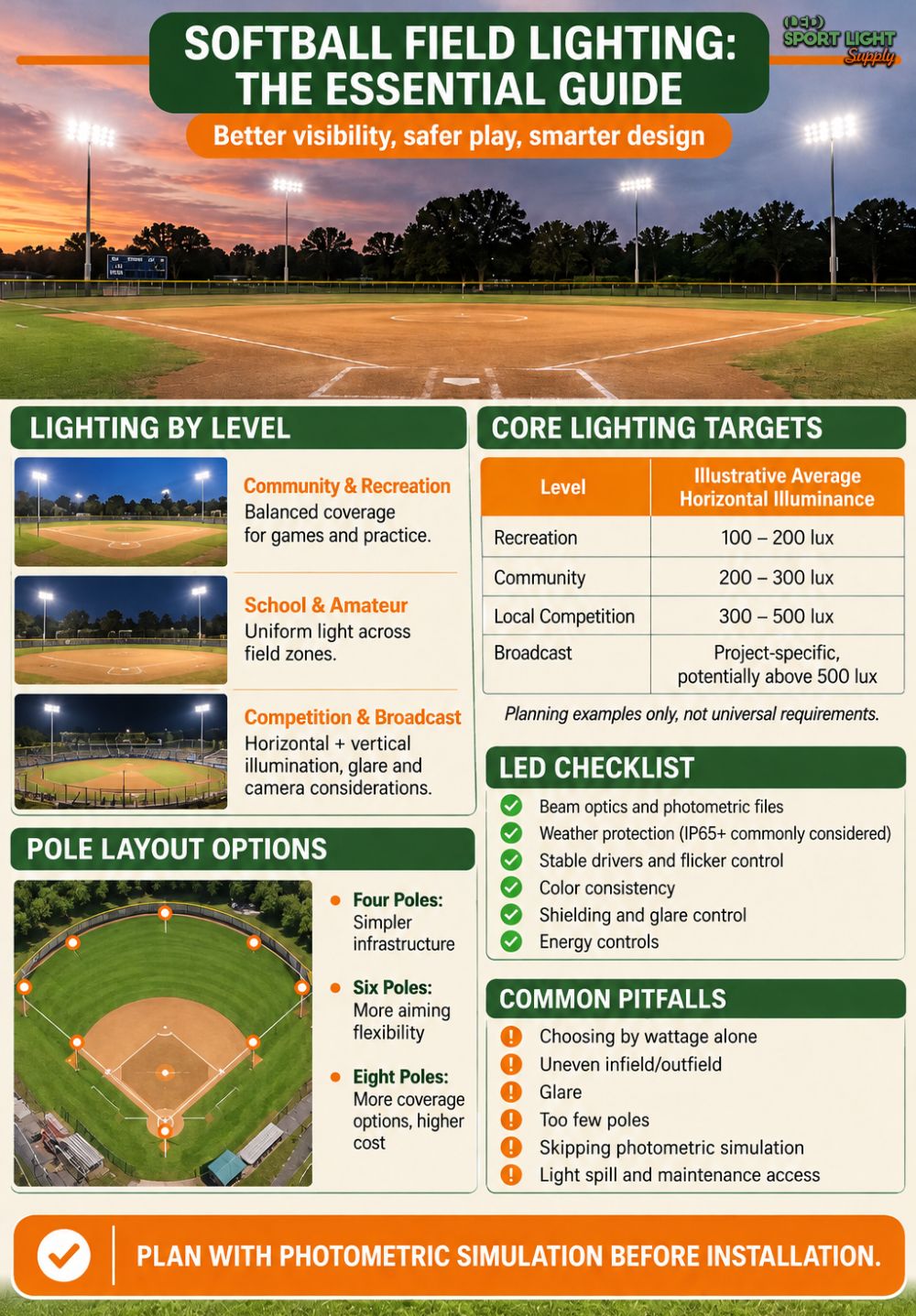
The first step in planning a softball field lighting project is identifying the level of play and the activities the facility needs to support. Lighting requirements are not identical across all softball venues because the speed of play, expected viewing conditions, competition rules, and spectator facilities can differ considerably.
A field designed for recreational games may operate with moderate illumination and straightforward lighting controls. A venue used for school competitions or regional tournaments may need better uniformity, stronger illumination, and improved glare management. Facilities intended for high-level competitions may also need vertical illumination and additional performance considerations for spectators and broadcasting.
Choosing the appropriate lighting level at the beginning helps determine the required LED output, number of fixtures, pole arrangement, electrical capacity, and overall project budget.
Community softball fields are generally used for recreational games, local leagues, practice sessions, and informal evening activities. Their lighting systems need to provide comfortable visibility without requiring the same level of investment as a major competition venue.
A design may use a relatively simple pole arrangement with LED floodlights positioned around the playing area. However, lower project budgets should not be an excuse for poor illumination. Players still need to see the ball clearly, identify teammates, and move safely across the infield and outfield.
One common mistake in recreational facilities is concentrating most of the lighting around the infield while allowing the outfield to remain noticeably darker. This creates an inconsistent playing environment, particularly when players need to follow high balls or move quickly toward the warning track. A balanced lighting design should account for the entire playing area rather than focusing only on the most frequently used positions.
Community facilities can also benefit from independent lighting controls. For example, operators may use a reduced lighting setting for practice sessions and a higher setting for scheduled games. This flexibility helps reduce electricity consumption while maintaining appropriate visibility.
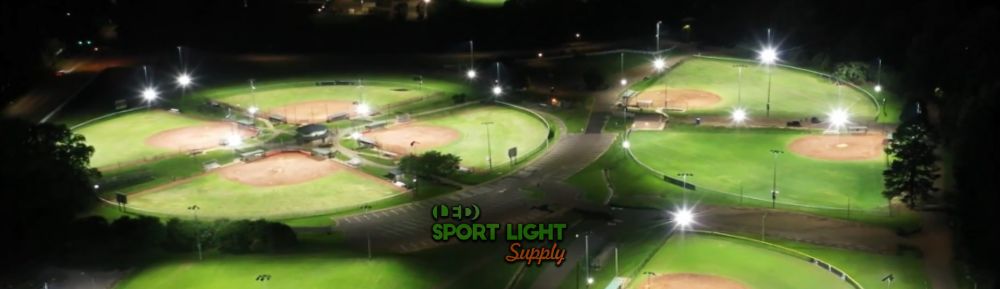
School and amateur softball facilities often accommodate several activities, including physical education, team training, school competitions, and local tournaments. Their lighting systems therefore need to support different operating conditions throughout the week.
Uniformity becomes particularly relevant at this level because players regularly move between the infield and outfield while tracking the ball from different viewing positions. Noticeable differences in brightness can make visual adaptation more difficult, especially when a player moves from a well-lit area into a darker section of the field.
Schools should also consider the needs of spectators, coaches, officials, and maintenance personnel. Lighting around dugouts, player access routes, and seating areas may need to be designed separately from the primary playing area.
For facilities that host both training and competitions, a programmable LED lighting system can provide several operating modes. A lower setting can be used during practice, while a higher setting can be activated for formal games. The exact output for each mode should be determined through lighting calculations rather than arbitrary dimming percentages.
Higher-level competition venues generally have more demanding lighting requirements. Players need to track fast-moving balls under consistent visual conditions, while officials and spectators must be able to follow the action from different positions around the field.
A professional lighting design should consider both horizontal and vertical illuminance. Horizontal illuminance describes the light reaching the playing surface, while vertical illuminance describes the light reaching a vertical plane, such as the front of a player or the side of an airborne ball.
The distinction matters because a field can achieve a satisfactory horizontal lux reading while still providing inadequate visibility of airborne objects from certain viewing directions. Multiple lighting positions and carefully controlled fixture aiming help improve coverage across the playing area.
High-level venues should also consider glare, color rendering, flicker performance, and the requirements of the competition organizer. If the facility hosts televised games, the lighting design may need to satisfy additional camera-related requirements.
Broadcast softball facilities have additional requirements because lighting needs to work for cameras as well as people watching the game in person. A lighting system that looks bright to spectators may still produce poor camera images if vertical illuminance, color quality, or uniformity is inadequate.
Camera operators need consistent illumination as players move around the field. Noticeable differences between the infield and outfield can affect exposure settings, while inconsistent color appearance between fixtures can make the image look uneven.
Vertical illuminance is particularly relevant for broadcast applications because cameras capture players and airborne balls from specific viewing directions. The lighting designer must therefore consider camera positions, anticipated viewing angles, and the required level of image quality.
High-speed and slow-motion recording can also place additional demands on LED drivers. Poorly controlled electrical output may produce visible flicker or banding in recorded footage, even when the lighting appears stable to people watching the game.
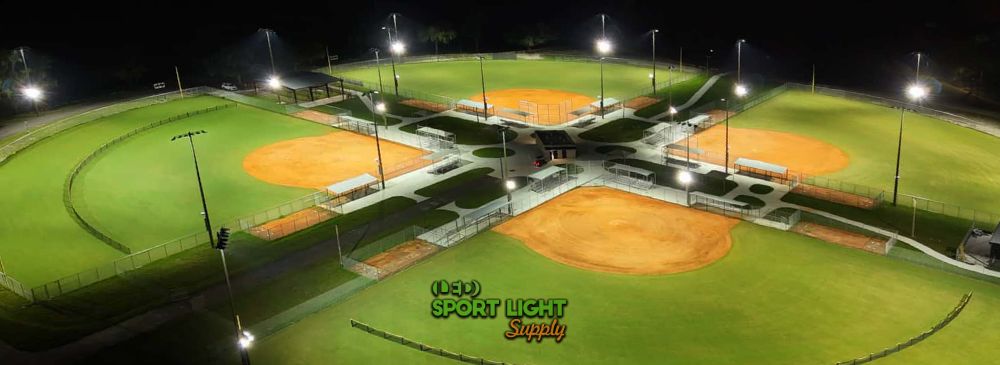
Good softball field lighting depends on several connected design factors. Brightness determines how much light reaches the playing area, while uniformity describes how consistently that light is distributed. Color quality, glare, shadows, flicker, and environmental light control also influence the final result.
These factors should be evaluated together. Increasing the output of individual fixtures may improve average illuminance, for example, but it will not necessarily correct dark areas or reduce glare. In some situations, adding more fixtures with better optical distribution can produce a more comfortable and efficient result than simply choosing higher-wattage equipment.
Illuminance is the amount of light reaching a particular surface. It is commonly measured in lux or foot-candles, and it provides one of the main ways to evaluate the brightness of a softball field.
One lux represents one lumen of luminous flux distributed over one square meter. One foot-candle represents one lumen per square foot. The conversion is straightforward:
1 foot-candle = approximately 10.764 lux.
For example, a playing surface with an average horizontal illuminance of 300 lux has approximately 27.9 foot-candles. Understanding both units is useful when comparing lighting specifications from different suppliers or design standards.
Softball field lighting calculations usually distinguish between horizontal and vertical illuminance. Horizontal illuminance is measured on a horizontal reference plane across the field, while vertical illuminance is measured on a vertical plane at specified locations and orientations.
Horizontal measurements help determine whether the infield and outfield receive sufficient light. Vertical measurements provide additional information about the visibility of players and airborne balls from different directions. Both can be relevant, although the required measurements depend on the playing level and project specifications.
The following table provides a general illustration of how different lighting levels can be used as preliminary planning scenarios. These are not universal softball requirements or substitutes for a sport-specific lighting standard.
| Preliminary application | Illustrative average horizontal illuminance |
|---|---|
| Basic recreational use | 100–200 lux |
| Community games and training | 200–300 lux |
| Higher-level local competition | 300–500 lux |
| Advanced competition or broadcast | Project-specific, potentially above 500 lux |
The values above are broad planning examples rather than prescribed minimums. Actual targets must be selected according to the applicable design guidance, competition requirements, field geometry, and intended viewing conditions. Some projects may specify different illumination levels for the infield and outfield.
It is also necessary to distinguish between initial illuminance and maintained illuminance. New LED fixtures usually produce more light than they will after years of operation. Dust accumulation, optical aging, component degradation, and other operating conditions gradually reduce the amount of usable light reaching the field.
A lighting design should account for this reduction through an appropriate maintenance factor. Otherwise, a system that meets its target immediately after installation may fall below the required level later in its service life.
Uniformity describes how evenly illumination is distributed across a designated area. It is one of the main factors affecting visual comfort and the ability of players to follow the action.
A field with high average illuminance can still have poor lighting quality if some areas are excessively bright while others remain dark. For example, a brightly illuminated pitching area surrounded by a much darker outfield may create an uncomfortable visual environment when players shift their attention between the two zones.
Lighting designers commonly evaluate uniformity using two ratios:
Minimum-to-average uniformity (Emin/Eavg) compares the lowest measured illuminance with the average illuminance across the calculation area.
Minimum-to-maximum uniformity (Emin/Emax) compares the lowest measured value with the highest measured value.
A higher ratio generally indicates more consistent illumination. However, the required ratio depends on the applicable standard and project classification, so designers should avoid selecting a target without checking the relevant specification.
For example, consider a field with an average illuminance of 300 lux and a minimum illuminance of 180 lux. Its minimum-to-average ratio would be:
180 ÷ 300 = 0.60.
If the average remained at 300 lux but the minimum fell to 90 lux, the ratio would become 0.30. Although both fields have the same average illuminance, the second arrangement has a much more noticeable lighting imbalance.
Uniformity can be improved by adjusting pole positions, changing fixture beam distributions, modifying aiming angles, and increasing the number of lighting positions where necessary. The objective is not simply to distribute more light, but to direct it where it is needed.
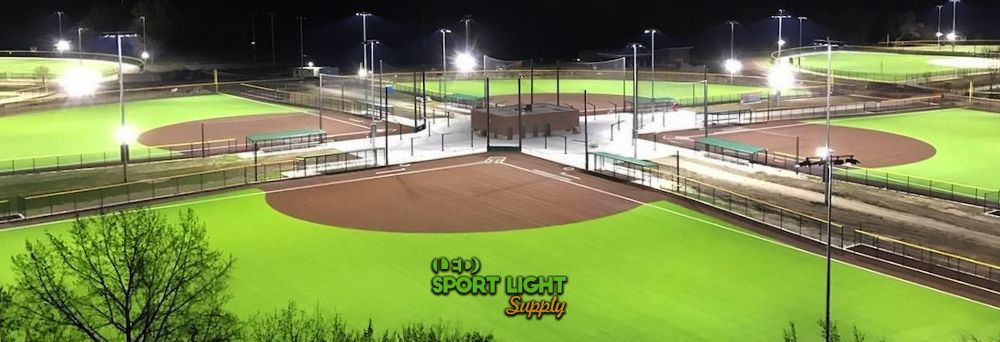
Correlated color temperature, or CCT, describes the apparent warmth or coolness of white light. It is measured in kelvin (K), with lower values appearing warmer and higher values appearing cooler.
Outdoor LED sports lighting commonly uses white-light sources in the approximate range of 4000K to 5700K. A 4000K fixture produces a relatively neutral white appearance, while a 5000K or 5700K fixture generally looks cooler.
For softball fields, a consistent color appearance across the playing area is usually more useful than choosing the highest available color temperature. When fixtures with significantly different CCT values are installed together, the field may look visually inconsistent.
The selected CCT should also reflect the project’s lighting specification, environmental conditions, and visual preferences. Higher CCT does not automatically mean greater illuminance or better visibility. A 5000K fixture is not necessarily brighter than a 4000K fixture with the same measured output and optical performance.
Designers should also consider the surrounding environment. In locations with strict environmental lighting requirements, a lower CCT may be preferable where it can satisfy the project’s visual and performance needs.
The Color Rendering Index (CRI), commonly represented by Ra, indicates how accurately a light source reproduces object colors compared with a reference source. It is particularly relevant in sports facilities where players, spectators, and cameras need to distinguish visual details.
A fixture with a CRI of 70 or higher may be suitable for many general outdoor sports applications, depending on the applicable specification. More demanding broadcast projects may require additional color-quality criteria rather than relying on CRI alone.
For example, two LED fixtures can have similar lumen output and CCT while producing noticeably different color appearances. This can happen because their spectral distributions are different.
When selecting LED floodlights, check the manufacturer’s photometric and color-quality documentation. For projects involving television production, ask whether additional color metrics, such as television lighting consistency requirements, need to be specified.
Glare is excessive brightness that causes visual discomfort or reduces the ability to see clearly. It is a particular concern in softball because players frequently look upward to follow fly balls.
A fixture positioned poorly may direct intense light into a player’s field of view. Even when the field has adequate average illuminance, direct glare can make it harder to follow the ball during certain plays.
Glare depends on several factors, including fixture brightness, mounting position, aiming direction, optical design, and the observer’s viewing angle. The position of each fixture should therefore be evaluated from the perspectives of players, umpires, spectators, and other regular users.
There are several ways to improve glare control. Precision optics can direct more light toward the intended playing area, while internal shields, louvers, and external shielding accessories can help control unwanted high-angle light. Appropriate pole heights and aiming strategies can also reduce the chance of fixtures shining directly into common viewing directions.
For softball facilities, the designer should pay particular attention to the views of outfielders looking toward the infield and players tracking balls above the field. A glare assessment based only on a single viewing direction may overlook uncomfortable conditions elsewhere.
Shadows are created when objects block light from one or more directions. In a softball field, players, equipment, fences, and other structures can create shadows across the playing surface.
A lighting design that relies heavily on one direction of illumination may produce long or pronounced shadows. Multiple lighting positions can provide overlapping beams that reduce these effects and improve the visibility of players and field markings.
The aim is not to eliminate every shadow, which is generally unrealistic in an outdoor sports environment. Instead, the lighting should avoid creating harsh, distracting shadow patterns that interfere with play.
Designers should examine shadow behavior around home plate, the pitcher’s area, bases, dugouts, and the outfield. Fixture positions should be selected to provide balanced illumination from different directions without introducing excessive glare.
LED floodlights operate through electronic drivers that regulate electrical power supplied to the light source. Poor driver design or incompatible dimming equipment can produce fluctuations in light output.
Some fluctuations are too rapid for people to notice directly, but they may still affect cameras or create stroboscopic effects when moving objects are viewed under certain conditions. In softball, this deserves attention because the ball and players can move quickly.
For ordinary recreational facilities, stable LED operation and reliable drivers should be part of the fixture specification. Broadcast venues may require more stringent flicker-performance testing to support slow-motion and high-speed recording.
When comparing fixtures, ask manufacturers for documented flicker performance under the intended operating conditions. If the system includes dimming, the specification should cover the entire expected dimming range rather than only full-output operation.
Energy efficiency is not determined by wattage alone. It depends on how effectively a lighting system converts electrical power into usable light and how much of that light reaches the intended playing area.
A high-efficiency fixture may still perform poorly if its beam distribution sends too much light outside the field. Conversely, a carefully designed system may achieve the required illumination with fewer unnecessary lumens.
Lighting controls provide another way to reduce energy use. A facility may use separate settings for training, recreational games, and formal competitions, provided each setting maintains the required visibility for its intended activity.
Scheduling controls can also prevent lights from remaining on when the field is not in use. Where appropriate, operators can use automatic shutoff schedules, manual overrides, and separate controls for different playing areas.
Outdoor sports lighting should illuminate the field without unnecessarily affecting nearby homes, roads, or natural areas. Uncontrolled light spill can cause complaints, interfere with neighboring properties, and create environmental concerns.
The design should consider both horizontal and vertical spill beyond the field boundary. Upward light emissions should also be controlled through suitable fixture optics, shielding, and aiming.
A project near residential buildings may need more restrictive lighting controls than a facility in an isolated sports complex. Local planning authorities may specify limits for illuminance at property boundaries, operating hours, or the direction of installed fixtures.
A good lighting design therefore considers the surrounding environment from the beginning instead of treating light pollution as a problem to address after installation.
Softball field lighting projects may need to follow national standards, international sports lighting guidance, local regulations, and requirements established by competition organizers. These documents help designers determine suitable lighting performance and provide a framework for evaluating the completed installation.
However, not every general sports lighting standard contains a dedicated softball schedule or applies automatically to every type of venue. Designers should verify the relevant sport classification, competition rules, and current edition before using numerical values in a project specification.
The Illuminating Engineering Society (IES) publishes guidance for lighting sports and recreational facilities in the United States. The current publication is ANSI/IES RP-6-24, Recommended Practice: Lighting Sports and Recreational Areas, published in 2025.
It provides guidance on lighting fundamentals, general and sport-specific design considerations, outdoor sports lighting, illuminance recommendations, computer calculations, floodlight aiming, field measurements, uniformity, and broadcast applications.
For softball facilities, the guidance can help designers evaluate the visual needs of players and spectators while selecting appropriate lighting arrangements. It also provides a framework for considering different levels of play rather than applying one lighting specification to every field.
RP-6 is a recommended practice, not automatically a legally binding requirement in every location. Its recommendations may become part of a project contract or local specification, but the applicable authority and project documents determine what must be followed.
EN 12193 is a European standard covering lighting requirements for sports facilities. The 2018 edition addresses sports lighting classes, illuminance, uniformity, glare restriction, color properties, measurement, and related performance considerations.
The standard organizes many sports lighting applications according to three broad classes. These classes reflect different levels of competition and facility use, although the actual numerical requirements depend on the sport and the applicable schedule.
Class I generally relates to higher-level national and international competition. Class II covers many regional and local competition applications, while Class III is commonly associated with recreational activities, training, and school sports.
The classification provides a useful way to establish project requirements before the lighting design begins. However, designers should consult the applicable sport-specific provisions rather than assuming that the same illuminance values apply to softball, football, tennis, and other sports.
The International Commission on Illumination (CIE) publishes technical documents addressing lighting quality, glare, and environmental effects. Several publications can support the planning of outdoor softball lighting projects.
CIE guidance on glare evaluation helps designers understand how bright light sources affect visual comfort and performance. This is especially relevant for players who need to look upward while tracking airborne balls.
CIE 150 addresses the limitation of obtrusive light from outdoor lighting installations. It provides a framework for considering the effects of outdoor lighting beyond the intended site, including spill light and upward emissions.
CIE publications on sports lighting for television and film can also provide useful background for broadcast projects. Their application should be checked against current publication status and the specific camera requirements of the venue.
International guidance does not replace local regulations. A softball field lighting project may also need to comply with electrical installation rules, structural design requirements, planning approvals, environmental restrictions, and construction permits.
In the United States, for example, electrical work may need to comply with the locally adopted edition of the National Electrical Code, while pole foundations and structural design must account for applicable building codes and wind-loading requirements.
Projects in other countries may follow different electrical standards, structural design codes, and environmental lighting regulations. Some jurisdictions also impose restrictions on operating hours or light levels at nearby property boundaries.
The design team should establish which documents apply before finalizing the fixture schedule or construction drawings. This avoids the risk of completing a technically sound lighting design that does not satisfy the local approval process.
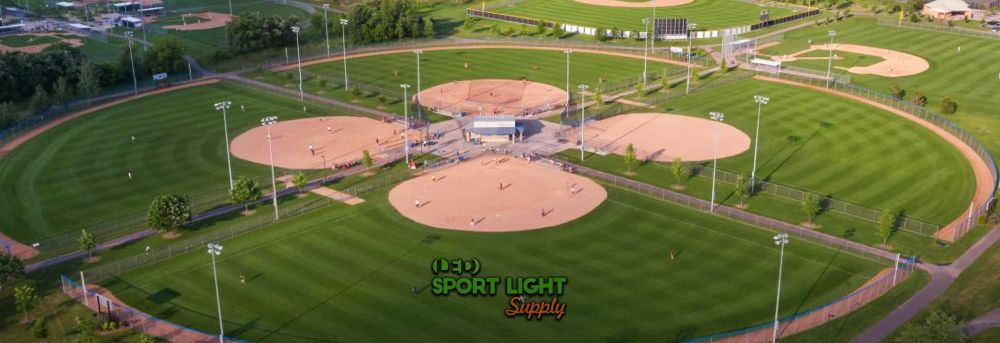
Pole placement has a direct effect on lighting coverage, uniformity, glare, and installation cost. Even high-quality LED floodlights may perform poorly when they are mounted in unsuitable locations or aimed without considering the entire field.
A good pole layout begins with the actual dimensions of the playing area. The designer then identifies the locations that need illumination, evaluates possible mounting positions, and determines how fixtures can distribute light across the infield and outfield.
There is no single pole arrangement that suits every softball field. Four-pole, six-pole, and eight-pole layouts are common design concepts, but the appropriate configuration depends on field size, lighting targets, available space, surrounding structures, and the photometric performance of the selected fixtures.
A softball field typically includes the infield, outfield, foul territory, warning track where provided, dugouts, and spectator areas. Each zone has different lighting needs, and the exact calculation boundaries should be defined before the design begins.
The infield includes home plate, the pitcher’s area, and the bases. It is an area of frequent player movement and rapid changes in direction, so the lighting should provide consistent visibility across the playing surface.
The outfield covers a much larger area and presents different visual challenges. Outfielders need to judge the direction and trajectory of airborne balls while moving across the field. The lighting design should therefore avoid large differences in brightness between the infield and outfield.
Foul territory may also need illumination depending on the playing rules and facility use. Dugouts, spectator seating, access paths, and other surrounding areas should be evaluated separately so that their lighting requirements do not interfere with the main playing area.
A four-pole arrangement places lighting positions around the field, often near the outer corners of the playing area or at suitable perimeter locations. It is a relatively simple concept and may be appropriate for certain smaller recreational fields.
The advantage is that the design uses fewer pole foundations and may require less site infrastructure. However, each pole may need to support a larger group of fixtures, and the beam distribution must be carefully designed to cover the entire playing area.
One potential limitation is that a four-pole arrangement can produce uneven illumination if the fixtures cannot reach the required areas from their mounting positions. It may also create difficult glare conditions if the aiming angles are too aggressive.
A four-pole system should therefore be evaluated through photometric calculations rather than selected simply because it has the lowest pole count.
A six-pole arrangement provides additional lighting positions and may offer greater flexibility when distributing fixtures around the field. The extra positions can help improve coverage and reduce the amount of light that each pole must provide.
Depending on the site geometry, poles may be distributed along the foul-line sides and other suitable perimeter locations. The precise arrangement should account for player viewing directions, field boundaries, spectator facilities, and nearby properties.
Six poles do not automatically produce better lighting than four poles. The result depends on fixture optics, mounting heights, aiming angles, and the number of fixtures installed at each position.
The configuration is most useful when the additional mounting positions help solve a specific photometric problem, such as insufficient outfield coverage or excessive aiming angles.
An eight-pole arrangement offers more lighting positions and may be considered for larger facilities or projects with demanding coverage requirements. Distributing the light sources across more locations can provide additional flexibility when controlling shadows and uniformity.
However, more poles also mean additional foundations, electrical connections, structural work, and maintenance responsibilities. The project may become more expensive without delivering a meaningful improvement if the extra poles are not needed.
The designer should compare alternative layouts using the same target illuminance, calculation grid, maintenance factor, and performance criteria. This makes it easier to understand whether the additional infrastructure provides a worthwhile improvement.
The following table summarizes typical design considerations for different pole arrangements. It is a conceptual comparison rather than a fixed recommendation for a particular field size.
| Pole configuration | Potential advantages | Design considerations |
|---|---|---|
| Four poles | Fewer foundations and simpler infrastructure | Greater reliance on each pole’s fixture arrangement |
| Six poles | More flexibility in light distribution | Requires careful coordination of mounting positions |
| Eight poles | Additional coverage and aiming options | Higher structural, electrical, and maintenance costs |
The best configuration is the one that meets the project’s lighting requirements with acceptable glare, uniformity, environmental impact, and total cost. Pole quantity should be a result of the design rather than the starting assumption.
Lighting poles should generally be positioned outside the active playing area and any required safety clearances. Their locations must also account for fences, player movement, vehicle access, underground utilities, spectator areas, and maintenance requirements.
A common approach is to distribute poles around the field perimeter so that the fixtures can illuminate different zones from multiple directions. This helps reduce excessive dependence on individual fixtures and allows designers to balance the light distribution.
The exact position of each pole should be established through site measurements and photometric modeling. A pole that looks ideally placed on a simple field diagram may create a glare problem when its fixtures are viewed from a particular player position.
Designers should also coordinate pole locations with the dugouts, scoreboard, backstop, spectator seating, and surrounding buildings. This reduces the chance of needing expensive changes after construction has started.
Mounting height affects how light reaches the field and the angles at which fixtures are viewed by players. Taller poles can allow light to be distributed over a wider area with less aggressive aiming, but they also introduce greater structural and installation demands.
Pole heights for outdoor softball facilities may fall broadly within the range of approximately 50 to 100 feet, depending on the project. This is a planning reference rather than a universal requirement, and some sites may require different heights because of field geometry, regulations, or structural limitations.
A taller pole is not automatically better. Increasing mounting height may require stronger foundations, additional structural engineering, and more complex installation equipment. It can also affect the fixture output needed to achieve the required illuminance at field level.
The appropriate height should be evaluated together with the number of fixtures, optical distribution, pole position, and glare restrictions. Wind exposure and soil conditions must also be considered before the final pole specification is approved.
Beam angle describes the spread of light produced by a fixture. Narrow beams concentrate light over a smaller area, while wider beams distribute it over a larger area.
Softball field lighting may use different beam distributions depending on the pole position and the area being illuminated. A fixture aimed toward the distant outfield may need a different optical distribution from one serving the infield directly below a pole.
Choosing a beam angle based only on the fixture’s advertised specification can be misleading. Two products with the same nominal beam angle may have different intensity distributions and optical performance.
Designers should therefore review the complete photometric file, usually supplied in IES or LDT format, and use it in lighting simulation software. This makes it possible to evaluate the actual distribution rather than relying on a simplified beam-angle description.
The infield and outfield should be considered as connected but distinct lighting zones. The infield often requires careful attention to the pitching area, bases, and home plate, while the outfield needs broad, consistent coverage over a larger surface.
The transition between the two areas deserves particular attention. If the infield is substantially brighter than the outfield, players may experience noticeable changes in visual conditions as the ball moves between zones.
The design should also account for the directions from which players view the field. A fixture arrangement that produces acceptable horizontal readings may still leave poor vertical illumination for players tracking airborne balls.
Sports complexes with multiple softball fields face additional layout challenges. Adjacent fields may share access roads, spectator areas, parking facilities, and electrical infrastructure, so the lighting design should consider the entire site.
Poles serving one field may also affect the light distribution of a neighboring field. This can create overlapping illumination, unnecessary energy use, or glare from fixtures that are not part of the player’s own playing area.
Independent lighting controls are useful because they allow each field to operate according to its schedule. Shared infrastructure can reduce some construction costs, but each field still needs its own photometric evaluation and appropriate lighting controls.
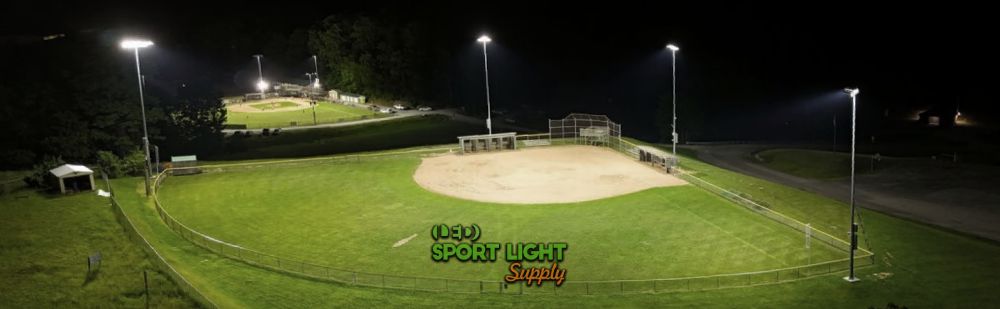
LED technology has become a widely used option for outdoor sports lighting because it can provide high luminous efficacy, controllable light distribution, and flexible operating modes. However, not every LED floodlight is suitable for softball applications.
A product designed for general outdoor area lighting may not provide the optical control, output, durability, or glare performance required for a sports field. Buyers should evaluate complete fixture specifications rather than choosing equipment based on price or wattage alone.
Wattage measures electrical power consumption, while lumens measure the total visible light output of a source. These two figures are related, but they describe different aspects of a lighting fixture.
For example, a 1,000-watt LED floodlight with an efficacy of 150 lumens per watt would produce approximately 150,000 lumens before accounting for any additional optical considerations. A different 1,000-watt product with an efficacy of 120 lumens per watt would produce approximately 120,000 lumens.
However, total lumen output does not reveal how effectively the fixture directs light onto the field. Optical efficiency, beam distribution, mounting height, aiming direction, and light losses all influence the final result.
This is why professional sports lighting design focuses on calculated illuminance rather than simply adding together the lumen ratings of all installed fixtures.
Luminous efficacy measures how much visible light a fixture produces for each watt of electrical power it consumes. It is expressed in lumens per watt (lm/W).
Modern outdoor LED floodlights may offer fixture efficacies in the approximate range of 120 to 180 lm/W, although actual values depend on the product, operating current, optical configuration, and testing conditions.
A higher lm/W rating can reduce energy consumption, but it should not be the only selection criterion. A fixture with excellent efficacy may still be unsuitable if its light distribution creates glare or fails to provide sufficient coverage.
The more useful comparison is the amount of electrical power required to achieve the specified maintained illuminance and uniformity across the actual field.
LED sports floodlights are available with different optical distributions. Narrow, medium, and wide beams can be used to direct light toward different parts of the field.
Some fixtures also offer asymmetric optics designed to distribute light more effectively toward a particular area. These products can be useful where pole positions and field geometry make conventional symmetrical distribution less efficient.
Optical accessories may include internal shields, louvers, and external glare-control components. Their purpose is to reduce unwanted light and improve control over where the fixture sends its output.
The selected optics should be supported by manufacturer photometric files. Designers can then evaluate the actual light distribution in a simulation instead of assuming that a particular beam label will automatically produce the desired result.
Softball field floodlights are exposed to rain, dust, humidity, temperature changes, wind, and potentially corrosive environmental conditions. The fixture enclosure should be suitable for the site’s actual operating environment.
Ingress Protection (IP) ratings describe the level of protection against solid objects and water. For outdoor sports fixtures, IP65 or higher is commonly specified, depending on the product design and project requirements.
Impact protection is another consideration. An IK rating indicates resistance to mechanical impact, although the required level depends on the risk of physical damage at the installation site.
Materials and surface treatments also influence service life. Aluminum housings with suitable corrosion-resistant finishes are commonly used in outdoor LED floodlights, while exposed fasteners and mounting components should be selected for the local environment.
The LED driver regulates the electrical power supplied to the LED modules. Its performance affects light stability, dimming behavior, power quality, and overall system reliability.
When evaluating a sports lighting fixture, check the driver’s operating temperature range, power factor, surge protection, dimming compatibility, and flicker performance. These details become particularly relevant when the lighting system is expected to operate for several hours every evening.
Surge protection is especially relevant for tall outdoor installations because lighting poles and long electrical circuits can be exposed to electrical disturbances. The protection strategy should be designed for the entire electrical system rather than relying only on a single fixture component.
LED fixture lifespan is often expressed using an L70 or L80 rating. L70 describes the point at which the LED light output is expected to reach 70% of its initial value under specified test conditions, while L80 represents 80%.
For example, an L80 rating of 50,000 hours indicates that the relevant LED performance is expected to retain at least 80% of its initial output at the stated operating duration, subject to the manufacturer’s test conditions.
This does not mean the entire lighting fixture will necessarily operate without maintenance for 50,000 hours. Drivers, seals, wiring, surge protection components, and mounting hardware may have different service lives.
Facility owners should review the complete warranty and maintenance arrangements instead of relying on the LED chip lifespan alone.
Lighting problems often originate during the planning stage rather than after the fixtures have been installed. Choosing unsuitable equipment, overlooking player viewing angles, or skipping photometric calculations can lead to expensive corrections later.
Understanding common design mistakes helps facility owners evaluate proposals more effectively and avoid paying for a lighting system that does not perform as expected.
One of the most common mistakes is selecting floodlights based on wattage without examining their actual photometric performance. A higher-wattage fixture may consume more electricity while still producing an unsuitable beam distribution.
For example, two 1,000-watt floodlights may have different lumen outputs, optical efficiency, and intensity patterns. Even if their total output is similar, one may distribute light more effectively across the outfield.
The solution is to request complete fixture specifications, including lumen output, efficacy, beam distribution, and photometric files. The proposed fixtures should then be evaluated through lighting simulation using the actual field dimensions and mounting positions.
A field may have a high average illuminance but still contain areas that are noticeably darker than the rest of the playing surface. This often happens when the designer focuses on total fixture output instead of how light is distributed.
Players may experience difficulty adapting to large changes in brightness when moving between the infield and outfield. Uneven lighting can also make it harder to follow the ball against different backgrounds.
The solution is to establish a uniformity target before selecting the equipment. Designers should review the minimum, average, and maximum illuminance values for each relevant field zone and adjust the fixture arrangement where necessary.
Glare can remain a problem even when a lighting system meets its horizontal illuminance target. This is especially relevant for softball because players frequently look upward while tracking the ball.
Poorly positioned fixtures may shine directly into common viewing directions. Increasing fixture output can make the problem worse if the underlying aiming arrangement is not corrected.
A better approach is to evaluate glare from multiple player positions. Pole height, fixture orientation, shielding, and optical distribution should all be considered together rather than treating glare as a simple fixture specification.
Trying to cover an entire softball field with too few lighting positions can make it difficult to achieve consistent illumination. Individual poles may need to support excessive numbers of fixtures, resulting in complicated aiming requirements.
The problem is not necessarily the pole count itself. Some well-designed fields can achieve good results with relatively few poles, while other layouts need more positions because of their geometry or surrounding obstructions.
The solution is to compare different pole arrangements through photometric simulation. The designer should evaluate whether additional poles improve coverage, uniformity, glare control, and overall project value.
Pole height affects beam distribution, aiming angles, structural requirements, and glare. A pole that is too low may force fixtures to be aimed at steep angles, while an unnecessarily tall pole can increase construction costs.
The correct mounting height depends on the field dimensions, fixture optics, required illumination, and available installation locations. It should not be chosen using a standard height copied from an unrelated project.
Before construction, the pole layout should be reviewed together with the photometric model and structural calculations. This allows the team to identify problems before foundations and mounting structures are installed.
Designs that focus exclusively on horizontal illuminance may overlook the lighting conditions needed for tracking airborne balls and viewing players from different directions.
This can become particularly noticeable in the outfield, where players frequently look upward. The playing surface may appear adequately illuminated while the visual conditions for tracking the ball remain less comfortable.
The solution is to include vertical illuminance calculations where required by the project specification. Designers should identify representative viewing directions and assess whether the lighting arrangement provides suitable coverage.
Uncontrolled outdoor lighting can affect neighboring homes, roads, and surrounding properties. This may lead to complaints or require expensive changes to the installed system.
The solution is to review the site’s environmental lighting requirements before selecting fixtures. Appropriate shielding, precision optics, aiming control, and operating schedules can help reduce unnecessary light emissions.
Where the project is close to residential areas, property-boundary calculations should be included in the photometric assessment.
Tall sports lighting poles can be difficult and expensive to service. A design that looks efficient during installation may create long-term problems if fixtures are difficult to reach or replacement components are unavailable.
The solution is to consider maintenance methods before approving the pole arrangement. Facility owners should review access requirements, fixture mounting systems, replacement procedures, driver locations, and the availability of spare parts.
Maintenance planning should also consider whether the facility can continue operating safely while one lighting position is being serviced.
Perhaps the most expensive planning mistake is purchasing fixtures before confirming that the proposed system can achieve the required lighting performance.
Without a photometric model, it is difficult to evaluate the interaction between pole height, fixture quantity, beam angle, and aiming direction. A system may look reasonable on paper but produce dark spots or glare after installation.
The solution is to complete a professional lighting simulation before ordering equipment. The simulation should use the actual product photometric files and project dimensions, and the final design should include a report showing the relevant performance values.
A successful softball field lighting project begins with a clear understanding of how the facility will be used. Recreational fields, school facilities, competitive venues, and broadcast stadiums have different performance requirements, so the lighting design should reflect the actual needs of the players and operators.
Brightness is only one part of the equation. Uniformity, vertical illuminance, color quality, glare control, pole height, beam distribution, and environmental light management all influence the final result. These factors need to be evaluated together to create a comfortable and reliable playing environment.
The choice of LED fixtures and pole arrangements should also be supported by professional photometric calculations. Comparing different layouts before construction can help identify the most suitable solution, prevent unnecessary equipment purchases, and reduce the likelihood of expensive modifications after installation.
For facility owners planning a new softball field or upgrading an existing metal halide system, working with an experienced sports lighting provider can make the process more straightforward. Our team can help review your field dimensions, lighting objectives, existing infrastructure, and budget to develop a suitable LED lighting proposal. Contact our company for a professional consultation and a project-specific lighting assessment, including fixture recommendations, pole layout options, photometric simulation, and an estimated installation budget.