
Upgrading a basketball court with proper lighting can completely change how a space is used. A court that sits empty after sunset can become a busy community area where people play, train, and gather in the evening. However, the cost of installing new lighting systems, especially modern LED solutions, can make many organizations hesitate.
The good news is that basketball court lighting grants can help reduce the financial burden. Schools, municipalities, sports clubs, and community groups may have several funding options available if they know where to look and how to prepare a strong application. While grants do not always cover every dollar of a project, some programs can provide significant financial support.
Understanding where to apply, what funding sources are available, and whether you can receive 100% expense coverage can help you plan your basketball court lighting project with more confidence.
What Are Basketball Court Lighting Grants?
Basketball court lighting grants are funding programs designed to support improvements to sports facilities, recreation areas, and community spaces. These grants are usually offered by government agencies, nonprofit organizations, sports foundations, energy companies, and private businesses.
The purpose behind these programs is often broader than simply installing lights. Many funding organizations look for projects that create positive community outcomes, such as encouraging youth participation, improving public safety, increasing access to outdoor recreation, and supporting energy-efficient upgrades.
For example, a neighborhood basketball court that previously closed at 6 p.m. may become available until 10 p.m. after a lighting upgrade. This creates more opportunities for after-school activities, community leagues, and recreational use.
Grant providers typically evaluate projects based on factors such as community impact, project feasibility, budget planning, and long-term benefits.
Where Can You Apply for Basketball Court Lighting Grants?
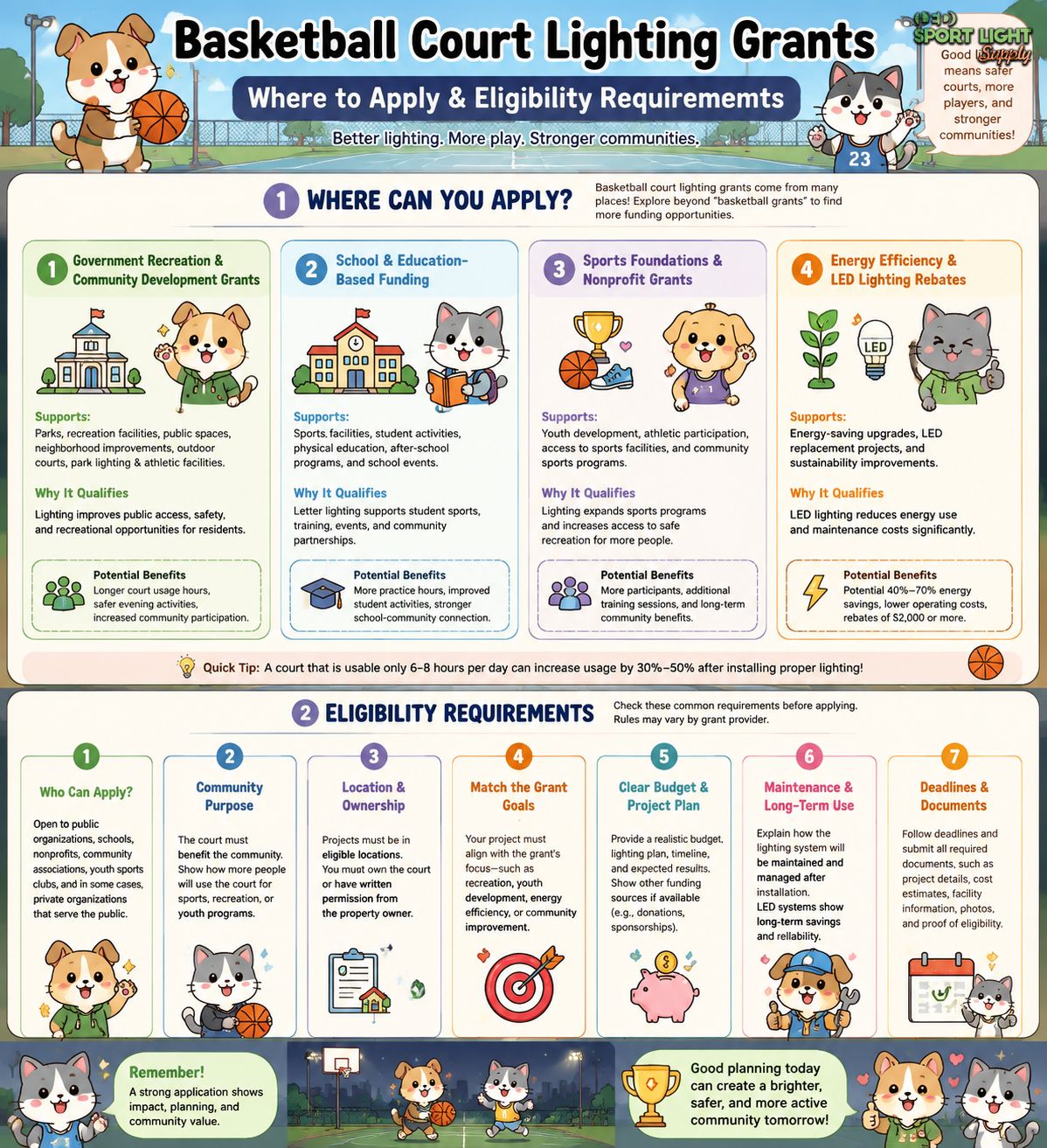
Finding the right funding source for a basketball court lighting project can seem challenging at first. Many organizations begin their search using terms like “basketball grants” or “sports facility funding,” but they may miss valuable opportunities because many grant programs are not listed under these specific categories.
Basketball court lighting projects are often included within broader funding areas such as community recreation improvements, public park development, youth sports programs, neighborhood improvement projects, and energy efficiency upgrades. Looking beyond traditional sports grants can open the door to more potential funding opportunities.
A basketball court lighting upgrade is not simply about adding brighter lights. Many grant providers view these projects as investments that improve community safety, encourage physical activity, and increase access to shared recreational spaces. For example, a court that is only usable during daylight hours may provide around 6 to 8 hours of playing time each day. After installing proper lighting, the same court may become available for evening activities, potentially increasing usage opportunities by 30% to 50%.
When searching for funding, organizations should consider different sources and focus on finding grants that match the purpose and impact of their project.
| Grant Source | Who Can Apply | What the Funding Supports | Why Basketball Court Lighting May Qualify | Potential Benefits |
|---|---|---|---|---|
| Government Recreation & Community Development Grants | Local communities, municipalities, public facilities, nonprofit groups | Park upgrades, recreation facilities, public space improvements, community development projects | Lighting improves public access, safety, and recreational opportunities | Longer court usage hours, safer evening activities, increased community participation |
| School & Education-Based Funding | Schools, educational institutions, school districts | Sports facilities, student activities, physical education, after-school programs | Better lighting supports student sports, training sessions, events, and community partnerships | More practice hours, improved student activities, stronger school-community connection |
| Sports Foundations & Nonprofit Grants | Youth organizations, nonprofit groups, community sports programs | Youth development, athletic participation, access to sports facilities | Lighting helps expand sports programs and provides better access to recreation | More participants, additional training sessions, long-term community benefits |
| Energy Efficiency & LED Lighting Rebates | Schools, businesses, nonprofits, public facilities, property owners | Energy-saving upgrades and LED replacement projects | LED lighting reduces energy use and maintenance costs | Potential 40%–70% energy savings, lower operating costs, possible rebates of $2,000 or more |
Government Recreation and Community Development Grants
Government funding programs are one of the most common sources for organizations looking to improve sports facilities and public recreation spaces. Local governments, state agencies, and federal programs often provide financial support for projects that improve community infrastructure.
Many cities and municipalities have annual budgets dedicated to parks, recreation areas, and neighborhood improvements. These funds may support a wide range of projects, including playground upgrades, walking trails, outdoor courts, park lighting systems, and athletic facility improvements.
For example, a city recreation department may offer funding for projects that increase public access to outdoor spaces. A basketball court lighting project may qualify if it helps residents use the facility for longer hours, creates safer evening recreation opportunities, or supports community sports programs.
When applying for government grants, organizations should avoid focusing only on the purchase of new lighting equipment. A stronger application explains the overall community impact behind the project.
For instance, instead of saying, “We need new basketball court lights,” a proposal could explain that the upgraded court will allow local residents to enjoy evening recreation, provide additional training hours for youth teams, and create a safer outdoor space after sunset.
A neighborhood basketball court currently serving around 50 players per week during daylight hours may potentially support 100 or more weekly users after lighting improvements because more people can access the facility after work, school, or other daytime commitments.
Organizations should also explore smaller local funding programs. While large government grants may provide significant financial support, they often attract many applicants. Local community improvement funds may have fewer competitors and can sometimes be more accessible for smaller organizations.
School and Education-Based Funding Opportunities
Schools and educational institutions can often find funding opportunities through athletic facility improvement programs, school development budgets, and education-related grants.
A basketball court lighting project can be presented as more than a facility upgrade. Schools can highlight how improved lighting supports student activities, physical education programs, after-school sports, and community partnerships.
For example, a school basketball court that becomes unavailable immediately after classes due to poor lighting may limit students’ ability to participate in training sessions or sports clubs. With proper lighting, the same court could support additional activities such as basketball practices, student competitions, community recreation programs, and evening events.
Many schools successfully combine multiple funding sources instead of depending on a single grant. For example, a $25,000 lighting project may be funded through a combination of different contributions, such as $10,000 from a school improvement budget, $7,500 from a local community grant, $5,000 from business sponsorships, and $2,500 from fundraising activities.
This type of combined funding strategy can make a project easier to complete because it reduces the financial pressure on one funding source.
Schools should also consider working with parent associations, local businesses, and community organizations. A basketball court that benefits both students and nearby residents often creates a stronger funding case because the project supports a larger group of users.
Sports Foundations and Nonprofit Grants
Sports foundations and nonprofit organizations are another potential source of funding for basketball court lighting improvements.
Many sports-related organizations provide grants that encourage athletic participation, support youth development, and improve access to recreational facilities. These programs often focus on communities where residents may have limited access to safe and affordable sports spaces.
A basketball court lighting project can be attractive to these organizations because it creates long-term benefits rather than supporting only a single event or activity. Once installed, the lighting system can continue supporting community programs, youth training, and recreational use for many years.
When applying for sports foundation grants, organizations should clearly explain who will benefit from the project and how the upgraded facility will be used.
For example, a community group that currently operates weekend basketball programs for 80 teenagers could explain that improved lighting would allow training sessions to increase from 2 evenings per week to 5 evenings per week.
Using measurable information can make the proposal stronger. Instead of simply stating that “many young people will benefit,” an organization could explain that the upgraded court is expected to support approximately 150 youth participants annually and provide an additional 400 hours of recreational access each year.
Grant providers are more likely to understand the value of a project when they can see clear numbers and expected results.
Energy Efficiency and LED Lighting Rebates
Since many basketball court lighting projects involve replacing older lighting systems with modern LED technology, energy-related programs can also provide valuable funding opportunities.
Utility companies, energy organizations, and sustainability programs sometimes offer rebates or incentives for facilities that install energy-saving lighting systems.
LED basketball court lighting has become increasingly popular because it provides better brightness control, lower energy consumption, improved reliability, and longer operating life compared with older lighting systems.
Depending on the existing equipment, switching to LED lighting may reduce electricity usage by approximately 40% to 70%. For facilities that operate lights several hours every evening, these savings can become a major financial advantage over time.
For example, if an older lighting system costs around $500 per month in electricity expenses, a more efficient LED system may potentially reduce costs to approximately $150 to $300 per month depending on local electricity rates, operating hours, and system design.
These energy savings can strengthen a grant application because the project provides both community benefits and financial advantages.
Organizations should check with local energy providers to see whether rebate programs are available. Some programs may provide several thousand dollars in support, such as $2,000, $5,000, or more, which can significantly reduce the remaining project cost.
Can I Apply for 100% of the Basketball Court Lighting Expenses?
One of the most common questions from schools, community organizations, and facility owners is whether a grant can cover 100% of basketball court lighting expenses.
The answer depends on several factors, including the specific grant program, type of organization, location, and overall purpose of the project.
Some funding programs are designed to fully support community improvement projects. In certain situations, eligible organizations may receive enough funding to cover the complete cost of lighting equipment, installation, electrical work, and related expenses.
However, many grant programs provide partial funding rather than complete project coverage. It is common for grants to cover percentages such as 25%, 50%, or 75% of the total cost.
For example, if a basketball court lighting project costs $30,000, possible funding situations may include:
- A full grant covering the entire $30,000 project cost.
- A 75% grant covering $22,500, with the organization contributing the remaining $7,500.
- A 50% grant providing $15,000, with additional funding needed from other sources.
- A smaller grant of $7,500 combined with sponsorships, donations, or organizational funds.
Receiving full funding becomes more realistic when a project demonstrates strong community value, matches the goals of the grant provider, and shows clear long-term benefits.
How the Type of Organization Affects Funding Opportunities
The organization applying for the grant can influence the level of funding available.
Public schools, nonprofit organizations, government facilities, and community groups often have access to more grant opportunities because their projects usually serve larger populations.
A public basketball court used by hundreds of local residents may have stronger funding potential compared with a private facility that only benefits a small group of members.
For example, a neighborhood court used by approximately 300 residents each month may demonstrate a wider community impact than a private training facility serving only 30 regular users.
However, private organizations are not automatically excluded. Some may qualify if they can show that their facility supports public programs, youth development activities, or community partnerships.
Matching Your Project With the Grant Provider’s Goals
Every grant provider has different priorities. Some organizations focus on youth sports development, while others prioritize environmental improvements, public safety, or community accessibility.
Understanding these goals can greatly improve the chance of approval.
A basketball court lighting project can often support multiple objectives at the same time. For example, an LED lighting upgrade can increase evening recreation opportunities, support youth sports programs, reduce energy consumption, improve visibility, and extend the usable hours of a public facility.
A proposal that connects with several funding priorities may stand out more than an application that only focuses on purchasing new lights.
For example, explaining that a lighting upgrade will help 200 local youth participants, reduce energy usage by 50%, and provide 500 additional hours of annual court access creates a much stronger picture of the project’s value.
The Quality of the Grant Application Matters
Even when a project meets eligibility requirements, the quality of the application can influence the final decision.
Grant reviewers want to understand why the project matters, how the funds will be used, and what measurable results can be expected.
A strong application should clearly describe the current condition of the basketball court, problems caused by poor lighting, expected users, estimated costs, installation timeline, and long-term maintenance plans.
Specific numbers can make the proposal more convincing. Instead of saying, “The court is used frequently,” an organization could explain that the facility currently receives approximately 200 visits per month and expects usage to increase to 350 visits after the lighting upgrade.
A detailed and realistic proposal shows that the organization has carefully planned the project and understands how the investment will create lasting benefits.
With the right approach, basketball court lighting projects can become much more achievable. Whether the goal is securing full grant funding, combining several financial sources, or reducing expenses through LED rebates, finding the right funding opportunity and presenting a clear project plan can make a significant difference.
Eligibility Requirements for Applying for Basketball Court Lighting Grants
Before applying for a basketball court lighting grant, it is important to check whether your organization and project meet the program’s requirements. Every grant provider has its own rules, but most funding programs look for applicants that can demonstrate community value, proper project planning, and responsible use of funds.
Who Can Apply for Basketball Court Lighting Grants?
Eligibility often depends on the type of organization applying. Many grant programs are open to public organizations, nonprofit groups, schools, and community associations that manage or support recreational facilities.
Common eligible applicants may include schools, local government departments, parks and recreation agencies, youth sports clubs, nonprofit organizations, and community centers. Some private organizations may also qualify if their basketball courts are open to public use or support community programs.
For example, a privately managed sports facility that only serves paying members may have fewer funding options compared with a neighborhood basketball court that provides free access to local residents.
The Basketball Court Must Serve a Community Purpose
Many grant providers prefer projects that create benefits beyond a single group. A strong application usually explains how the improved lighting will help more people access the facility.
Projects that support youth activities, community sports programs, public recreation, or safer outdoor spaces often have stronger eligibility potential.
Providing details such as the number of expected users, community programs hosted at the court, and extended operating hours can help demonstrate the value of the project.
Location and Ownership Requirements
Some grants have specific location requirements. For example, certain programs may only support projects located in specific cities, states, regions, or underserved communities.
Applicants may also need to prove that they own the basketball court or have official permission from the property owner to complete the lighting upgrade.
Having documents such as property records, facility agreements, or approval letters can help confirm that the project is ready to move forward.
The Project Must Match the Grant’s Funding Goals
Each grant program has different priorities. Some focus on improving recreation spaces, while others support energy efficiency, youth development, or community improvement.
A basketball court lighting project is more likely to qualify when its goals match the purpose of the grant.
For instance, an LED lighting upgrade may fit well with an energy-saving program because it can reduce electricity consumption and long-term maintenance costs. A community sports grant may focus more on increasing access to recreational activities.
Before applying, carefully review the grant guidelines and explain how your project supports those goals.
Having a Clear Budget and Project Plan
Grant providers usually want applicants to show that they have a realistic plan for using the funds.
A complete application may need details about the lighting system, estimated installation costs, project timeline, and expected results.
Applicants should also explain whether they have other sources of funding, such as donations, sponsorships, or matching contributions.
A clear financial plan shows that the organization is prepared to complete the project and maintain the upgraded lighting system after installation.
Meeting Maintenance and Long-Term Use Expectations
Some grant providers want to know that their investment will continue benefiting the community for years.
Applicants may need to provide information about future maintenance plans, who will manage the facility, and how the lighting system will be maintained.
For example, installing energy-efficient LED lights with a longer lifespan can demonstrate that the organization is planning for lower maintenance costs and long-term operation.
Checking Application Deadlines and Required Documents
Even if an organization meets all eligibility requirements, missing deadlines or failing to provide required documents can prevent approval.
Applicants should prepare materials such as project descriptions, cost estimates, facility information, proof of eligibility, and supporting photos before submitting an application.
Taking time to review all requirements carefully can improve the chances of submitting a complete and competitive grant request.
Meeting the eligibility requirements is the first step toward securing basketball court lighting funding. By choosing the right grant program and showing how the project benefits the community, organizations can create a stronger application and increase their chances of receiving financial support.
Common Reasons Basketball Court Lighting Grant Applications Are Rejected
Applying for a basketball court lighting grant involves more than explaining the need for new lights. Many applications are rejected because they fail to show the project’s overall value, provide incomplete information, or do not match the goals of the funding program.
Grant providers are not only looking at the cost of the project. They also want to understand the return on investment (ROI) and how the funding will create long-term value for the community. A strong application should show that the lighting upgrade is not simply an expense, but an investment that can improve facility usage, reduce operating costs, and provide measurable benefits over time.
Understanding the common mistakes can help organizations create a stronger proposal and improve their chances of receiving financial support.
Focusing Only on the Lighting Equipment Instead of the Community Benefits
One common mistake is focusing too much on the lighting products rather than explaining how the project will benefit the community. While details about LED fixtures, installation methods, and equipment costs are useful, grant providers usually want to understand the impact behind the investment.
A proposal that simply says, “We need funding for new basketball court lights,” may not be convincing enough. A stronger application explains how the upgrade will create more opportunities for residents, improve safety, support youth programs, and increase the overall value of the facility.
For example, a lighting project may allow a court to stay open 3 to 5 additional hours each evening, increase participation in youth programs, and provide more recreational opportunities throughout the year. Instead of only saying that 100 people currently use the court, an organization could explain that improved lighting may increase usage to 250 users per month and create an additional 150 to 200 hours of available playing time annually.
The ROI of the project should also be highlighted. If a $30,000 lighting upgrade allows a facility to host more community events, increase program participation, and reduce electricity costs by thousands of dollars over several years, grant providers can better understand the long-term value of their investment.
Including measurable results helps reviewers see the real impact behind the funding request.
Providing an Incomplete or Unrealistic Budget
Another common reason for rejection is an unclear project budget. Some applicants only include the cost of lighting fixtures and forget other expenses such as electrical upgrades, installation labor, permits, control systems, and future maintenance.
For example, an organization may estimate that lighting equipment costs $8,000 but later discover that installation and electrical work bring the total project cost closer to $20,000. A budget that does not reflect the full project scope can make reviewers question whether the organization is prepared.
A realistic budget should also explain the expected financial benefits after installation. Modern LED basketball court lighting systems may reduce energy consumption by 40% to 70% compared with older lighting solutions, depending on the existing equipment and operating schedule.
Showing both the project cost and potential long-term savings creates a clearer ROI picture. For example, if an organization saves $3,000 per year in energy and maintenance expenses after upgrading its lighting system, the project may recover a significant portion of its cost over several years.
A detailed budget does not need to be complicated, but it should demonstrate that the organization understands both the investment required and the value created.
Applying for Grants That Do Not Match the Project
Some organizations apply for as many grants as possible without checking whether their project actually fits the program requirements. This can waste time and reduce the chances of success.
Different grant programs have different rules regarding eligible applicants, project locations, funding purposes, and budget limits. For example, a program designed for indoor school facilities may not support an outdoor community basketball court, while an energy rebate program may only cover LED upgrades rather than general construction work.
Before applying, organizations should carefully review whether the grant matches their project goals, eligibility requirements, and expected outcomes.
A well-targeted application is usually much stronger than a general proposal sent to the wrong funding source because it clearly connects the project benefits with the goals of the grant provider.
Not Showing Enough Evidence of Community Need
Grant providers want to understand why the project is needed and what problem it solves. An application that simply states that a court needs better lighting may not provide enough reason for funding.
A stronger proposal explains how the current situation affects the community. Poor lighting may prevent evening sports activities, limit youth programs, or create safety concerns for residents using the space after sunset.
Supporting information such as current usage numbers, photos of the existing court, community feedback, and letters from local organizations can make the application more persuasive.
For example, explaining that a court currently receives 200 visits per month but could support 350 visits after a lighting upgrade provides a clearer picture of the expected return. More users, more programs, and longer operating hours all represent additional value created from the investment.
Forgetting About Long-Term Maintenance and Operating Savings
Some applicants focus only on installation and do not explain how the lighting system will be managed after completion.
Grant providers want to know that their funding will continue creating value for years. Including a maintenance plan can show that the organization has considered the long-term operation of the facility.
For example, LED lighting systems often have lifespans of around 50,000 hours or more. Compared with older lighting systems, they typically require fewer replacements and less maintenance, which can reduce future operating expenses.
A strong application can explain how the new system will provide ongoing benefits through lower electricity bills, reduced maintenance requirements, and improved facility reliability.
Missing Eligibility Requirements or Important Documents
Even a strong project can be rejected if the application does not meet basic requirements. Common issues include applying as an ineligible organization, missing required documents, submitting after the deadline, or failing to provide complete project information.
Before submitting an application, organizations should prepare documents such as proof of ownership or facility permission, project estimates, lighting plans, organizational information, and approval letters if required.
A complete and organized application makes it easier for grant reviewers to understand the project and evaluate its potential impact.
Not Providing a Clear Project Timeline
Grant providers also want to know whether the project is realistic and ready to move forward. Applications that do not include a clear timeline may appear unprepared.
A simple project schedule can help demonstrate that the organization has a practical plan. For example, the first month may involve finalizing the lighting design and budget, the next two months may focus on approval and equipment preparation, and installation may take place within the following months.
A realistic timeline shows that funding will be used efficiently and that the project can move from planning to completion without unnecessary delays.
Failing to Explain Why Funding Is Needed Now
Many grant programs receive more applications than available funding, so organizations need to explain why their project deserves attention at the current time.
Factors such as increasing community demand, outdated lighting systems, rising electricity costs, or growing participation in sports programs can help create a stronger case.
For example, if basketball participation has increased by 40% over the past two years but the court cannot support evening activities because of poor lighting, this creates a clear reason for upgrading the facility.
A successful grant application does not simply ask for money. It demonstrates the expected ROI by showing how funding will create measurable improvements, reduce long-term costs, and provide ongoing benefits for the community.
Finding the Right Funding Path for Your Basketball Court Lighting Upgrade
Basketball court lighting grants can make a major difference for organizations looking to improve sports facilities without carrying the entire financial burden alone. While receiving 100% funding is possible in some cases, many projects succeed by combining grants, rebates, sponsorships, and other financial resources.
The key is understanding available funding sources, preparing a detailed project plan, and showing the real value your upgraded court will bring to the community.
If you are planning a basketball court lighting project and need help choosing the right lighting solution, estimating costs, or preparing for a funding application, feel free to approach us for professional consultation. Our team can help you explore suitable options and find a practical approach that fits your project goals and budget.