
Sports lighting has a pretty simple job: put enough light on the playing area so athletes can see clearly and spectators can enjoy the game. The tricky part is making sure that light stays where it belongs. When floodlights send unwanted illumination beyond a football pitch, baseball field, tennis court, cricket ground, horse arena, or golf facility, the result is known as spill light.
Spill light is more than a minor lighting-design issue. It can affect nearby homes, roads, spectators, players, wildlife, and the nighttime appearance of an area. As sports facilities increasingly use high-output LED systems for evening games and training, getting the direction, intensity, and timing of that light right has become a bigger part of good lighting design. DarkSky International defines light spill as unwanted light reaching adjacent areas, particularly residential or ecological areas.
The good news is that powerful sports lighting and responsible lighting do not have to be opposites. With suitable optics, careful aiming, shielding, appropriate mounting heights, and lighting controls, much of the unwanted light can be reduced without compromising visibility on the field.
What Is Stadium Spill Light?
Stadium spill light is light that travels beyond the area that a sports lighting system is designed to illuminate. Imagine a football pitch surrounded by darkness. The floodlights should illuminate the pitch, players, and relevant spectator areas. If some of that light reaches neighboring houses, roads, gardens, parking areas, or the sky without serving a useful purpose, that is spill light.
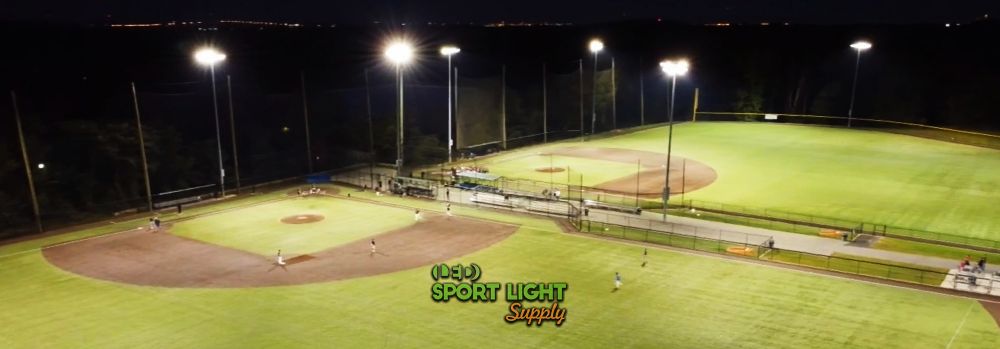
The same principle applies to a baseball field. The lighting system needs to illuminate the infield and outfield, but light extending well beyond the boundary can become unwanted illumination. A tennis court has a smaller playing area, so the challenge is different, but the basic idea remains the same.
Spill light is closely related to light trespass and obtrusive light. DarkSky describes light trespass as light falling where it is not wanted or needed, while glare refers to excessive brightness that can affect visual comfort or performance.
It is also worth separating spill light from sky glow. Light that travels upward can brighten the night sky, while light directed sideways can reach neighboring properties. A poorly controlled sports lighting installation can contribute to both.
Why Does Spill Light Happen?
Stadium spill light rarely comes from a single mistake. In most cases, it is the result of several lighting-design factors working together. The type of luminaire, LED light output, beam angle, optical distribution, mounting height, pole location, aiming angle, surrounding buildings, and operating hours can all influence how much light stays on the playing surface and how much escapes beyond it.
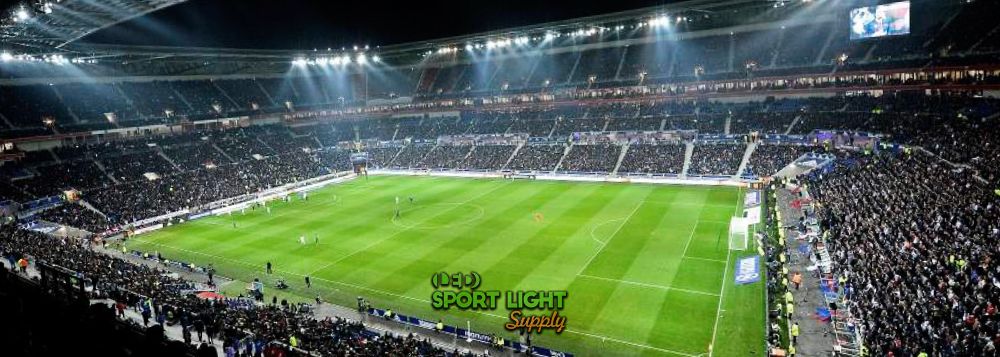
This becomes more noticeable when a sports venue is expected to provide strong illumination for evening competitions. A modern football stadium, for example, may use dozens of high-output LED floodlights to achieve the required illuminance and uniformity across a large pitch. A baseball field, cricket ground, or golf driving range can have similarly demanding coverage requirements. The challenge is that high lighting performance and good spill-light control have to work together. Simply increasing the wattage is not a shortcut to better sports lighting.
High-Output Floodlights and Excessive Light Output
Sports venues need a lot of light for good reason. Players have to see the ball, teammates, opponents, boundaries, and changes in movement without struggling against dark or uneven areas. Spectators also need enough illumination to follow the action, while cameras may require consistent lighting across the field.
Football is a good example. A full-size pitch is roughly 105 × 68 metres under common international dimensions, so the lighting system has a sizeable area to cover. If the luminaires are designed to illuminate such a large surface from the sides or corners, they need enough output and carefully selected beam distributions to reach the middle of the pitch while maintaining acceptable uniformity.
Baseball has a slightly different challenge. The infield and outfield have different lighting requirements, and players may need to track a fast-moving ball against the night sky. Cricket grounds are generally much larger again, meaning floodlights need to distribute light across a broad playing area. Tennis courts are smaller, but players frequently look upward to follow the ball, which makes glare and high-angle brightness particularly noticeable.
The problem starts when lighting output is treated as the only measure of performance. A fixture producing 100,000 lumens is not automatically better than one producing 70,000 lumens if a large portion of that extra light falls outside the target area. Useful illumination is about where the light lands, not simply how much light the fixture produces.
This is why sports lighting designers normally look at factors such as illuminance, uniformity, beam distribution, glare, spill light, and light levels outside the playing area rather than judging a system by wattage alone.
Beam Angles and Optical Distribution
The optical system is one of the biggest pieces of the spill-light puzzle. It controls how the LED light is distributed after it leaves the luminaire. A wide beam can spread light across a large area, while a narrow or asymmetric beam can direct more of the available output toward a specific zone.
For a tennis court, a tightly controlled distribution can help keep light within the court and surrounding playing zone. A cricket ground needs a different optical approach because the target area is much larger. A golf driving range may need a combination of distributions to illuminate hitting positions and target areas without sending excessive light beyond the range.
Asymmetric optics can be particularly useful for sports lighting because they allow the light distribution to be shaped according to the position of the fixture and the geometry of the playing surface. Instead of sending light equally in every direction, the optical design can push more light toward the areas that actually need it.
This is where terms such as beam angle, beam spread, candela distribution, optical control, asymmetric distribution, and photometric performance become more than technical vocabulary. They describe how effectively a sports floodlight turns electrical energy into useful illumination.
For example, two LED floodlights could have a similar lumen output but produce very different results on the ground. One may create a broad pool of light extending well outside the field, while another may concentrate its output more effectively across the playing surface. From the outside, both fixtures may appear similarly powerful. From a photometric perspective, however, they can behave quite differently.
Mounting Height and Pole Location
The height of a sports-lighting pole also affects spill light. It might seem logical that lower fixtures would automatically produce less unwanted light because the distance to the playing surface is shorter. That is not necessarily the case.
When floodlights are mounted higher, designers can sometimes use lower aiming angles to illuminate the field. This can help reduce direct glare and limit how much light travels outside the target area, provided the optics and aiming angles are properly selected.
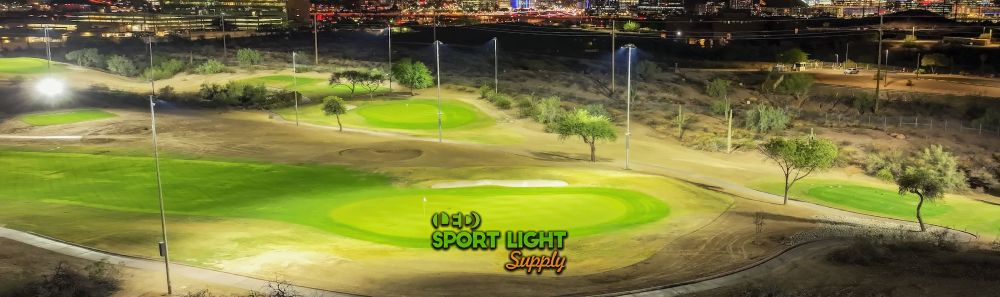
Pole location matters just as much. In a football stadium, fixtures may be positioned around the pitch or integrated into stadium structures. On a baseball field, tall poles are often placed around the outfield and other strategic locations. Tennis courts may use poles close to the court perimeter, while horse arenas and golf facilities can have more open layouts.
The surrounding environment should be considered at the same time. A pole that works perfectly on an isolated sports field may create a very different result when installed 30 or 50 metres from residential windows.
Incorrect Aiming Can Send Light in the Wrong Direction
Even a high-quality sports LED floodlight can create spill light when it is poorly aimed. The fixture may have excellent optics on paper, but if its vertical or horizontal angle is incorrect, the light distribution can shift away from the intended target.
This is why professional sports lighting projects usually involve photometric calculations before installation and aiming adjustments during commissioning. The goal is to make sure the calculated light distribution matches what happens on the actual site.
A few degrees can make a noticeable difference, especially when a powerful fixture is mounted high above the ground. A light aimed slightly too far outward can send a portion of its beam beyond the stadium boundary, potentially increasing light trespass on nearby properties.
On-site aiming should therefore be treated as part of the lighting design rather than simply an installation task. The final position of each luminaire can influence illuminance, uniformity, glare, and spill-light levels at the same time.
Surrounding Buildings and Reflective Surfaces
The sports field itself is not the only thing interacting with the light. Stands, roofs, advertising boards, concrete structures, metal surfaces, and even pale walls can reflect or scatter illumination.
A football stadium with large spectator stands may behave very differently from an open cricket ground. Similarly, a tennis facility surrounded by tall fencing and buildings can have a different nighttime lighting environment from a standalone court.
Reflective surfaces do not necessarily create spill light by themselves, but they can contribute to unwanted brightness in areas that were not part of the original lighting target. During the design stage, it is therefore useful to consider the complete site rather than looking only at the horizontal illuminance on the field.
Operating Hours Also Matter
Spill light is not only about where light goes. It is also about when it is switched on.
A stadium may need high lighting levels during an evening match, but it does not necessarily need competition-level illumination when the venue is empty. Training sessions, maintenance work, cleaning, and local events can have different lighting requirements.
For example, a sports facility operating at full output for four hours during a major event has a very different lighting profile from one running the same system at full power for eight or ten hours every night.
Dimming, zoning, timers, scheduling, and automatic controls can therefore play a useful role. Instead of treating the lighting system as simply “on” or “off,” modern controls can allow the operator to adjust the output to match the activity taking place.
What Effects Can Stadium Spill Light Have?
The effects of spill light depend heavily on the location, size, operating schedule, and surrounding environment of a sports facility. A stadium in the middle of a brightly lit commercial district will present a different situation from a football field located beside a quiet residential neighborhood.
The same goes for golf courses, horse arenas, and cricket grounds. Their large, open surroundings can allow unwanted light to travel farther than it might in a dense urban environment. Looking at the site as a whole gives a much clearer picture of the potential impact.
| Potential Effect | How Spill Light Causes It | Why It Matters |
|---|---|---|
| Light Trespass | Light extends beyond the sports facility and reaches nearby homes, roads, or properties. | Can cause disturbance, especially during evening matches and training. |
| Glare | Bright floodlights are visible from uncomfortable viewing angles. | Can affect players, officials, spectators, and cameras. |
| Environmental Impact | Unwanted light reaches surrounding parks, open land, or natural areas. | Can contribute to sky glow and disturb nighttime environments. |
| Energy Waste | Light is directed toward areas that do not need illumination. | Electricity is consumed without providing useful lighting for the sport. |
| Uneven Visibility | Poorly designed lighting creates overly bright and dark areas. | Can make it harder for players to track the ball and judge movement. |
| Greater Impact on Large Sites | Wide areas such as cricket grounds and golf facilities require extensive light coverage. | Poor beam control can allow unwanted light to travel farther beyond the playing area. |
| Higher Risk Near Homes | Floodlights are installed close to residential properties or windows. | Even moderate spill light can become noticeable in otherwise dark surroundings. |
| Need for Better Design | Incorrect optics, aiming, mounting, or output allow light to escape the target area. | Photometric planning, shielding, precise aiming, and dimming can help control spill light. |
Effects on Nearby Homes and Properties
One of the most obvious forms of light trespass occurs when sports lighting reaches neighboring properties. A football field or baseball diamond may be several dozen metres away from a house, yet powerful floodlights can still be visible through windows or illuminate parts of a garden.
This can be particularly noticeable during late-evening matches or training sessions. Even when the light level is not extremely high, the contrast between a bright floodlit area and a normally dark residential environment can make the illumination feel much stronger.
The issue is not limited to football or baseball. A tennis facility, cricket ground, horse arena, or golf driving range located close to homes can create similar concerns if the luminaires are not properly shielded or aimed.
Good sports lighting design therefore considers the property boundary, not just the boundary of the playing surface. Photometric calculations can be used to estimate light levels at nearby locations and identify areas where additional optical control or shielding may be needed.
Glare for Players and Spectators
Spill light and glare are closely connected, but they are not the same thing. Spill light refers to unwanted illumination outside the intended area, while glare is associated with excessive brightness in a person’s field of view that can reduce visual comfort or make it harder to see.
This distinction matters in sports because players are constantly changing their viewing direction. A tennis player may look upward to follow a high ball. A cricket batter or fielder may need to track a ball through the air. Baseball players can face similar challenges when following a fly ball, while football players may occasionally look toward areas close to powerful floodlights.
For spectators, glare can also make viewing less comfortable, particularly when a luminaire is positioned where it is directly visible from seating areas.
A well-designed system should therefore consider not only the amount of light reaching the playing surface but also the position of bright light sources relative to players, officials, spectators, and cameras.
Effects on the Surrounding Environment
Sports facilities often sit alongside open land, parks, residential neighborhoods, roads, or natural areas. Once powerful lighting is introduced, the nighttime environment around the facility can change considerably.
Uncontrolled outdoor lighting can contribute to sky glow, light trespass, and glare. The effect can be especially visible at venues surrounded by relatively dark areas. A golf course on the edge of a town, for instance, may have a much darker background than a football stadium surrounded by city buildings, making stray illumination easier to notice.
Wildlife can also be a consideration. Many animals are active during the night or use darkness as part of their natural behavior. The degree of impact varies by species, habitat, light level, spectrum, timing, and location, so it is better to avoid broad claims that every sports light installation will cause the same ecological effect.
Instead, site-specific lighting assessment can help identify whether nearby ecological areas require additional controls, reduced operating hours, shielding, or different light characteristics.
Effects on Golf Courses and Large Open Areas
Golf facilities deserve particular attention because their scale can make light management more complicated. A golf driving range may extend hundreds of metres from the hitting area, while a course can cover many hectares.
When lighting is installed for evening practice or other nighttime activities, designers have to think about the entire illuminated zone and what lies beyond it. A beam that extends only a little beyond a tennis court boundary is one thing; the same optical error across a large open golf facility can affect a much larger area.
The open landscape can also make stray light more visible. Nearby houses may have a clear view of elevated floodlights, while surrounding vegetation and natural areas can receive illumination that was never part of the original plan.
Effects on Energy Consumption
Spill light can also represent wasted energy. Every photon travelling toward an area that does not need illumination is part of the electrical energy consumed by the lighting system without providing much useful value to the sporting activity.
LED technology has made sports lighting considerably more controllable and efficient, but LED does not automatically solve the spill-light problem. An efficient LED floodlight that is too powerful, uses the wrong beam distribution, or is aimed incorrectly can still illuminate the wrong place.
For example, reducing a system from 100 kW to 80 kW may lower power consumption, but if the remaining 80 kW is poorly distributed, the underlying lighting problem has not really been solved. A better approach is often to combine appropriate light output with accurate optical control, then use dimming and scheduling to reduce output when full illumination is not required.
This is where lighting efficiency becomes more than a simple wattage calculation. A well-designed system aims to deliver the required illuminance and uniformity with as little unnecessary output as practical.
Why More Light Does Not Always Mean Better Sports Lighting
There is a natural temptation to associate brighter lighting with better visibility. In sports, however, the relationship is more complicated. Players need suitable illuminance, but they also need good uniformity, controlled glare, appropriate contrast, and consistent visibility across the playing area.
Imagine a football pitch where one section is extremely bright while another section is noticeably darker. The average lux level might look acceptable on paper, but players could still experience an uneven visual environment.
The same principle applies to baseball, cricket, tennis, horse arenas, and golf facilities. Lighting quality is a combination of quantity, distribution, uniformity, glare control, and visual comfort.
That is why professional lighting design often focuses on measured values across multiple points on the playing surface rather than relying on one average figure. Depending on the sport and competition level, standards and project specifications may require particular target illuminance and uniformity values, so the design should always be checked against the relevant local and sporting requirements.
Why Spill-Light Control Starts Before Installation
Once a stadium or sports field has been fully installed, correcting spill light can be more complicated than preventing it during the design stage. Changing fixture positions, replacing optics, adding shields, or adjusting poles after construction can add cost and downtime.
During the planning stage, designers can model the proposed floodlights using photometric software. The model can show expected illumination across the playing surface as well as potential light levels outside the field.
This gives the project team an opportunity to compare different mounting heights, beam angles, fixture positions, and shielding options before equipment is permanently installed.
For a football stadium, that might mean testing several floodlight positions around the pitch. For a baseball field, it may involve examining the relationship between infield and outfield lighting. For a tennis court, the focus may be on keeping the beam tightly controlled around the court while minimizing glare. For cricket, horse arenas, and golf facilities, the surrounding open space can be incorporated into the assessment.
In other words, spill-light control works best when it is designed into the lighting system rather than added as a fix afterward. The right combination of LED output, optics, pole height, aiming, shielding, controls, and operating schedules can provide strong sports illumination while keeping unwanted light under much better control.
Spill Light Across Different Sports Facilities
Different sports create different lighting challenges. A football stadium, baseball field, tennis court, cricket ground, horse arena, and golf course all need good visibility, but the shape of the playing area, the movement of athletes, the position of spectators, and the surrounding environment can vary dramatically. As a result, there is no single floodlight layout that works equally well for every venue.
The basic goal remains the same: provide enough illumination where the sport takes place while keeping unwanted light within reasonable limits. Sports lighting should be designed around the venue, not simply around the fixture. A 105 × 68 metre football pitch, a compact tennis court, and a large golf driving range clearly require different approaches to beam distribution, mounting height, aiming, and light control.
| Sports Facility / Topic | Main Spill-Light Challenge | Key Lighting Consideration | Recommended Approach |
|---|---|---|---|
| Football Stadium | Large pitch and nearby homes can be affected by stray light. | Uniformity, glare control, accurate aiming, and beam distribution. | Use precision optics, suitable mounting heights, and careful aiming. |
| Baseball Field | Light can extend beyond the outfield and create glare for players. | Different lighting needs for infield and outfield, plus vertical illumination. | Use controlled beam angles and position floodlights carefully. |
| Tennis Court | Compact playing area makes unwanted light and glare more noticeable. | Players often look upward to track the ball. | Use precise optics and control glare from visible luminaires. |
| Cricket Field | Large open grounds allow light to travel toward roads, homes, and open land. | Wide coverage and visibility of airborne balls. | Balance coverage with controlled beam spread and site-specific design. |
| Horse Arena | Light can reach stables, paddocks, nearby properties, and open fields. | Even illumination and reduced glare. | Use uniform lighting, suitable optics, shielding, and careful fixture placement. |
| Golf Course / Driving Range | Very large areas can allow unwanted light to travel far beyond the target zone. | Long-distance coverage and protection of surrounding dark areas. | Use accurate beam control, aiming, and site planning. |
| Reduce Spill Light | Poor design can send light outside the playing area. | Optics, aiming, mounting height, shielding, and operating hours. | Combine appropriate optics, precise aiming, shields/visors, and dimming controls. |
| Overall Principle | More light does not necessarily mean better lighting. | Light should reach the areas where it is actually needed. | Design around the venue, not simply around the fixture. |
Football Stadiums
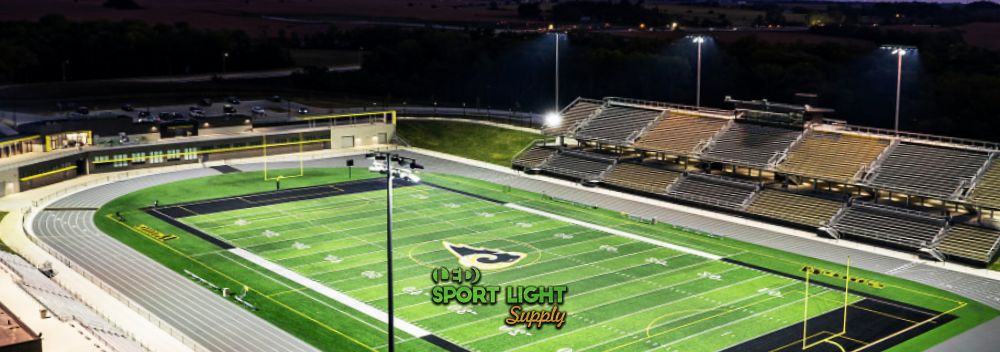
Football pitches are large rectangular playing areas where consistent illumination is needed across the entire field. Players need to see teammates, opponents, and the ball from one end of the pitch to the other, while spectators and cameras also need a clear view of the action.
Floodlights are commonly mounted at considerable heights around the pitch or integrated into stadium structures. This gives lighting designers a good opportunity to direct light downward toward the playing surface, but it also means that a poorly aimed high-output fixture can send light well beyond the stadium boundary.
The surrounding area matters too. A football stadium located in a dense urban district may already have a relatively bright nighttime environment, whereas a local football ground beside houses or open countryside can make spill light much more noticeable. In the second situation, even small amounts of light escaping toward residential windows can become a concern.
Modern football lighting therefore tends to focus on a combination of high uniformity, controlled glare, accurate aiming, and precise beam distribution. The objective is not simply to make the pitch brighter. It is to make sure the required light reaches the pitch without unnecessarily illuminating the areas around it.
A recent example comes from Sportanlage Kall-Sötenich in Germany. In June 2026, the facility became the first European installation to receive DarkSky Approved Outdoor Sports Lighting certification. The project demonstrated how precision lighting can provide suitable illumination for a football field while controlling unwanted light reaching the surrounding community.
Baseball Fields
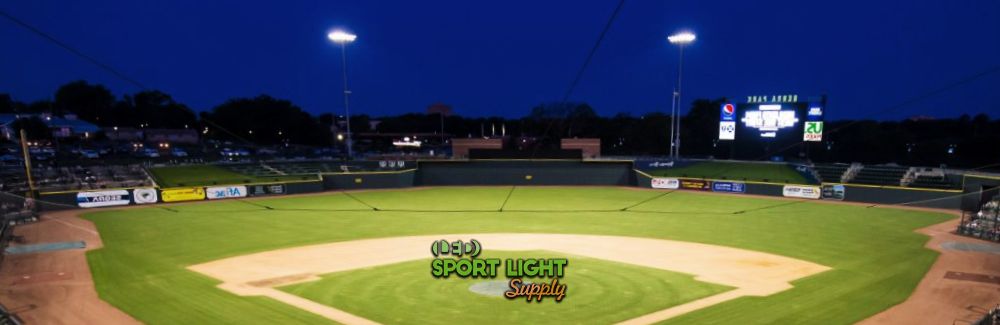
Baseball fields have their own lighting requirements because the playing area is divided into different zones and players may need to follow a ball traveling rapidly through the air. The relationship between the infield, outfield, player positions, and spectator areas makes the lighting layout more complicated than simply placing several floodlights around the boundary.
Tall lighting poles are often used to provide the required coverage. Their height can help distribute light across the field, but fixture aiming becomes particularly important because the outfield can extend a considerable distance from the light sources.
A poorly selected beam angle may send part of the light beyond the outfield, while an overly aggressive aiming angle can increase glare for players or spectators. Designers therefore need to balance horizontal illumination, vertical illumination, uniformity, and glare control rather than looking at average lux levels alone.
The surrounding area should also be considered. If a baseball field is close to homes, roads, or commercial buildings, lighting calculations can help identify whether light is likely to extend beyond the property boundary.
Tennis Courts
Tennis courts are much smaller than football pitches, but that does not necessarily make spill-light control easier. In fact, because the target area is relatively compact, poorly controlled light can become more obvious.
A tennis lighting system needs to provide consistent illumination across the court while allowing players to track the ball comfortably. Players frequently look upward, particularly when dealing with serves, lobs, and high shots, so the position and brightness of luminaires within their field of view deserve careful attention.
If a floodlight has an unnecessarily broad distribution, a considerable amount of light may land outside the court. That light does not improve play, yet it can illuminate neighboring courts, buildings, walkways, or residential properties.
For tennis facilities, precision optics and glare control go hand in hand. The right optical distribution can keep more light focused on the court while appropriate mounting positions and aiming angles help reduce uncomfortable views of the luminaires.
Tennis facilities have also appeared among DarkSky’s certified outdoor sports-lighting projects, demonstrating that responsible lighting design applies to smaller sports venues as well as large stadiums.
Cricket Fields
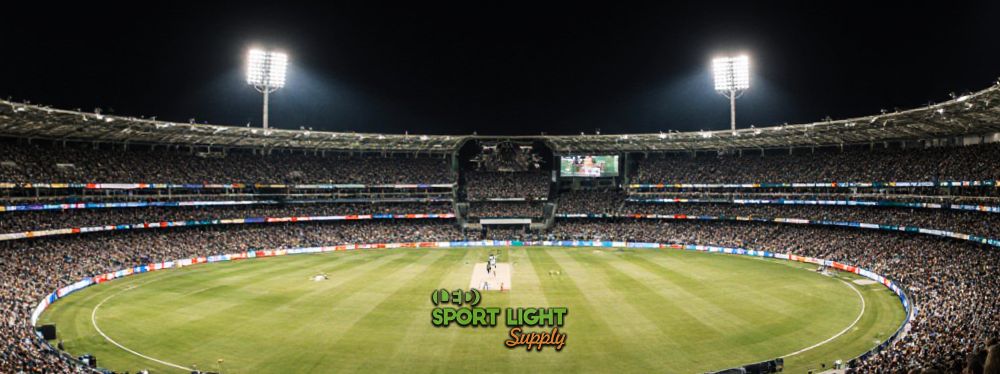
Cricket grounds are generally large, open areas, so providing adequate lighting can involve significant distances between the luminaires and the playing surface. Players need to follow the ball across the field, while spectators and cameras require consistent visibility of the action.
The boundary can become a particular spill-light concern. Floodlights need to illuminate the relevant cricket playing areas, but excessive beam spread can send light toward nearby roads, homes, parking areas, or open land.
Cricket also demonstrates why vertical illumination can matter alongside horizontal illumination. The ball is often airborne, so the visual environment above the playing surface can affect how easily players track it.
A suitable design therefore looks at the entire playing environment rather than treating the cricket pitch as an isolated rectangle. The field, boundary, surrounding property, floodlight positions, and viewing directions all form part of the lighting equation.
Horse Arenas
Horse arenas require a slightly different approach because the goal is not simply to produce a high level of illumination. Riders need clear visibility of the arena surface, obstacles, and movements, while a comfortable visual environment is also desirable for horses and people working around the facility.
Large differences between bright and dark areas can make an arena feel visually harsh. For that reason, designers often pay close attention to uniformity and the avoidance of strong glare.
The surrounding areas should not be forgotten either. An equestrian facility may include stables, paddocks, access roads, parking areas, neighboring properties, and open fields. A floodlight aimed across the arena can unintentionally illuminate some of these spaces.
In horse arenas, controlled and even illumination can be more useful than simply increasing light output. Careful fixture positioning, suitable optics, and shielding can help create a comfortable arena while limiting light beyond the intended area.
Golf Courses and Driving Ranges
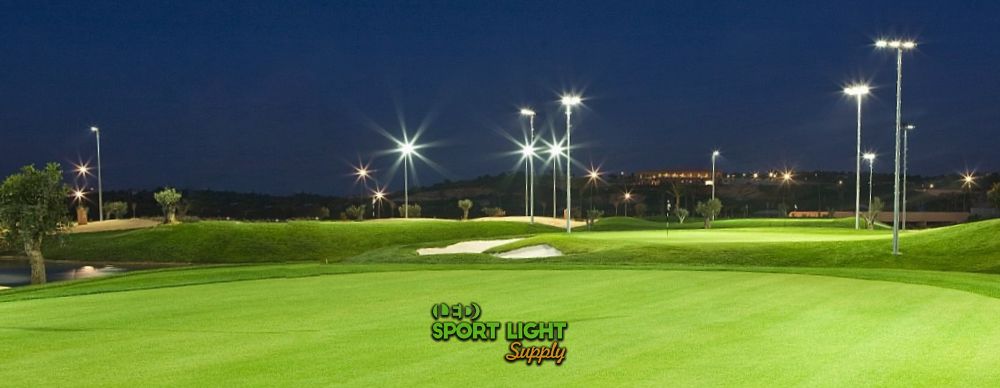
Golf facilities present one of the more unusual spill-light challenges because of their scale. A driving range can stretch hundreds of metres, while a golf course may cover many hectares. Once lighting is introduced for nighttime practice or related activities, the designer has a much larger area to consider.
A driving range needs light to reach the hitting area and target zones without allowing excessive illumination to travel beyond the range. If the beam distribution is too wide or the floodlights are incorrectly aimed, unwanted light can extend into surrounding properties, roads, vegetation, or natural areas.
Golf courses can also be surrounded by relatively dark landscapes. That means stray illumination may be more visible than it would be in a brightly lit urban environment. A small amount of light escaping from a facility can stand out against an otherwise dark horizon.
For golf facilities, the lighting design should therefore consider not only the illuminated area but also what lies beyond it. The larger the site, the more important accurate beam control and site planning become.
How Can Stadium Spill Light Be Reduced?
Reducing spill light starts during the design stage rather than after a facility has already generated complaints. Once poles, luminaires, cables, and other infrastructure are installed, making major changes can be more expensive and disruptive.
A good lighting plan considers the playing surface, fixture positions, mounting heights, beam angles, nearby buildings, property boundaries, viewing directions, environmental surroundings, and operating hours. Photometric modelling can then be used to predict how the proposed system will perform before installation.
Choose Appropriate Optics
The first step is choosing optics that match the actual application. A tennis court needs a different light distribution from a cricket ground, while a football stadium and golf driving range have their own requirements.
Asymmetric optics can direct more of the available output toward the playing surface instead of distributing light equally in every direction. Narrower beam distributions can work well for more concentrated target areas, while carefully selected wider distributions can cover larger fields when the design calls for them.
The key is matching the beam angle and optical distribution to the actual geometry of the venue. Choosing a fixture based only on lumen output can lead to an inefficient design if much of that output ends up outside the target area.
Aim Fixtures Precisely
Even a well-designed luminaire needs to be aimed correctly. A small change in the horizontal or vertical angle can shift the beam and alter both the illumination on the field and the amount of light reaching areas outside it.
Photometric modelling can show the expected light distribution before installation, but real-world commissioning also matters. Buildings, poles, fences, stands, trees, and other site conditions can affect the final result.
After installation, each luminaire should be checked and adjusted according to the lighting plan. This is particularly useful for high-output sports floodlights, where a relatively small aiming error can send a large amount of light away from the intended target.
Use Shields and Visors
Light shields, visors, and other shielding accessories can block part of a luminaire’s output from travelling toward unwanted areas. They can be particularly helpful where a sports facility is close to residential buildings, roads, woodland, or other sensitive locations.
For example, a football floodlight may illuminate the pitch correctly while still producing a portion of its beam toward nearby houses. A suitable visor or shield can restrict that part of the distribution without necessarily reducing the useful light reaching the playing surface.
However, shielding should not be used as a substitute for good optical design. The best results usually come from combining the right optic, correct aiming, suitable mounting, and shielding where necessary.
Add Dimming and Lighting Controls
Sports facilities do not necessarily need maximum illumination every time the lights are switched on. A professional match, evening training session, maintenance period, and empty stadium can have very different lighting requirements.
Modern LED sports-lighting systems can be combined with dimming and control systems to adjust output according to the activity. A facility might operate at a higher level during a competition, reduce output during training, and switch the lights off completely when the venue is no longer in use.
Scheduling can also help prevent lights from remaining on unnecessarily after an event. If a facility operates for four hours on an evening, for example, there is little reason to keep competition-level lighting running for another three hours when the site is empty.
This approach can reduce both unwanted illumination and electricity consumption. It also gives facility operators more flexibility without requiring them to compromise the lighting quality needed during actual sporting activities.
Questions and Answers About Stadium Spill Light
What Is the Difference Between Spill Light, Glare, and Light Pollution?
Although these terms are often used interchangeably, they describe different aspects of outdoor lighting.
Spill light is light that extends beyond the area where illumination is intended. For example, if a football floodlight is designed to illuminate the pitch but also lights up the windows of a nearby house, the unwanted illumination reaching the property can be described as spill light or light trespass.
Glare relates more closely to visual discomfort or difficulty seeing caused by excessive brightness or the position of a bright light source. A tennis player looking toward a visible floodlight while tracking a high ball may experience glare even if the light is not technically falling outside the sports facility.
Light pollution is a broader term covering unwanted or excessive artificial light in the nighttime environment. It can include sky glow, light trespass, glare, and other forms of obtrusive illumination.
The three can occur together, but they are not identical. Understanding the difference helps designers select the right solution, whether that means changing the optical distribution, adjusting the aiming angle, adding shielding, reducing brightness, or changing the operating schedule.
How Much Spill Light Is Acceptable?
There is no single number that applies to every sports facility. Acceptable levels can depend on local regulations, planning conditions, environmental sensitivity, surrounding land use, and the type of sports venue.
For a football stadium beside residential properties, the lighting assessment may need to pay close attention to vertical illuminance at nearby windows. A golf facility surrounded by dark countryside may have different considerations, while a tennis facility in a dense urban area may have higher levels of existing ambient light.
This is why lighting projects should be checked against the applicable local standards and project requirements rather than relying on a universal spill-light number.
Can LED Sports Lights Eliminate Spill Light?
Not completely. LED technology can provide much better optical and control options than many older lighting systems, but an LED floodlight can still create spill light if it is too powerful, poorly aimed, or equipped with an unsuitable beam distribution.
Think of LED as a highly controllable lighting technology rather than a magic spill-light eraser. The luminaire, optic, installation angle, mounting height, shielding, and control strategy all matter.
Can Higher Poles Reduce Spill Light?
They can in some designs, but pole height should not be considered in isolation. A higher mounting position can allow designers to use lower aiming angles, which may help reduce glare and unwanted light when the optics and layout are properly designed.
However, increasing pole height without reviewing the entire photometric design can create other problems. The best mounting height depends on the venue, surrounding environment, fixture characteristics, required illuminance, and local constraints.
Does Reducing Lumens Always Reduce Spill Light?
Reducing output can reduce unwanted illumination, but it is not always the most effective solution. If a football pitch needs a particular level of illumination and the system is already struggling with uniformity, simply turning everything down may create dark areas on the field.
A better approach can be to improve the distribution first. Changing the optics, adjusting fixture positions, refining aiming angles, adding shielding, and using targeted dimming can sometimes reduce spill light while maintaining suitable illumination where it is actually needed.
How Can a Sports Facility Check for Spill Light?
A professional assessment normally starts with a photometric model showing predicted illumination across the playing area and surrounding zones. Measurements can then be taken after installation to compare actual performance with the design.
Depending on the project, measurements may consider horizontal illuminance on the playing surface, vertical illuminance, uniformity, glare, and light levels at or beyond the site boundary. For facilities close to homes or environmentally sensitive areas, these additional measurements can provide a clearer picture of whether unwanted light is reaching surrounding locations.
Can Spill Light Be Fixed After the Lights Are Installed?
Yes, in many cases, although prevention during the design stage is usually easier. Existing installations can sometimes be improved by changing aiming angles, replacing optics, adding visors or shields, adjusting lighting levels, or introducing better controls.
If the underlying problem is caused by fixture locations or an unsuitable lighting layout, however, more substantial changes may be needed. That is why photometric planning before installation can save both time and money later.
What Is the Best Way to Control Spill Light at a Sports Facility?
There is no single magic fix. The strongest approach is usually a combination of suitable optics, accurate fixture positioning, correct aiming, appropriate mounting height, shielding, and lighting controls.
The exact combination will depend on whether the venue is a football stadium, baseball field, tennis court, cricket ground, horse arena, or golf facility. A well-designed system should meet the visual requirements of the sport while also considering neighboring properties, roads, natural areas, operating hours, and the wider nighttime environment.
Lighting the Game Without Lighting Everything Around It
Spill light is an unavoidable topic whenever a large outdoor area needs strong illumination after dark, but it does not have to be an unavoidable problem. Football stadiums, baseball fields, tennis courts, cricket grounds, horse arenas, and golf facilities all have different layouts and visual requirements, yet they share the same basic lighting challenge: put useful light where people need it and keep unwanted light out of the places where they do not.
With better optics, careful aiming, suitable mounting positions, shielding, photometric planning, and smart controls, sports facilities can create bright, comfortable playing environments while reducing light trespass, glare, sky glow, and unnecessary energy use. The result is a lighting system that works for athletes and spectators without turning the surrounding neighborhood or landscape into an accidental extension of the stadium.