
Race tracks look pretty wild at night, right? Those long straightaways glowing under clean white light, corners popping with visibility, pits buzzing with activity. Behind that smooth experience is a whole system of lighting rules and design choices that keep drivers, crews, and spectators able to see what they need while staying safe. The setup isn’t just about throwing bright lamps around; it’s a blend of standards, layout, tech choices, and a bunch of decisions that need to work together. The following walk-through dives into race track lighting standards from a more down-to-earth angle, touching on how everything fits together and what helps make a setup feel solid.
The main goal of lighting a race track is to give everyone on-site—drivers, pit crews, marshals, photographers, TV crews, and spectators—a clean, steady view of what’s happening. When cars are flying down a straight at 150–200 mph, even a tiny dip in brightness or a sudden dark patch can throw off a driver’s rhythm. Racing drivers rely heavily on visual cues like braking markers, apex points, track textures, safety boards, and flag signals. If the lighting doesn’t hold up, those cues get harder to read, and every fraction of a second starts to feel unpredictable.
That’s why tracks aim for consistent, stable visibility, not just raw brightness. The goal is to avoid those “weird shadows” or harsh transitions where cars move from a bright zone into a dimmer area. Smooth lighting along the entire racing line helps drivers maintain confidence, especially during night races or endurance events where fatigue is already a factor.
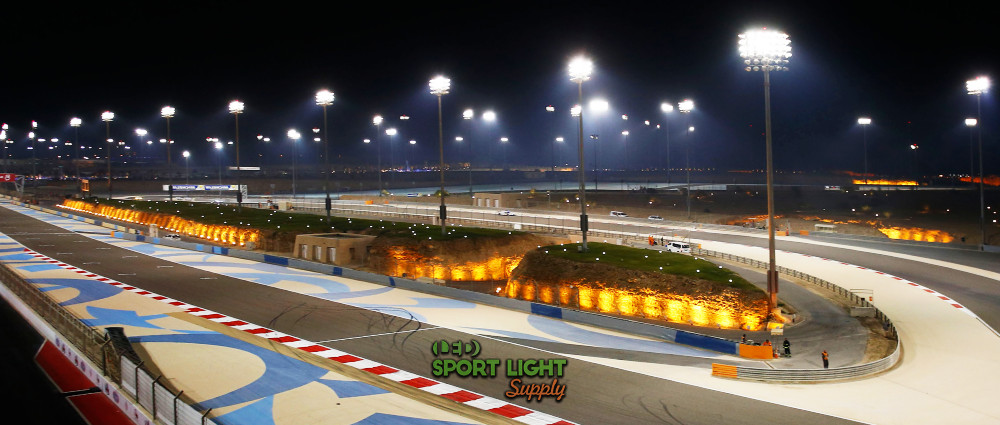
A typical circuit might have 10 to 25 turns, each with different entry angles, elevation shifts, and runoff areas. Lighting has to cover all of that in a way that feels natural at race pace. When drivers flick their eyes between the apex, mirrors, and dashboard at high speeds, they shouldn’t be fighting glare or sudden glare reflections from wet asphalt or glossy curbs.
Corners, braking zones, and chicanes often require even more precise lighting than long straights because drivers spend more time adjusting their line through these sections. A lighting dip of even 50 lux in a fast corner can affect how quickly a driver reads the track surface or notices something like tire debris or gravel dragged onto the racing line.
The pit lane is another zone that demands extra attention. Pit crews often work under time pressures measured in seconds, so strong, clean lighting makes a real difference in how well they can spot tools, hand signals, or minor issues during a stop.
Modern motorsport relies heavily on TV coverage, with high-frame-rate cameras sometimes shooting at 120–240 fps or higher. If the lighting system flickers even slightly, it shows up instantly on slow-motion replays or helmet-cam footage. That’s why high-end circuits aim for flicker-free performance and color stability across every fixture.
Good lighting also makes car liveries look sharp on screen. A race where each car’s colors pop cleanly doesn’t just look nicer—it helps commentators, spotters, and fans track position changes more easily. And because many sponsors judge their visibility based on broadcast clarity, lighting becomes part of the event’s commercial backbone too.
When something goes wrong on track—like a spin, a stalled engine, or debris after a collision—marshals need to react fast. They have to see surface conditions clearly, spot oil streaks, identify the exact position of a stopped car, and communicate with race control. Good lighting helps reveal those subtle details that might otherwise blend into the background, especially on darker asphalt or in fast-moving shadows.
Even small reflective objects, like a loose wheel nut or broken carbon piece, can cause huge problems if cars hit them at racing speed. Strong vertical lighting, usually around 300 to 700 lux, helps marshals see those hazards without having to move dangerously close to the track.
Pit crews also benefit from bright, even lighting. Under pressure, with engines roaring and radios buzzing, nobody wants to deal with glare bouncing off helmets or shadows hiding crucial components. The right setup lets them work quickly without feeling blinded or strained, keeping operations running smoothly throughout the race.
At a packed event, thousands of people rely on the lighting to move safely around the venue. Spectators need clear pathways. Photographers need good angles without lens flare. Even during track walks or inspection laps, teams look for details like tire marks or patches of rubber buildup, and lighting helps reveal those.
Everything ties back to building a safe and functional environment for everyone sharing the space, from world-class drivers to first-time fans. When the lighting does its job well, most people don’t even think about it—it just feels natural, smooth, and ready for racing.
Lighting standards for race tracks usually talk about both horizontal illuminance and vertical illuminance, and both matter way more than people think. Horizontal illuminance refers to how much light hits the track surface itself, which affects how clearly drivers see textures, braking zones, debris, tire marks, and even subtle grip changes. Vertical illuminance is all about how well-lit cars, flags, marshals, signs, and other upright objects appear when viewed head-on. Drivers don’t just look at the road—they’re constantly checking references around and ahead of them—so both lighting directions have real value.
Most professional-grade tracks aim for 500 to 1000 lux (about 46 to 93 footcandles) horizontally, depending on the racing category. Formula-style racing, for example, leans toward the higher end because the speeds are more extreme. Vertical lighting often sits around 300 to 700 lux (28 to 65 fc), especially in spots where cameras record or where drivers need extra detail. Those numbers aren’t pulled out of thin air—they’re designed to give consistent visibility whether a car is diving into a turn at full speed or blasting down a straight past broadcast cameras.
Having that balance between horizontal and vertical illumination helps reduce visual strain and gives drivers a steady sense of depth and distance, which becomes pretty crucial at 180–200 mph.
Not all sections of a track need the same kind of lighting. Straightaways benefit from clean, steady brightness without pockets of shadow. Drivers on a straight are mostly focusing far ahead, so uniform lighting helps them judge distance and closing speeds without sudden brightness dips.
Corners, on the other hand, need more nuanced lighting because the car’s orientation changes constantly. As drivers turn in, they scan the apex, exit, and track edge in just a split second. This is why corners often need 20–30% more lighting—especially vertical lighting—to highlight car shapes, curbs, marshal posts, and signage at odd angles.
High-speed corners, like those found on GP circuits, also demand higher illuminance because drivers approach them at speeds where reaction time is already squeezed. A little extra lighting in these zones offers smoother transitions and more readable visual cues.
Uniformity is all about how even the lighting feels across the circuit. When one section sits at 1000 lux and the next drops to 300 lux, drivers’ eyes constantly have to readjust, which is tiring and can slow reaction times. Good race track design pushes for a uniformity ratio in the 0.5 to 0.7 range.
A ratio closer to 1.0 would mean the entire track is evenly lit, but that’s tough to achieve with large outdoor circuits. Still, the smoother the lighting, the more “natural” the track feels during night racing. Spectators and broadcasters benefit from this too—cars remain clearly visible no matter where they are on the circuit, which improves viewing quality and replay footage.
Glare is a nightmare for drivers. At speeds over 220 km/h, even a brief flash or hot spot from a poorly aimed light can disrupt focus. Modern LEDs do a much better job controlling glare compared to older metal halide systems, but aiming angles, shielding, and height still matter a ton. Lights should illuminate the racing line without blasting drivers in the eyes as they approach.
Flicker matters just as much, especially with today’s high-end broadcasting. Cameras running at 240 fps or higher will expose even slight flicker, causing weird banding in slow-motion shots. That’s why quality LED drivers target flicker rates under 1%, creating stable, smooth lighting that holds up in replays, onboard cams, and drone shots.
Color rendering index (CRI) measures how accurately colors appear under a light source, and race tracks typically aim for a CRI of 80 or higher. That doesn’t just make the track look good; it makes racing safer. Flags need to be instantly recognizable, especially during yellow flags, red flags, or safety car signals. Car liveries, sponsor decals, pit crew uniforms, and safety signage all appear clearer when the lighting has strong color accuracy.
Lower CRI lighting can make certain colors look muted or muddy. Under that kind of lighting, a marshal waving a red flag or a piece of debris on the track might not pop visually the way it should. Higher CRI gives both drivers and cameras a clearer, more natural view of everything happening on the circuit, which supports both racing action and audience experience.
| Category | Typical Values |
|---|---|
| Horizontal Illuminance | 500–1000 lux (46–93 fc) |
| Vertical Illuminance | 300–700 lux (28–65 fc) |
| Corner Illuminance Increase | +20–30% vs. straightaways |
| Uniformity Ratio | 0.5–0.7 |
| CRI (Color Rendering Index) | ≥80 |
| Flicker | <1% |
Track layout shapes nearly every decision in a lighting plan, and it’s something designers can’t shortcut. A straight section usually calls for long, clean lighting beams that stretch across several hundred meters without dropping off. Drivers on a straight are looking far ahead—sometimes 300 meters or more—so the lighting needs to stay smooth and steady, giving them a clear view of braking boards, cars ahead, and the racing line.
Curves are a whole different story. Because cars rotate and drivers shift their focus quickly from entry to apex to exit, the beams must overlap in a way that feels seamless. Good corner lighting follows the driver’s visual flow, almost wrapping around the bend so the road never “disappears” into dimness. On tighter turns, designers often bump up vertical lighting to make sure guardrails, curbs, and apex markers pop clearly at all angles.
Pit lanes are lit even brighter—often 1000 lux or more—because crews need to see everything instantly during high-pressure stops. A small shadow on a tire gun, a missed hand signal, or a mechanic not noticing a loose cable can cost precious seconds. The lighting in the pit area usually comes from higher angles or mounted structures to avoid blinding reflections on helmets and glossy bodywork.
Spectator zones usually get softer illumination, since harsh lighting can distract from the track action. Visitors should be able to move safely through walkways, stands, and food areas without the lighting spilling aggressively onto the racing surface.
The circuit itself introduces plenty of challenges too. Overpasses and bridges often create shadow pockets if the lighting angles aren’t dialed in just right. Tracks with elevation changes—like uphill braking zones or downhill sweepers—need adjusted aiming angles to avoid dark spots. Even safety barriers matter: white-painted walls reflect more light than darker ones, so designers sometimes tweak intensities to avoid excessive bounce-back glare.
Pole placement isn’t just a technical calculation; it’s a blend of geometry, beam physics, and a good eye for coverage. Designers look at how wide each section is, how high poles need to be to clear grandstands or fencing, and what angle gives the best coverage without causing glare. Most major circuits use pole heights in the 18 to 30-meter range because that elevation spreads the light wider and reduces the chance of hot spots.
The number of poles varies hugely depending on the layout. A compact circuit might get away with 40 to 60 poles, while a long international-grade track can exceed 200 poles once you count straights, curves, pits, and spectator zones. It’s pretty normal for corners to have more poles at tighter spacing because they need more precise lighting coverage. Long straights, by contrast, can put poles farther apart since the beams stretch along a flatter line.
Poles almost always sit outside runoff areas, both for safety and regulations. You don’t want anything solid near the zone where cars might slide off. The spacing is usually staggered instead of symmetrical, letting beams overlap gradually so the lighting feels clean rather than striped or patchy.
Designers also consider maintenance access. Poles might look static, but workers still need to reach fixtures for cleanings, angle adjustments, and replacements. Tracks that overlook this end up with beautiful lighting on paper but tough logistics once racing season kicks in.
Lighting performance is only one part of the equation—compliance and structural reliability matter just as much. Most circuits follow motorsport standards inspired by FIA guidelines or regional equivalents, which define requirements for brightness levels, uniformity ratios, glare control, and emergency lighting. These rules exist because lighting directly affects driver visibility, flag recognition, and even how well safety cars and marshals are seen at night.
Beyond the visual standards, there’s the structural side. Poles need to handle strong winds, rainstorms, and continuous vibration from cars hitting rumble strips or blasting past at high speed. A race weekend exposes fixtures to more shaking and resonance than a typical outdoor light might face in months, so durability isn’t something that can be skimped on.
Electrical design also builds in redundancy. Circuits often use multiple power feeds so if one fails, the track doesn’t suddenly plunge into darkness. Backup systems ensure at least partial illumination stays active while the main circuits recover. Emergency lighting needs to switch on instantly and cover escape paths, service roads, and critical areas without missing a beat.
Creating a solid lighting layout for a race track is about more than meeting numbers on a spec sheet. It’s about thinking the way a driver thinks, seeing the track the way a pit crew sees it, and planning the system so it stays reliable even with cars shaking the ground at full throttle. A good layout feels natural, smooth, and predictable—and a lot of that comes from understanding how light interacts with speed, angles, and movement.
One of the biggest keys to a smooth lighting experience is imagining what the track looks like at race pace. When a driver is doing 180 mph down a straight, their eyes are constantly adjusting between the road ahead, their mirrors, and their braking markers. If your lighting creates sudden jumps from bright to dark, the driver’s eyes have to work overtime, and that can mess with rhythm and timing.
Smooth transitions between illuminated sections reduce the visual “shock” on the eyes. Lighting that flows in the same direction as the race line also helps a lot. You don’t want fixtures shooting light straight into a driver’s field of view, especially when they’re entering a braking zone. A little beam alignment goes a long way in keeping the racing line readable and comfortable.
High-quality LED fixtures make a noticeable difference in how long the system stays stable. LEDs on racetracks run for long hours, often at full power, and the heat they generate can shorten their lifespan if the fixture doesn’t cool properly. Strong heat dissipation isn’t just a nice feature—it helps prevent failures during the season.
Tracks usually mount fixtures at serious height—sometimes 20 to 25 meters up—so you really don’t want to be sending a crew up there every other month. Better fixtures mean fewer repairs and far less downtime, which is huge for venues that host multiple racing categories or nighttime events.
Before any poles get installed, designers usually run a full 3D lighting simulation. This step saves a lot of headache later. With simulation software, you can test how light behaves in tricky corners, figure out where hotspots appear, and identify areas that might end up too dim.
Shadows, glare lines, uneven brightness—these things become obvious in a digital model long before construction begins. A small aiming adjustment—sometimes just 2 or 3 degrees—can completely fix a dark patch on a corner exit. Simulation helps the entire setup feel polished and intentional once installed.
Lighting tech improves pretty quickly. A setup installed today might need upgrades in a few years to handle sharper broadcast cameras, higher frame rates, or even adaptive lighting systems that respond to race events. Designing with future upgrades in mind saves a ton of time and money later.
Good infrastructure means having LED drivers that support dimming, zoning, and remote monitoring. Remote diagnostics let teams spot early signs of fixture failure or power irregularities before they affect a race weekend. Wiring paths and control cabinets should also have extra capacity so adding new zones or swapping out old modules is straightforward.
Even the best lighting systems need upkeep. Dust, exhaust residue, pollen, and moisture can collect on lenses and reduce brightness by 5–10%, which adds up fast when you have dozens or hundreds of fixtures. A smart design includes access routes for lifts or maintenance equipment so crews can clean, inspect, or replace fixtures safely.
Scheduled maintenance—done during off-season or between big events—keeps light levels consistent and helps catch alignment issues early. It’s pretty common for fixtures to drift slightly after months of vibration from racing, so checking alignment is just as important as cleaning.
A thoughtful maintenance plan means the lighting stays smooth and steady event after event, without sudden surprises during a race weekend.
Putting all of this together—driver-friendly angles, reliable fixtures, smart simulations, future-ready wiring, and practical maintenance access—creates a lighting layout that feels cohesive and steady. When everything works in harmony, drivers get clean sightlines, spectators get a crisp view of the action, and broadcast crews capture stunning shots without worrying about flicker or dark patches.
A good lighting system doesn’t call attention to itself—it just makes the racing experience feel sharp, smooth, and fully alive under the lights.
Good race track lighting blends standards, layout strategy, and solid design choices into one coherent system. The mix of horizontal and vertical illuminance, thoughtful pole placement, glare control, uniformity, and color accuracy all help give drivers and spectators a consistent experience. When everything works together, a night race feels smooth, sharp, and almost natural—even though thousands of lumens of engineered light are shaping what everyone sees. A well-planned setup doesn’t just meet the numbers; it gives the track its character and keeps every moment clear and engaging.