
Pickleball doesn’t slow down when the sun goes down. In fact, many of the busiest courts come alive after work hours, when players want one more game before heading home. Good lighting makes that possible. Bad lighting makes players miss easy shots, lose track of the ball, or just call it a night early. Thoughtful lighting design keeps games flowing, protects players’ eyes, and makes a court feel welcoming instead of harsh.
Designing lighting for a pickleball court is not just about adding brighter fixtures. It’s about placement, angles, color, and how all those details work together. When done right, players barely notice the lights at all. They just play.
Understanding Pickleball’s Unique Lighting Needs
A small court with a fast-paced personality
Pickleball courts are compact, but the game moves fast and keeps the ball low. Most rallies happen below 8 feet, often right at eye level, which makes lighting quality stand out more than on many other sports courts. When visibility isn’t consistent, players struggle to track the ball and rallies break down quickly.
Quick reactions are a big part of the game, especially at the net. Even a slight delay in how the ball is seen can throw off timing. That’s why courts that look “bright enough” on paper don’t always feel comfortable once play starts.
Why glare and uneven light show up so easily
Unlike tennis, where balls arc high into the air, pickleball rallies stay flat. Players track the ball horizontally, putting their eyes directly in line with poorly aimed lights. Even small aiming mistakes can cause glare during serves or overheads. Players may not call it glare, but they notice missed shots or brief moments where the ball disappears.
Uneven brightness creates the same problem. A drop from 300 lux to 150 lux across the court forces constant eye adjustment, leading to fatigue during longer sessions.
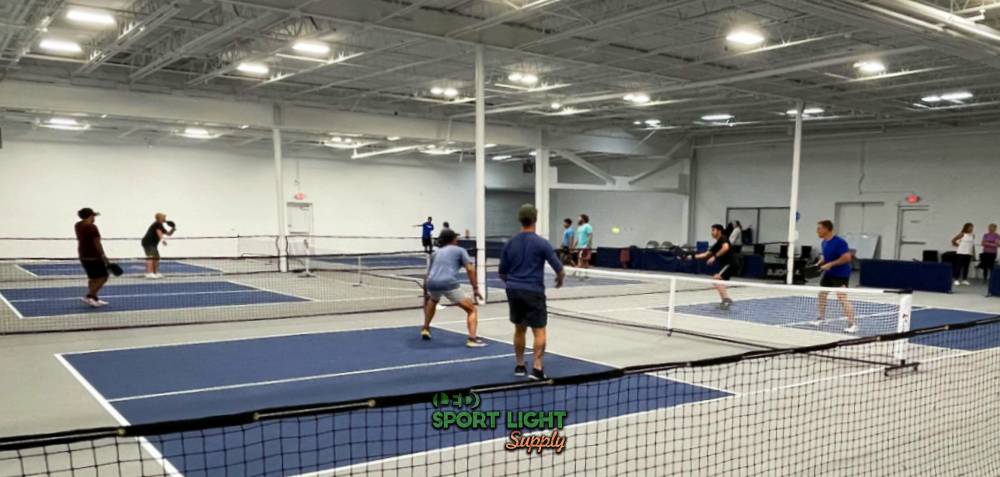
Court size and coverage challenges
A standard court measures 20 by 44 feet, but lighting has to cover run-off areas too. In multi-court layouts, courts are often only 8 to 10 feet apart, so spill light and overlap need careful control. Pole height, spacing, and beam angle all affect whether corners feel clear or dim.
What players really want
Players don’t think in lux or beam angles. They just want the ball to look the same wherever it goes, with no harsh glare or dark spots. When lighting is done well, no one talks about it at all. They just keep playing, long after the sun goes down.
Lighting Standards and Recommended Levels
How bright is “bright enough” for pickleball?
Lighting levels for pickleball courts are usually measured in lux or foot-candles, and while the numbers look technical, the feeling on court is what really matters. For casual recreational play, many parks and community courts target around 200 lux, which is roughly 20 foot-candles. That level works well for relaxed evening games where players are familiar with each other and the pace stays friendly.
Once you move into league play or more competitive settings, that number tends to climb. Courts in the 300 to 500 lux range generally feel sharper and more responsive, especially during faster rallies at the net. Players track the ball more easily, and depth perception improves when reacting to quick shots near the baseline. Some showcase venues or facilities designed for filming may go even higher, but piling on brightness doesn’t automatically improve play. Past a certain point, extra light can actually make glare and eye fatigue worse.
The sweet spot is enough light to make the ball pop against the court surface, without making players squint or constantly adjust their vision.
| Item | Typical Range / Value |
|---|---|
| Recreational play brightness | ~200 lux (20 foot-candles) |
| League / competitive play | 300 to 500 lux |
| Common uniformity ratio | ~1.5 : 1 |
| Preferred color temperature | 4000K to 5000K |
| Typical pole height | 25 to 30 feet |
| Recommended CRI | 70 or higher |
| Common ball tracking height | Below 8 feet |
Why uniformity matters as much as brightness
Brightness alone doesn’t tell the full story. A court with strong lighting on one side and weaker lighting on the other can feel uncomfortable almost immediately. If players move from a 400-lux area into a 150-lux zone during a rally, their eyes are forced to keep adapting. Over the course of an hour or two, that adds up to noticeable fatigue.
That’s where uniformity ratios come in. Many well-designed pickleball courts aim for a uniformity ratio close to 1.5 to 1, meaning the brightest and dimmest areas are not dramatically different. When lighting feels even from baseline to baseline and sideline to sideline, players stop thinking about visibility and focus entirely on the game.
Consistent light makes rallies feel smoother, even if the overall brightness isn’t extremely high.
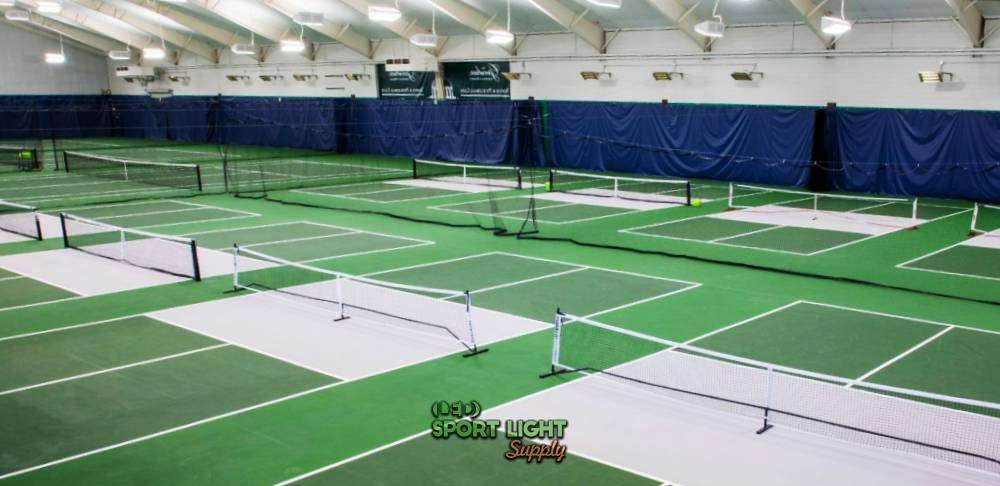
Anti-glare considerations that players really notice
Glare is one of the quickest ways to turn a good court into a frustrating one. Direct glare happens when a player can see the light source itself, often during a serve, overhead, or high return. Reflected glare shows up when light bounces off glossy court coatings, nearby fences, or even light-colored walls.
Modern LED fixtures with proper shielding, visors, and sharp cutoff optics help control this problem. Instead of throwing light in every direction, they aim it precisely where play happens. In real-world use, a lower glare rating often improves play more than adding extra fixtures.
Players may not use technical terms, but they’ll say things like “the lights don’t get in my eyes” or “I can see the ball the whole way.” That’s glare control doing its job.
Color temperature and how it affects visibility
Color temperature plays a big role in how comfortable a court feels at night. Most pickleball courts perform best in the 4000K to 5000K range, which looks similar to natural daylight. At this level, the ball stands out clearly against both darker and lighter court surfaces.
Warmer lighting, closer to 3000K, can feel pleasant but sometimes reduces contrast, especially with yellow or neon balls. Cooler lighting above 5000K can boost sharpness, but if pushed too far, it starts to feel harsh and artificial. That’s when players complain that the court feels “too bright” even if the lux levels are reasonable.
The goal is a neutral, clean look that stays easy on the eyes during long sessions.
Beam angle and light distribution across the court
Beam angle determines how light spreads from each fixture, and it has a huge impact on how even the court feels. Narrow beam angles are often paired with taller poles, around 25 to 30 feet, to push light deeper across the playing area. Wider beam angles help fill in side zones and reduce dark edges.
Using the right combination prevents bright circles directly under poles and dim patches near the corners. Good distribution makes the court feel larger and more balanced, even though the actual dimensions stay the same.
Beam control also helps limit spill light, which matters when courts sit near homes, walkways, or other sports areas.
Other technical parameters that affect comfort over time
Some lighting details don’t jump out on day one, but players feel them after a few weeks of regular play. Flicker is a good example. Poor-quality drivers can create subtle flicker that causes eye strain, even if it’s not obvious at first glance. High-quality LED drivers keep output stable and comfortable.
Color rendering index, or CRI, also plays a role. A CRI above 70 is usually enough for pickleball, helping players judge ball speed and spin more naturally. Higher CRI values can feel even better, especially under competitive lighting conditions.
Pickleball Court Lighting Layout Strategies
Why layout decisions matter more than the fixtures themselves
Lighting layout is where good design quietly does its job or completely misses the mark. Two courts can use the exact same LED fixtures and still feel totally different to play on, simply because of how those lights are positioned. Mounting height, spacing, aiming angles, and court orientation all work together. When one of those elements is off, players notice right away, even if they can’t quite explain why.
A well-planned layout spreads light evenly, keeps glare out of sightlines, and makes the court feel comfortable from the first serve to the last point.
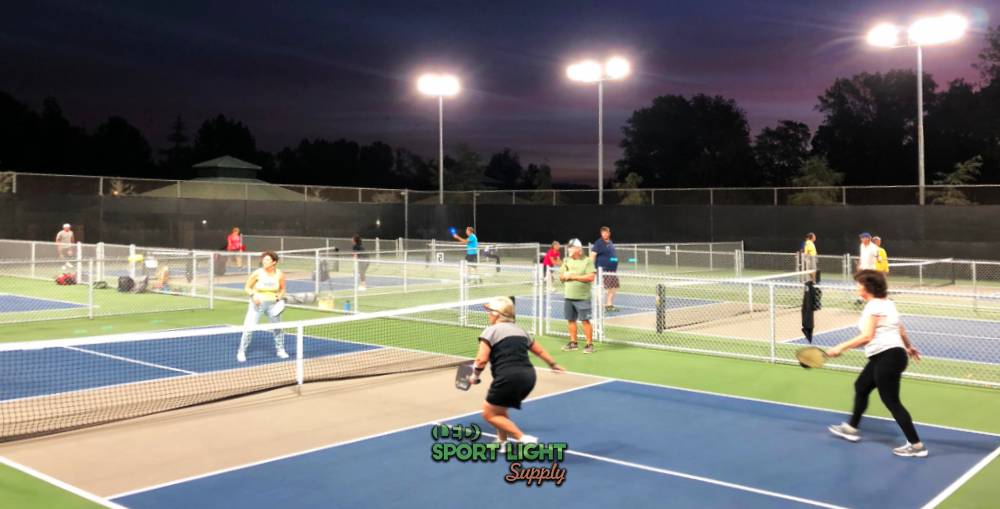
Pole height and how it shapes the light on court
Pole height is one of the first decisions that affects everything else. Many outdoor pickleball courts use poles between 20 and 30 feet tall. Taller poles allow light to reach the court at a softer angle, which helps reduce direct glare and smooth out shadows. With heights around 25 feet or more, fewer fixtures can often cover the same area more evenly.
Shorter poles, such as 15 to 18 feet, can still work, especially in locations with height restrictions. The tradeoff is that the light hits the court more steeply, which increases the chance of glare and dark patches. To compensate, designers often add more fixtures and rely heavily on precise aiming and beam control. It’s doable, but the margin for error gets smaller.
Single-court layouts and balanced coverage
For a single pickleball court, four-pole layouts are widely used for a reason. Poles are placed outside the sidelines and baselines, usually several feet beyond the fencing if space allows. This setup lets light come in from multiple directions, which softens shadows and keeps brightness more consistent across the entire playing area.
Four-pole layouts also make it easier to manage glare, since no single fixture has to carry the full load. Light overlaps gently in the center of the court instead of creating harsh hotspots under each pole.
Two-pole layouts are sometimes used when space is tight or budgets are limited. These typically place poles along the sidelines or behind the baselines. While they can work, they usually require higher mounting heights, narrower beam angles, and carefully selected optics. Without that extra attention, two-pole systems are more likely to produce uneven lighting or glare during serves and overhead shots.
Multi-court facilities and shared lighting systems
Multi-court pickleball complexes introduce another level of planning. Courts are often placed side by side with limited spacing, sometimes as little as 8 feet apart. Shared poles between courts can lower installation costs and reduce visual clutter, but spacing and aiming become even more sensitive.
Light from one court needs to overlap just enough with the next to keep uniformity smooth, without overpowering neighboring playing surfaces. If overlap is too weak, players notice dark seams between courts. If it’s too strong, one court may feel noticeably brighter than the others.
In these setups, photometric planning becomes especially valuable. Small adjustments in pole placement or beam angle can change how three or four courts feel at once.
Court orientation and natural light considerations
Court orientation affects lighting more than many people expect. Aligning courts north to south is a common choice because it reduces direct sun glare during early morning and late afternoon play. When natural light behaves predictably, artificial lighting doesn’t have to fight extreme contrast during dusk hours.
East-west orientations can still work, but they often require extra attention to glare control, especially as the sun sets behind one end of the court. In those cases, lighting layouts may need higher poles or more aggressive shielding to keep visibility comfortable during the transition from daylight to evening play.
| Item | Typical Value / Range |
|---|---|
| Common pole height | 20 to 30 ft |
| Short pole range | 15 to 18 ft |
| Typical spacing between courts | ~8 ft |
| Common single-court layout | 4 poles |
| Minimum poles used | 2 poles |
| Preferred court orientation | North to South |
Glare, Shadows, and Spill Light
How glare quietly changes the way people play
Glare does more than irritate players. It subtly reshapes how the game is played. When a server looks up and catches a bright fixture in their line of sight, their toss often changes without them even realizing it. A fraction of hesitation is enough to throw off rhythm. During rallies, a player tracking a lob may briefly lose the ball against a bright sky or light source, especially near the net where reactions need to be instant.
Pickleball makes glare more noticeable because players spend so much time looking straight ahead rather than up. Even a single exposed fixture can show up again and again during a match, especially during overheads and high returns. That’s why glare control often matters more to players than overall brightness.
Modern sports lighting relies on shielding, visors, and precise cutoff optics to keep light directed toward the playing surface and out of players’ eyes. When those elements are missing or poorly aimed, the court may look bright from a distance but feel uncomfortable once play starts.
Shadows and why they disrupt timing
Shadows are easy to overlook during installation, but players feel them immediately. Sharp shadows near the kitchen line can make soft dinks harder to judge. Along the baselines, shadows can briefly hide fast drives or skidding returns, causing mistimed swings.
The key issue isn’t the presence of shadows, but how hard-edged they are. Strong, single-direction lighting creates crisp shadows that move as players shift positions. Using multiple light sources from different angles helps soften those edges, so shadows fade instead of snapping into view.
On well-lit courts, the ball stays visible even as it crosses areas where light overlaps. Predictable lighting makes movement feel natural, which keeps rallies flowing and reduces visual strain during longer sessions.
Spill light and its impact beyond the fence
Spill light becomes a real concern once courts sit near homes, walkways, or other facilities. Light that spills beyond the playing area can shine into windows, distract drivers, or interfere with nearby activities. Even when the court itself feels fine, complaints from neighbors can limit operating hours or trigger costly adjustments later.
Fixtures with sharp cutoff angles help contain light within the court boundaries. Proper aiming matters just as much. A fixture tilted only a few degrees too high can send unwanted light far beyond the fence line.
Thoughtful spill light control keeps facilities on good terms with surrounding communities and reduces the risk of restrictions or retrofits. When lighting is well planned, the court feels bright where it should and calm everywhere else.
When lighting fades into the background
The best lighting designs rarely get compliments, and that’s a good thing. Players aren’t distracted by glare during a serve. They don’t notice shadows creeping across the kitchen line. Neighbors don’t see light spilling into their evenings.
When lighting feels invisible, the game takes center stage. Players stay longer, courts stay active, and everyone shares the space comfortably, both on and off the court.
Indoor vs Outdoor Pickleball Lighting Design
Ceiling height and spatial limits indoors
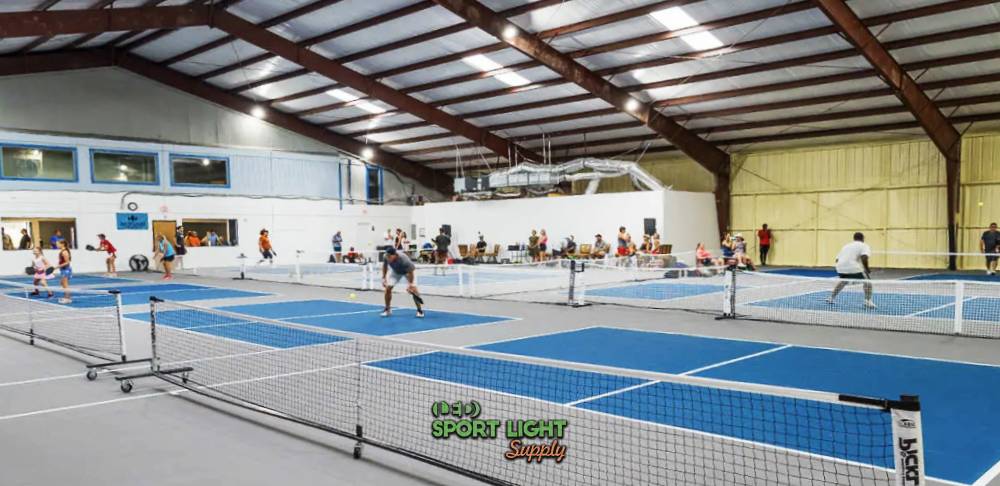
Indoor pickleball courts really do live in a different world. Ceiling height often becomes the first hard limit designers have to work around. In gyms or converted warehouses with ceilings under 25 feet, fixtures need wider beam angles and closer spacing to avoid bright pools directly under each light. If spacing is too wide, players end up moving in and out of uneven brightness during rallies.
High-ceiling spaces, often 35 feet or more, allow light to spread more naturally and evenly. The tradeoff is added complexity during installation and aiming. Fixtures must be mounted higher, and even small aiming errors become more noticeable at that height. Good planning up front saves a lot of ladder time later.
Reflections and surface control indoors
Reflections are far more noticeable indoors because light has nowhere to escape. Glossy floors, painted walls, metal trusses, and even scoreboards can bounce light back into players’ eyes. This reflected glare doesn’t always feel harsh, but it creates visual clutter that makes tracking the ball more tiring over time.
Using matte finishes on walls and ceilings helps absorb excess light. Controlled reflectivity keeps illumination focused on the court surface instead of bouncing around the space. When reflections are managed well, indoor courts feel calmer and easier to play on, even at higher light levels.
Weather and durability outdoors
Outdoor courts deal with conditions indoor spaces never see. Fixtures are exposed to rain, heat, cold, and sometimes strong wind. Durable housings, proper seals, and corrosion-resistant materials become part of the lighting conversation, not just afterthoughts.
Temperature swings also affect performance. Quality outdoor LED fixtures are designed to operate consistently from below freezing to extreme summer heat. When lower-grade equipment is used, output can shift or components wear faster than expected.
Maintenance and access considerations
Maintenance looks very different indoors versus outdoors. Indoors, access is usually easier, often involving lifts or catwalks. Outdoors, replacing or servicing a fixture on a 25 to 30-foot pole takes more planning, specialized equipment, and sometimes temporary court closures.
That’s why long lifespan, reliable drivers, and stable output matter even more outdoors. Fewer service calls mean less disruption to players and lower long-term operating costs.
Control systems and scheduling differences
Indoor facilities often benefit from more advanced lighting controls. Courts may be used for multiple sports or events, so zoning and dimming allow operators to adjust brightness depending on the activity. Pickleball practice sessions may not need the same light levels as competitive matches.
Outdoor courts usually focus more on scheduling and cut-off times. Timers and automated shutoff systems help manage energy use and comply with local noise or light ordinances. Smart controls add flexibility without adding complexity for users.
Acoustics and visual comfort indoors
While lighting doesn’t directly control sound, visual comfort plays a role in how noisy a space feels. Poor lighting combined with echo-heavy gyms can feel chaotic. Even, glare-free lighting helps players stay visually relaxed, which surprisingly affects how they perceive the overall environment.
Indoor courts with good lighting tend to feel more organized and calmer, even during busy sessions.
Surroundings and community impact outdoors
Outdoor courts exist within a larger environment. Nearby homes, roads, walking paths, and other sports areas all feel the effects of lighting choices. Spill light and sky glow become bigger concerns outside, especially in residential areas.
Fixtures with sharp cutoff optics and careful aiming help keep light focused on the court and out of surrounding spaces. When outdoor lighting respects its surroundings, facilities face fewer complaints and can often extend usable hours without conflict.
One goal, two different paths
Indoor and outdoor pickleball lighting face very different challenges, but they share the same goal. Players want even visibility, comfortable brightness, and as few distractions as possible. When lighting is designed with the space in mind, the court feels natural to play on, no matter what’s overhead or beyond the fence.
Common Lighting Mistakes to Avoid
Rushing layout decisions
A lot of lighting problems are baked in long before the first pole shows up on site. When the layout phase is rushed, decisions are often made based on convenience rather than how the court will actually feel during play. Lights end up mounted too low, which pushes light directly into players’ eyes instead of letting it spread naturally across the surface. The result is higher glare and harsher shadows, especially during serves and overhead shots.
Pole spacing is another area where shortcuts cause trouble. When poles are placed too far apart, dark zones tend to appear near the baselines or in the corners. These are already high-pressure areas where players are reacting to fast drives and deep returns. Even a slight drop in brightness can make timing feel off. Once players notice these inconsistencies, they’re hard to unsee, and correcting them later usually means adding fixtures or relocating poles, neither of which is cheap or simple.
Forgetting about future expansion
Another common mistake is designing lighting only for today’s needs. Pickleball facilities have a way of growing faster than expected. A park that starts with two courts may want four or six within a few years. When lighting layouts don’t account for that possibility, expansion becomes awkward.
New poles might end up in less-than-ideal positions, blocking views or crowding walkways. Existing fixtures may not provide enough overlap to keep brightness even across the new courts. Retrofitting often costs more than planning ahead, and the final result can look pieced together rather than intentional. Leaving room for growth early keeps the system flexible and visually clean.
Choosing fixtures by wattage or price alone
It’s tempting to compare fixtures by wattage or upfront price, especially when budgets are tight. Unfortunately, this approach rarely leads to the best playing experience. Two fixtures rated at 300 watts can behave very differently once they’re mounted. One may deliver smooth, even coverage, while the other creates bright spots and dark gaps.
Optics, beam shape, driver quality, and housing design all affect how usable the light actually is. A well-designed 250-watt fixture with precise beam control can outperform a 400-watt unit that sprays light in every direction. Focusing only on wattage often leads to higher energy use without better visibility.
Overlooking glare ratings and aiming angles
Some projects chase brightness numbers so aggressively that glare control gets pushed to the background. Fixtures without proper shielding or cutoff optics may hit target lux levels on paper but feel uncomfortable the moment players step on court. Glare doesn’t always show up in measurements, but it shows up in missed shots and squinting.
Aiming angles are just as influential. Even high-quality fixtures can cause problems if they’re tilted slightly too high or aimed toward common sightlines. A few degrees of misalignment can turn a comfortable court into a frustrating one. Good lighting depends as much on how fixtures are aimed as which fixtures are chosen.
Skipping photometric planning
Skipping photometric planning is another mistake that often comes back to haunt facilities. Without a light distribution study, designers are essentially making educated guesses. They may know how bright each fixture is, but not how multiple fixtures interact once they’re all on.
Photometric studies map out brightness levels, overlap, and uniformity before anything is installed. They show where shadows might form and whether target light levels are realistic. By turning assumptions into measurable outcomes, photometrics reduce surprises and limit the need for expensive adjustments later.
Underestimating maintenance and access
Maintenance rarely gets much attention during the design phase, but it becomes very real once the courts are in use. Outdoor fixtures mounted at 25 or 30 feet require lifts, trained crews, and sometimes temporary court closures. If fixtures fail frequently or are hard to access, operating costs climb quickly.
Choosing durable fixtures with long lifespans helps, but placement matters too. Planning clear access routes and considering how maintenance crews will reach each pole saves time and frustration over the years. A system that’s easy to maintain tends to stay in better shape and deliver more consistent performance.
Ignoring the surrounding environment
Finally, some lighting designs focus only on the court itself and forget about what’s around it. Nearby homes, sidewalks, parking lots, or other sports areas can all be affected by spill light and glare. When these factors are ignored, complaints often follow, sometimes leading to restricted hours or forced retrofits.
Lighting that respects its surroundings is more likely to stand the test of time. By controlling spill light and keeping brightness where it belongs, facilities protect both the playing experience and their relationship with the surrounding community.
Planning Your Pickleball Lighting Project
Start with how the court will actually be used
Every successful lighting project begins with a clear picture of how the court will be used day to day. A neighborhood park hosting casual evening games a few times a week has very different needs from a club running league matches or weekend tournaments. Usage patterns shape everything, from target light levels to how often the system is turned on and off.
For example, courts that see steady play after 6 p.m. may benefit from consistent mid-range lighting that feels comfortable for long sessions. Tournament-focused venues often aim higher, with brighter settings that support fast-paced play and spectators. Designing around real usage keeps lighting practical instead of overbuilt.
Think beyond upfront costs
Budget planning works best when it looks beyond the initial installation. Modern LED systems often cut energy use by 50 percent or more compared to older metal halide or halogen setups. Over time, those savings add up, especially for facilities running lights several hours each night.
Maintenance costs matter too. Fewer lamp replacements, longer fixture lifespans, and stable output reduce both labor and downtime. A slightly higher upfront investment can translate into years of lower operating expenses and fewer interruptions to court availability.
Factor in controls and flexibility
Lighting controls add flexibility that many facilities appreciate later. Zoning allows operators to light only the courts in use, rather than the entire complex. Dimming options help adjust brightness for practice sessions versus competitive play.
Timers and automated shutoffs also protect against lights being left on overnight, which saves energy and reduces wear. These systems don’t need to be complicated to be effective. Simple, well-planned controls often provide the best balance between ease of use and efficiency.
Check permits and regulations early
Permits and local regulations can quietly shape a lighting project. Pole height limits, maximum light levels, and operating hour restrictions vary by location. Some areas also have strict rules around spill light and sky glow, especially near residential neighborhoods.
Checking these requirements early avoids redesigns and delays. It also helps align lighting choices with community expectations, which makes long-term operation smoother.
Choose partners who understand the game
Working with experienced lighting designers or suppliers helps turn playing needs into practical solutions. The right partner asks about who’s playing, how often courts are used, and what surrounds the site. They look at more than square footage and fixture counts.
Good planning feels collaborative, not transactional. When designers understand how pickleball is played and how facilities operate, lighting decisions feel more confident and the finished court feels better to play on from day one.
Questions Buyers Often Ask Before Choosing Pickleball Lighting
1. How many lights are needed for one pickleball court?
The number of lights needed for a single pickleball court depends less on the court’s physical size and more on how the entire lighting system is planned. Most outdoor courts fall somewhere between four and eight fixtures, but that range can shift based on pole height, beam angle, fixture output, and the level of play the court is meant to support. A neighborhood court used for casual evening games might feel perfectly comfortable with fewer fixtures, while a league or tournament court often benefits from additional lights to improve uniformity and reduce shadows.
Pole height plays a major role in these decisions. Taller poles, usually in the 25 to 30-foot range, allow light to spread wider and more evenly, which can sometimes reduce the total number of fixtures needed. Shorter poles tend to concentrate light in smaller areas, so designers often add more fixtures to avoid dark zones near baselines or corners. The real goal isn’t just hitting a target lux number on paper, but making sure the court feels visually consistent from one end to the other throughout an entire match.
2. Is higher wattage always better?
Higher wattage can sound impressive, but it doesn’t guarantee better performance on the court. A well-designed 300-watt fixture with good optics, proper shielding, and careful aiming can easily outperform a poorly designed 500-watt light. Wattage only reflects how much energy the fixture consumes, not how effectively that energy is delivered to the playing surface.
What players actually notice is how evenly the light is distributed and whether glare is kept under control. Beam shape, cutoff angles, and fixture placement all influence this. In many situations, efficient fixtures with thoughtful layout provide clearer visibility while keeping energy costs in check. Simply adding more power without control often results in glare, spill light, and wasted electricity.
3. What color temperature do players usually prefer?
Most pickleball players feel comfortable under lighting in the 4000K to 5000K range. This color temperature looks bright and neutral, similar to daylight, which helps players track the ball during fast rallies and quick exchanges at the net. It also keeps court colors looking natural, whether the surface is blue, green, or a custom blend.
Lighting that’s too warm can make the ball blend into the background, especially during night play. Lighting that’s too cool can feel harsh and tiring over longer sessions. Staying within this middle range tends to work well for courts that see regular evening use and a wide range of players.
4. Can existing tennis court lights be reused for pickleball?
Reusing tennis court lights is sometimes possible, but it’s not always the best fit. Tennis lighting is designed to cover a much larger area and is usually aimed higher to support long ball arcs. When those same fixtures are used for pickleball, players often notice glare and uneven brightness because the game stays lower and closer to eye level.
In some cases, adjusting aiming angles or swapping optics can improve performance. In others, adding dedicated pickleball fixtures or replacing existing lights delivers better long-term results. A careful evaluation helps determine whether reuse makes sense or if it will introduce compromises that affect play quality over time.
5. How long do LED pickleball lights last?
High-quality LED pickleball lights are designed with long-term use in mind. Many professional-grade fixtures are rated for 50,000 to 100,000 hours before their light output drops to about 70 percent of the original level. If a court runs its lights for around four hours each night, that adds up to roughly 1,400 to 1,500 hours per year. At that pace, even a 50,000-hour fixture can last well over 20 years.
Of course, rated lifespan is only part of the story. Real-world longevity depends heavily on driver quality, heat management, and the environment the fixture operates in. Well-designed housings dissipate heat efficiently, which helps protect internal components and maintain steady output. In outdoor settings, fixtures that handle temperature swings and moisture properly tend to age more gracefully. When all these factors line up, facilities enjoy fewer replacements, fewer service calls, and lighting that looks consistent season after season.
6. How much energy can LED lighting really save?
Energy savings are one of the biggest reasons facilities move to LED lighting. Compared to older metal halide systems, modern LED pickleball lights often cut energy use by 40 to 60 percent, sometimes even more depending on the existing setup. For courts that operate several nights a week, those savings show up quickly on utility bills.
The gains don’t stop there. LEDs reach full brightness instantly, unlike metal halide lamps that need warm-up time. That makes it easier to turn lights off between sessions without wasting energy. Over several years, reduced power consumption combined with lower maintenance costs can offset a large portion of the initial investment, making LED upgrades financially appealing as well as visually better.
7. Do lighting controls make a noticeable difference?
Lighting controls can make a surprisingly big difference, especially in multi-court facilities. Zoning allows operators to turn on only the courts that are actually in use, instead of lighting the entire complex every evening. This alone can significantly reduce energy consumption.
Dimming adds another layer of flexibility. Casual open play may not need the same brightness as league matches or tournaments. With simple controls, facilities can adjust light levels to match the activity without affecting player comfort. Timers and automated shutoffs also help prevent lights from being left on overnight. When controls are intuitive, they save energy without adding hassle.
8. Will better lighting actually increase court usage?
Many facilities notice a clear increase in evening and nighttime play after upgrading lighting. Courts that feel evenly lit and free of glare are more inviting, especially for older players or those playing longer sessions. When visibility feels comfortable, players are more likely to stay for an extra game or book later time slots.
Improved lighting can also make courts feel safer and more professional. That perception alone encourages consistent use, league play, and organized events. Over time, better lighting often leads to more predictable scheduling and higher overall court utilization.
9. How do buyers know if a lighting proposal is well designed?
A strong lighting proposal goes beyond fixture counts and wattage numbers. It usually includes a photometric layout that shows predicted light levels and uniformity across the court surface. This helps buyers understand where light will be strongest and how evenly it will be distributed.
Clear explanations of fixture placement, mounting height, and glare control strategies are also good signs. When a proposal explains why certain choices were made, not just what those choices are, it builds confidence. Buyers can better visualize how the court will feel once the lights are on, which makes decision-making easier and more informed.
Lighting That Keeps the Game Moving
Great pickleball lighting doesn’t call attention to itself. Players focus on rallies, footwork, and strategy, not on squinting or stepping around shadows. When lighting supports the game quietly, courts stay busy longer and players leave happier.
Every site is different, from a single backyard court to a multi-court community complex. The best results come from matching lighting choices to real playing conditions, not generic specs.
If you’re planning a new court or upgrading an existing one, our team is happy to help review layouts, recommend fixtures, or walk through options that fit your goals and budget. Reach out anytime for a conversation that starts with how you play and ends with lighting that feels just right.