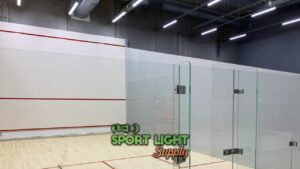

Step into a squash court and you immediately feel it. The enclosed space, the echo of shoes on timber, the sharp crack of ball on wall. It is fast, intense, and surprisingly unforgiving. The ball can travel well over 200 km per hour in elite matches. In that kind of environment, lighting is not just decoration overhead. It shapes reaction time, safety, fairness, and even how enjoyable the match feels.
Over the years, lighting standards for squash courts have evolved alongside advances in LED technology and broadcast requirements. Organizations such as the World Squash Federation and US Squash provide guidance that designers, engineers, and facility owners rely on when building or upgrading courts. Getting it right takes more than just installing bright fixtures. It requires understanding how players actually see the game.
What follows is a practical and experience-based look at squash court lighting standards, grounded in current recommendations and real-world application.
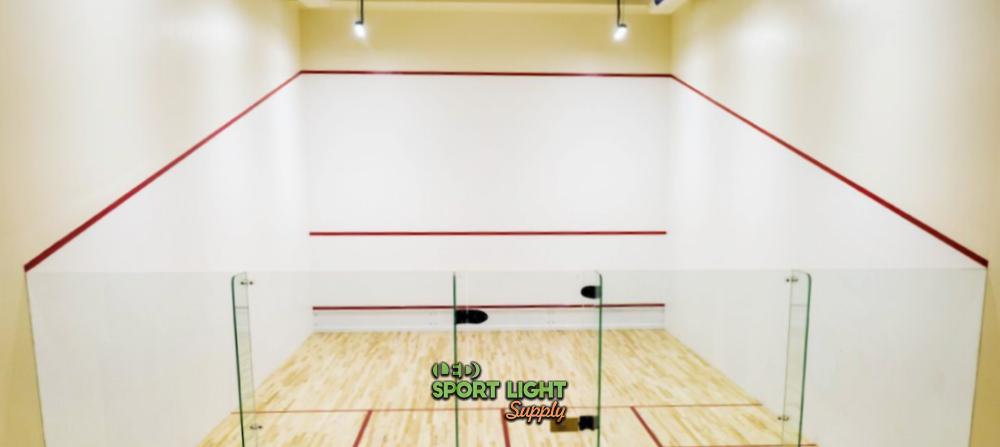
Squash is played inside a box measuring 9.75 meters long, 6.4 meters wide, and 5.64 meters high. Within that compact volume, players track a small black ball that often blends into dark corners and rebounds at extreme angles. Visual clarity becomes the silent partner in every rally.
At professional level, the ball’s speed and unpredictable trajectory demand extremely sharp contrast between the ball, the front wall, the side walls, and the floor. Even at club level, if the lighting creates shadowed back corners or uneven brightness across the floor, players will feel it immediately. Missed shots and awkward movements are often blamed on technique, but poor lighting frequently plays a role.
From a safety perspective, insufficient or uneven light increases the risk of collisions. Squash is already a close-contact sport. When two players chase the same ball in a dim rear corner, visibility can be the difference between a clean rally and a twisted ankle.
Well-designed lighting supports faster reaction times, smoother movement, and better overall performance. It also makes the space more welcoming for beginners who may already feel intimidated by the game’s pace.
Lighting recommendations for squash courts are not random numbers pulled out of thin air. They are shaped by international sports standards, optical research, and decades of tournament experience. The World Squash Federation sets out performance criteria for international competitions, especially for events played on full-glass show courts. Meanwhile, national associations such as US Squash provide technical facility guidelines that clubs, universities, and private developers rely on when planning new builds or renovations.
These organizations do more than just suggest brightness levels. They look at horizontal illuminance, vertical illuminance, uniformity ratios, glare ratings, color rendering index, correlated color temperature, flicker percentage, and even maintenance factors over time. In other words, they treat lighting as part of the competitive infrastructure, not just overhead hardware.
For recreational courts, the commonly referenced range is between 300 and 500 lux measured at finished floor level. That is usually sufficient for training sessions, school programs, and casual club matches. At 300 lux, the court is usable, but at closer to 500 lux, players typically report better clarity and less visual strain, especially in fast rallies.
Move into club championships or regional competitions and the expectation rises to around 500 to 750 lux. At this level, designers pay closer attention to uniformity ratio, often targeting at least 0.7 minimum to average illuminance. For example, if the average is 700 lux, the darkest measured point on the court should not fall below 490 lux. That difference might seem small on paper, but players feel it instantly if the back corners drop into shadow.
For national and international tournaments, 750 to 1,000 lux is widely adopted as a working range for horizontal illuminance. In some cases, especially in newer facilities, 900 lux is chosen as a balanced target that allows headroom for gradual lumen depreciation over time. LED fixtures do not stay at 100 percent output forever, so designers often apply a maintenance factor of around 0.8 when calculating long-term performance.
Once television enters the picture, the numbers shift again. High-definition broadcasting and ultra-slow-motion replay demand significantly higher and more controlled lighting conditions. It is common for show courts to operate between 1,200 and 2,000 lux horizontally, with vertical illuminance levels carefully matched to ensure players’ faces and the ball are clearly visible from multiple camera angles.
Vertical illuminance becomes especially relevant on the front wall and around the service line area. Cameras positioned at the back of the court require consistent light levels across the full height of the playing surface, sometimes measured at 1 meter and 2 meters above floor level. If vertical light is uneven, broadcast images can look flat or patchy even when the floor lux readings look impressive.
Another detail often specified for televised events is flicker performance. Modern LED drivers are expected to maintain flicker percentages below 1 percent at high frame rates. Without that control, slow-motion replays can reveal banding or strobing effects that are invisible to the naked eye but obvious on screen. For international competitions, lighting systems are often tested with high-speed cameras running at 1,000 frames per second to verify stability.
It is tempting to focus only on lux levels, but governing standards go deeper. Unified Glare Rating, typically targeted below 19 for indoor sports, helps protect players from discomfort glare when looking upward during lobs. Beam angles and luminaire shielding are evaluated during design simulations to keep glare within acceptable limits.
Color rendering index, often specified at 80 or above for club courts and 90 or above for broadcast venues, influences how well players can distinguish the ball against white or light-toned walls. Correlated color temperature generally sits between 4,000K and 5,000K. That cooler white tone supports alertness and enhances perceived sharpness without making the space feel clinical.
There is also the concept of illuminance uniformity on walls, not just the floor. For high-level competition, standards may require wall uniformity ratios similar to floor ratios, particularly on the front wall above the service line. These requirements ensure that the ball remains visible during high-speed exchanges and tight drops.
Not every court needs to meet broadcast-grade lighting targets. A community sports center hosting weekly leagues does not need 2,000 lux and high-speed camera testing. However, understanding the benchmark helps owners plan for the future. Retrofitting a court from 500 lux to 1,200 lux later can be significantly more expensive than designing for flexibility from the start.
In practical terms, facility planners often choose a scalable LED system with programmable drivers. That way, the same court can operate at 400 lux during casual play, 800 lux for tournaments, and higher levels if needed for filming or promotional events. It is a smart way to balance operational cost with performance capability.
When standards are applied thoughtfully rather than mechanically, they create a court that feels consistent, comfortable, and professional. Players might not walk in quoting lux values or uniformity ratios, but they will notice when everything just feels right.
| Level of Play | Horizontal Illuminance (Lux) | Uniformity (Min/Avg) | CRI | Flicker |
|---|---|---|---|---|
| Recreational | 300–500 | ≥ 0.7 (recommended) | ≥ 80 | Low |
| Club / Regional Competition | 500–750 | ≥ 0.7 | ≥ 80 | Low |
| National / International | 750–1,000 | ≥ 0.7 | ≥ 80 | Very Low |
| Broadcast / Show Court | 1,200–2,000 | ≥ 0.7 (floor & wall) | ≥ 90 | < 1% |
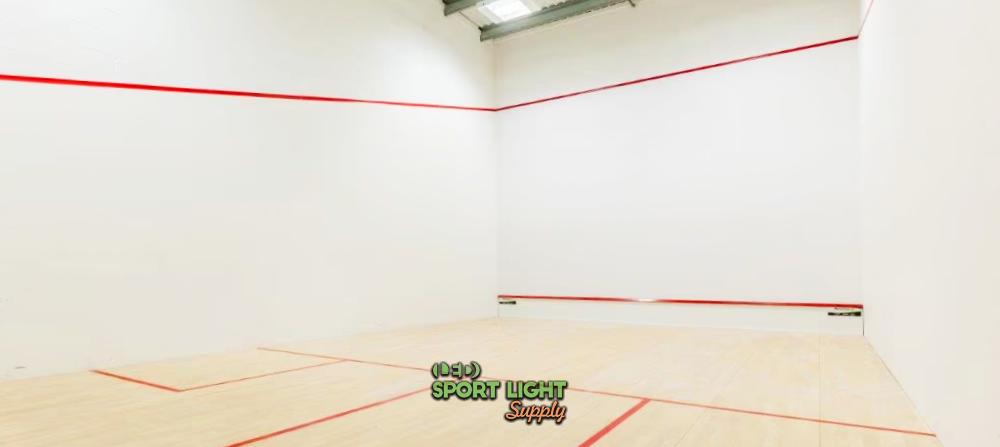
When people talk about squash court lighting, the first question is usually, “How many lux do we need?” Fair question. But lux levels only tell part of the story. You can measure 800 lux on average across the court and still have players complaining that something feels off. That “off” feeling almost always comes down to uneven distribution.
Average illuminance is just one data point. What really shapes visual comfort is how consistent that light is from the front wall to the back corners. A court that swings between 950 lux under the fixtures and 420 lux in the rear corners may technically average 800 lux, but it will not feel smooth or balanced during play.
Uniformity is usually expressed as the ratio between minimum illuminance and average illuminance, written as Emin divided by Eavg. A commonly accepted benchmark for squash courts is 0.7 or higher. That means if your average is 800 lux, the lowest measured point on the court should not fall below 560 lux.
Why does that matter? Because squash is played in every inch of the box. The back corners are where rallies are often won or lost. If those areas drop too far below the average, the black ball can blend into shadow for a split second. In a sport where reaction times are measured in fractions of a second, that split second changes everything.
In higher-level venues targeting 900 lux average, designers often aim for a minimum of at least 630 lux. Some premium facilities even push uniformity closer to 0.75 to create a more seamless visual field. The result is a court that feels steady and predictable, even during long, high-speed rallies.
Most lighting measurements start at floor level. A grid is laid out, often in equal intervals across the 9.75 by 6.4 meter playing area, and lux readings are taken about 1 meter above the floor. That gives you horizontal illuminance, which is useful, but not the whole picture.
Squash players spend a huge amount of time looking at the front wall. Drives, boasts, drops, and lobs all rely on clear visibility of wall markings such as the service line and out-of-bounds line. If the wall lighting is uneven, the ball’s rebound trajectory becomes harder to judge.
That is where vertical illuminance comes in. Lighting designers measure lux levels on the front and back walls, sometimes at heights of 1 meter, 2 meters, and even higher for broadcast courts. In competitive venues, vertical illuminance often approaches 70 to 100 percent of horizontal levels. So if the floor is at 1,000 lux, the front wall may also be designed to achieve 800 to 1,000 lux.
For televised matches, consistency across the entire wall surface helps cameras capture sharp images without dull patches or overexposed zones. Viewers may not know the numbers, but they definitely notice when a court looks flat or uneven on screen.
It is tempting to solve low readings by simply choosing fixtures with higher lumen output. On paper, upgrading from 20,000 lumens per fitting to 30,000 lumens per fitting sounds like a quick fix. In reality, it can create hot spots directly beneath the luminaires while leaving peripheral zones underlit.
Good squash lighting design usually starts with a detailed photometric simulation. Beam angles, mounting height, reflectance of wall finishes, and spacing between fixtures are all modeled carefully. In a standard court with a 5.64 meter ceiling, the positioning and aiming angles of luminaires must work together like a coordinated team.
Often, a balanced layout with moderate output fixtures spaced evenly across the ceiling delivers better uniformity than fewer high-powered fittings. It is less about brute brightness and more about controlled distribution.
Another factor that affects illuminance over time is lumen depreciation. LED systems gradually lose output, typically around 10 to 20 percent over several years depending on operating hours and thermal conditions. That is why many designers initially target slightly higher levels, such as 900 lux, to ensure the court remains above 750 lux even after years of use.
Maintenance factors are built into lighting calculations to account for dust accumulation, aging drivers, and reflectance changes on wall surfaces. A court that measures beautifully on day one but drops below recommended levels within two years creates unnecessary headaches for operators.
When illuminance and uniformity are handled thoughtfully, players experience a court that feels visually stable. No sudden dark corners. No distracting bright patches. Just a clean, even field of light that supports the speed and precision of the game. And when that happens, the lighting quietly does its job without anyone needing to talk about it.
If you have ever chased a high lob in squash, you know the moment. Your eyes lift, the ball arcs toward the back wall, and for a split second you are staring almost straight at the ceiling. If a luminaire is sitting right in that sight line, blasting raw brightness, the rally turns into a guessing game.
That is where glare control steps in. Even when a court measures a solid 800 or 1,000 lux, poor glare management can quietly reduce visual comfort and reaction speed. Players may not talk about Unified Glare Rating over coffee, but they will say things like, “It feels harsh,” or “I lose the ball when I look up.” That usually points to discomfort glare rather than insufficient brightness.
In indoor sports environments, Unified Glare Rating, or UGR, is commonly targeted below 19. Some high-end squash facilities aim even lower, especially when courts operate for 10 to 14 hours a day. Achieving that number is not about dimming the lights. It is about controlling how light leaves the fixture and how it enters the player’s field of view.
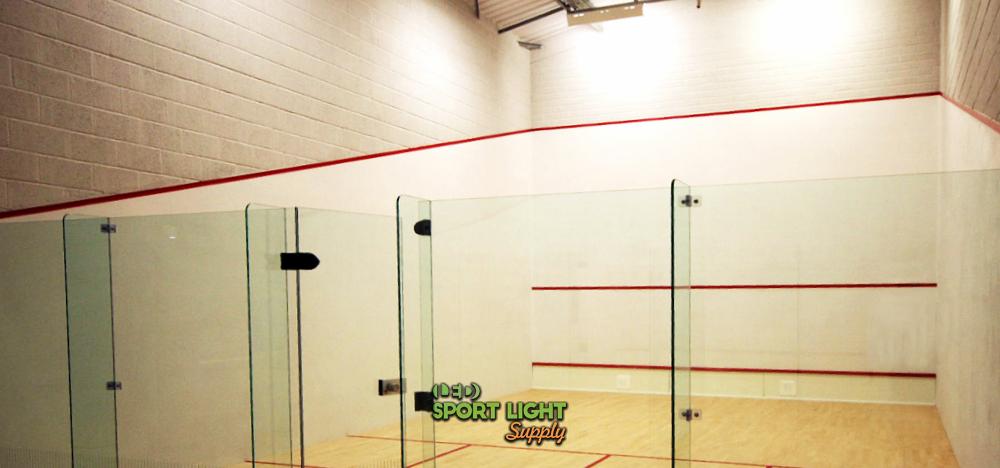
Most traditional squash courts rely heavily on direct lighting, where luminaires project light straight down onto the playing surface. Direct lighting is efficient and easier to calculate, but if not properly shielded, it can create intense brightness in upward sight lines.
Indirect lighting introduces another layer of control. Instead of sending all light directly toward the floor, part of the output is reflected off the ceiling or upper wall surfaces before diffusing into the space. This creates a softer, more uniform luminous environment. The ceiling effectively becomes a secondary light source, spreading brightness more evenly and reducing high-contrast glare points.
In practical terms, a hybrid system combining direct and indirect components can improve visual comfort without sacrificing illuminance levels. For example, a court designed for 900 lux average horizontal illuminance might allocate a portion of the luminous flux to ceiling reflection. The result is a more balanced luminance distribution across the visual field, especially when players look upward during lobs.
Indirect lighting also helps reduce harsh shadow transitions. When light wraps more gently around surfaces, the court feels visually stable. It does require careful ceiling finish selection, since reflectance values above 70 percent are typically needed to make indirect strategies effective.
Optics design plays a major role in glare control. Modern luminaires use engineered beam angles, internal reflectors, and microprismatic diffusers to spread light evenly while shielding the direct view of high-intensity LED chips. Shielding angles, often 30 degrees or more, help ensure that players do not see the brightest part of the source during upward glances.
In some advanced designs, luminaires are recessed slightly or equipped with louver systems that further reduce direct line-of-sight exposure. These details might seem small, but they can significantly lower perceived glare without reducing lux levels.
Mounting height also plays into the equation. With a standard squash court ceiling height of 5.64 meters, fixture placement must align with common ball trajectories. If fittings are positioned too close to the center line without proper shielding, players performing defensive lobs will repeatedly look directly into the light source. Over time, that leads to fatigue and reduced visual sharpness.
LED technology has made glare control far more refined compared to older metal halide systems. In the past, large point sources often produced intense hotspots and uneven diffusion. Today’s LED luminaires offer precise beam shaping and stable output, often maintaining flicker percentages below 1 percent for competitive play.
With the right optical design, LED systems can deliver 1,000 lux or more while maintaining acceptable glare ratings. It is no longer a trade-off between brightness and comfort. The focus has shifted toward controlled luminance, not just high lumen packages.
When the venue shifts to a full glass show court, glare management becomes more layered. Spectators are seated behind transparent walls, referees are elevated above the court, and multiple broadcast cameras capture the action from different angles. Each group has unique sight lines and visual demands.
Lighting designers must account for reflections on glass panels, direct glare into camera lenses, and the possibility of bright luminaires creating hotspots in televised images. Beam angles may be adjusted, luminaires slightly offset, or indirect components introduced to balance player comfort with broadcast clarity.
In some show courts, side lighting is added to boost vertical illuminance without increasing overhead intensity. This approach helps maintain high horizontal lux levels, sometimes between 1,200 and 1,800 lux for broadcast, while keeping glare within acceptable limits.
It becomes a choreography of light. Players need clarity during upward shots. Cameras need stable, flicker-free illumination. Spectators need a comfortable visual field that does not feel harsh. When everything is tuned properly, nobody talks about the lighting. They simply see a sharp, dynamic match unfolding inside a glowing glass arena, and the light quietly does its job in the background.
Beyond brightness and glare, color quality shapes how the game actually looks and feels. Color Rendering Index, or CRI, measures how accurately a light source reveals colors compared to natural light. In squash courts, a CRI of at least 80 is commonly specified for club environments. For professional and televised courts, 90 or higher is often preferred.
Higher CRI enhances the contrast between the black ball and the typically white or light-colored walls. It also improves how skin tones, court markings, and sponsor logos appear on camera. Under low CRI lighting, colors can look slightly washed out or flat. Under high CRI lighting, the visual field appears more natural and defined.
Correlated color temperature, measured in Kelvin, also influences perception. Most squash courts operate within the 4,000K to 5,000K range. That neutral to cool white tone supports alertness and clarity without feeling overly clinical. At around 4,000K, the environment feels bright and clean. Closer to 5,000K, the light becomes crisper, which some players prefer for competitive play.
Warmer light, such as 3,000K, might work beautifully in a lounge or café area, but inside a squash court it can soften contrast and slightly blur visual edges. In a sport where the ball can change direction in a heartbeat, that reduction in perceived sharpness is noticeable.
One detail that is sometimes overlooked is consistency across fixtures. Mixing luminaires with different color temperatures, even by a few hundred Kelvin, creates subtle patches of warm and cool tones across the court. It might not show up clearly in basic lux measurements, but the human eye picks up the imbalance.
Modern LED systems make consistency easier to maintain. When fixtures are sourced from the same manufacturer, same model line, and ideally the same production batch, color variation remains within tight tolerances. Proper commissioning ensures drivers are calibrated and dimming systems do not shift color output at different intensity levels.
When glare is controlled, CRI is high, and color temperature is consistent, the result is a court where the ball truly stands out. The lighting does not compete with the action. It supports it quietly, allowing players to focus on movement, timing, and strategy rather than fighting against visual discomfort.
Finishing the installation does not mean the job is done. In fact, some would say the real proof begins after the last fixture is mounted and powered on. Commissioning is where design calculations meet reality. It confirms whether the court actually delivers the 750, 900, or 1,000 lux that was promised on paper, and whether uniformity, glare control, and vertical illuminance targets are truly achieved.
A well-designed lighting system should perform as modeled, but variables such as wall reflectance, ceiling finish, installation tolerances, and even slight aiming differences can shift real-world results. That is why proper testing is not just a formality. It protects the facility owner, the contractor, and ultimately the players.
Lighting measurements are typically carried out using a calibrated digital lux meter that complies with international photometric standards. Calibration certificates should be current, usually within the last 12 months, to ensure accuracy. Even a 5 percent deviation can make a difference when you are trying to verify compliance with competition guidelines.
A measurement grid is laid out across the court floor. In many cases, readings are taken at evenly spaced intervals, for example every 1 to 1.5 meters across the 9.75 meter by 6.4 meter playing surface. The sensor is positioned approximately 1 meter above the finished floor to simulate the typical eye level of play. Each data point is recorded, then used to calculate average illuminance, minimum illuminance, and the uniformity ratio.
If the design target was 800 lux with a minimum to average ratio of 0.7, the data must show that the lowest reading does not drop below 560 lux. It is not uncommon for commissioning reports to include 20 to 30 individual measurement points to provide a clear performance snapshot.
Horizontal readings alone are not enough, especially for higher-level competition courts. Vertical illuminance measurements are often taken on the front wall, back wall, and sometimes side walls. Sensors may be placed at heights such as 1 meter and 2 meters above floor level to reflect typical ball impact zones.
For competitive venues targeting 900 lux horizontally, vertical illuminance may be expected to reach 700 to 900 lux as well, depending on governing body guidelines. If wall readings fall too low, the ball can appear less distinct during fast rebounds, particularly under broadcast conditions.
These measurements also help confirm that light distribution is even across the entire front wall, including areas above the service line and near the out-of-bounds line. Consistency here supports both player visibility and television image quality.
If the results fall slightly short of targets, adjustments are usually straightforward. Fixtures can be re-aimed to reduce hot spots and lift darker zones. Optics may be modified if interchangeable lenses were specified in the design. In some cases, dimming levels can be adjusted upward if the system was initially set conservatively.
In more advanced LED systems, programmable drivers allow output to be fine-tuned in 5 or 10 percent increments. That flexibility can make the difference between a 680 lux court and a 750 lux court without replacing hardware.
After adjustments are completed, a second round of measurements is typically conducted to confirm compliance. The final commissioning report documents all readings, equipment specifications, aiming angles, and calibration details. For venues hosting sanctioned tournaments, this documentation may be required during facility approval or certification processes.
For professional and televised venues, flicker testing is increasingly part of commissioning. Even when lighting appears stable to the human eye, high-speed cameras operating at 500 to 1,000 frames per second can detect subtle fluctuations.
Modern LED drivers designed for sports applications usually achieve flicker percentages below 1 percent at full output. During commissioning, specialized measurement devices or high-speed camera tests may be used to confirm performance. Stable output ensures clean slow-motion replays without banding or strobing artifacts.
When commissioning is handled thoroughly, the result is more than just a compliance certificate. It gives facility owners confidence that their investment performs as intended, season after season. Players step onto the court and simply feel that everything works. The light is even, comfortable, and reliable. That quiet consistency is often the clearest sign that the testing was done right.
Even with good intentions and decent budgets, squash court lighting can go wrong in surprisingly predictable ways. Many of the problems are not dramatic failures. They are small oversights that slowly chip away at performance until players start saying, “Something feels strange in the back corner,” or “The court looks uneven on camera.”
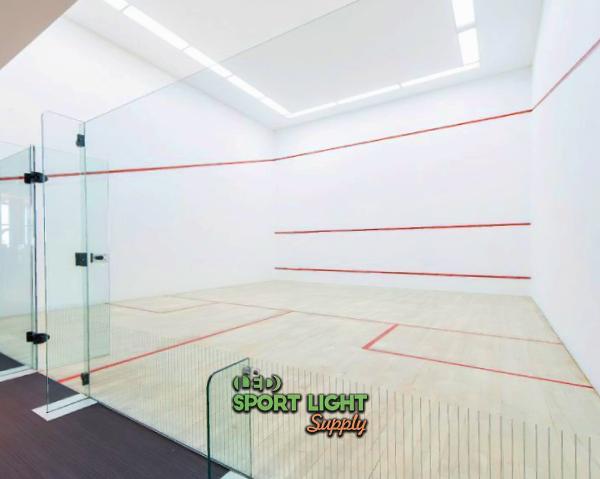 One of the most common missteps is underestimating vertical illuminance. Designers sometimes concentrate almost entirely on horizontal lux readings at floor level because those numbers are easy to measure and compare. But squash is a wall game. Players constantly track the ball as it strikes the front wall at speeds that can exceed 200 km per hour.
If the front wall above the service line drops 30 or 40 percent below the average floor illuminance, visibility suffers. The court may show a respectable 800 lux average on paper, yet rebounds look slightly dull or harder to read in real play. That disconnect often traces back to insufficient wall lighting. When vertical illuminance is not aligned with horizontal targets, the overall visual field feels unbalanced.
Another recurring issue appears during retrofit projects. A facility replaces aging metal halide or fluorescent fixtures with high-output LED luminaires and assumes the job is done. On day one, the lux meter shows a higher average, maybe jumping from 450 lux to 850 lux. It sounds like a clear upgrade.
But without recalculating beam angles, spacing, reflectance values, and aiming positions, the distribution pattern can become uneven. Bright hot spots form directly under the fittings, sometimes exceeding 1,200 lux, while outer zones lag behind at 500 or 600 lux. The average increases, yet uniformity ratio drops below 0.7, and the court feels patchy rather than smooth. More lumens alone rarely fix distribution problems.
Glare is another frequent complaint, especially when narrow beam optics are used without careful aiming. Fixtures positioned along the center line with limited shielding can create sharp brightness when players look up for defensive lobs.
The issue is not always obvious during a casual inspection. It reveals itself during actual rallies, when eyes shift quickly between floor, wall, and ceiling. A court can technically meet 900 lux and still feel uncomfortable if glare ratings exceed recommended thresholds. Players may not use technical terms like Unified Glare Rating, but they will sense the strain after a few intense matches.
Some facilities design purely for training and local matches, targeting 500 or 600 lux, with minimal attention to vertical uniformity or flicker performance. A few years later, the venue decides to host a regional championship or attract televised coverage.
Suddenly, the lighting system cannot meet 1,200 lux requirements or high-speed camera standards. Flicker becomes visible under slow-motion replay, and vertical illuminance falls short for camera angles. Upgrading at that stage often means replacing drivers or entire luminaires, which can be far more expensive than planning flexibility from the beginning.
Another subtle but costly oversight involves long-term performance. Designers sometimes calculate lighting levels without applying a maintenance factor for lumen depreciation and dust accumulation. An LED system installed to deliver exactly 750 lux may drop to 650 lux after several years of operation.
That gradual decline may go unnoticed at first, but over time, players experience reduced clarity, especially in lower reflectance areas. Building in a 10 to 20 percent buffer during design helps ensure the court maintains target performance throughout its lifespan.
Most of these pitfalls share a common theme – focusing too narrowly on one metric while overlooking the bigger performance picture. Squash lighting is a balance between horizontal illuminance, vertical illuminance, uniformity, glare control, color quality, and long-term stability.
When even one of these elements is treated as secondary, shadows appear where they should not, and the overall playing experience feels slightly compromised. Careful planning, realistic photometric simulations, thorough commissioning, and attention to future needs keep those issues from surfacing. When everything is aligned, the lighting simply works, quietly supporting every rally without drawing attention to itself.
Squash courts may be compact, but their lighting systems involve a sophisticated balance of brightness, uniformity, glare control, and color quality. When designed properly, lighting enhances player confidence, supports fair competition, and creates a visually appealing environment for spectators and cameras alike.
With LED technology continuing to evolve, future systems will likely offer even greater energy efficiency, smarter controls, and improved optical precision. Facilities that invest thoughtfully in lighting design often see measurable returns through reduced energy costs, longer fixture life, and higher player satisfaction.
If you are planning a new squash facility or upgrading an existing court, professional guidance can save time, money, and frustration. Our team works closely with facility owners, architects, and sports organizations to deliver lighting solutions that meet international standards while remaining practical and cost-effective. Feel free to reach out for a consultation. We are always happy to discuss your project and explore how to bring your court to its best possible light.