
Pickleball has quickly become one of the fastest-growing sports in North America, and many clubs, schools, parks, and homeowners are investing in quality court lighting to extend playing hours after sunset. Whether you’re planning a brand-new court or upgrading an older lighting system, one of the first questions you’ll probably ask is, “How much is this going to cost?”
The answer depends on several factors, including the number of courts, the lighting level you need, the condition of your existing electrical infrastructure, and the type of LED fixtures you choose. While some smaller retrofit projects may only require replacing outdated fixtures, a brand-new installation often involves poles, wiring, concrete foundations, electrical work, and professional lighting design.
Understanding where your budget goes makes it much easier to plan your project and avoid unexpected expenses. Here’s a closer look at what affects the overall cost of pickleball court lighting and how you can get the best value from your investment.
Average Cost to Light a Pickleball Court
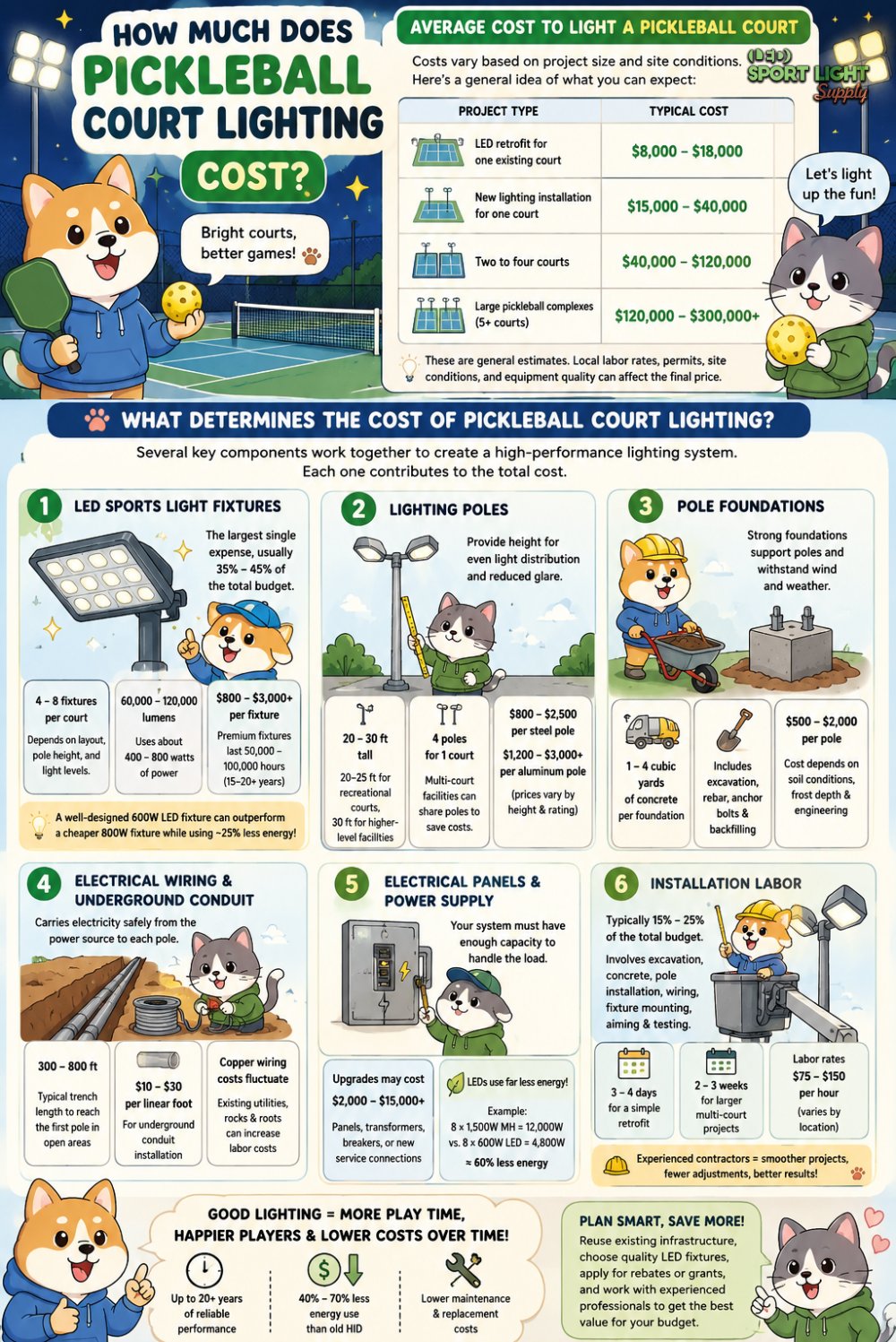
The total cost of installing pickleball court lighting can vary quite a bit depending on the project size and site conditions. As a general guide, a single outdoor court with a new LED lighting system typically costs between $15,000 and $40,000, while larger facilities with multiple courts may spend anywhere from $75,000 to well over $250,000.
Projects that already have usable poles and electrical infrastructure usually cost much less because they only require replacing existing fixtures with modern LED sports lights. On the other hand, new facilities starting from scratch often require excavation, concrete foundations, underground conduit, and electrical upgrades, all of which add to the overall budget.
The table below provides a general idea of what different types of projects may cost.
| Project Type | Typical Cost |
|---|---|
| LED retrofit for one existing court | $8,000 to $18,000 |
| New lighting installation for one court | $15,000 to $40,000 |
| Two to four courts | $40,000 to $120,000 |
| Large pickleball complexes | $120,000 to $300,000+ |
These figures are intended as general estimates. Local labor rates, permitting requirements, and the quality of the lighting equipment can all influence the final price.
What Determines the Cost of Pickleball Court Lighting?
No two pickleball court lighting projects are exactly alike. A small community court with existing poles and electrical service will have a very different budget from a brand-new sports complex being built from scratch. That’s why project costs can range from under $10,000 for a simple LED retrofit to well over $250,000 for a multi-court installation.
Several components work together to create a reliable, high-performance lighting system, and each one contributes to the final price. Understanding these cost factors can help you budget more accurately and compare contractor quotations with greater confidence.
LED Sports Light Fixtures
LED fixtures are usually the largest single expense in a pickleball court lighting project, often accounting for 35% to 45% of the total budget. Modern sports lighting uses high-output LED luminaires designed to provide bright, even illumination while consuming far less electricity than traditional metal halide systems.
A standard outdoor pickleball court typically requires 4 to 8 LED fixtures, depending on the lighting layout, pole height, and target light levels. Recreational courts may only need four fixtures, while tournament or competition courts often use six or eight fixtures to achieve higher brightness and better uniformity.
Individual sports lighting fixtures generally cost anywhere from $800 to $3,000 or more each, depending on factors such as lumen output, optical design, surge protection, driver quality, and warranty coverage. Premium sports lighting systems often include precision optics that direct more light onto the playing surface instead of wasting it outside the court.
Many commercial LED sports fixtures produce between 60,000 and 120,000 lumens while consuming approximately 400 to 800 watts of power. Higher-end models may exceed 150,000 lumens for larger sports facilities.
It’s also worth looking beyond wattage alone. A well-designed 600-watt LED fixture with advanced optics can often outperform a lower-quality 800-watt fixture, delivering better visibility while using around 25% less electricity. That’s because the quality of the optics plays a huge role in determining how efficiently light reaches the court.
Another factor to consider is lifespan. Many premium LED sports lights are rated for 50,000 to 100,000 operating hours. If a court operates around 20 hours per week, that’s roughly 1,000 hours per year, meaning the fixtures could continue performing well for 20 years or more before significant light depreciation occurs.
Choosing higher-quality fixtures often results in lower maintenance costs and better long-term value, even if the upfront investment is slightly higher.
Lighting Poles
Lighting poles provide the height needed to distribute light evenly across the court while helping reduce glare for players.
Most outdoor pickleball facilities use poles ranging from 20 to 30 feet tall. Recreational courts commonly use 20 to 25-foot poles, while higher-level facilities may choose 30-foot poles to improve light uniformity and reduce harsh shadows.
A typical single court usually requires four lighting poles, positioned around the perimeter. Multi-court facilities often share poles between adjacent courts, reducing both equipment and installation costs. For example, four standalone courts may require 16 poles, while an optimized shared layout might reduce that number to 10 to 12 poles, creating noticeable savings.
Pole prices vary depending on height, material, and wind load rating. Galvanized steel poles generally cost between $800 and $2,500 each, while aluminum poles may range from $1,200 to over $3,000 per pole.
Although aluminum is lighter and naturally corrosion-resistant, galvanized steel remains the most popular choice thanks to its durability, strength, and competitive pricing.
Pole Foundations
Every lighting pole requires a properly engineered concrete foundation capable of supporting the structure under both normal conditions and strong winds.
Foundation costs depend on factors such as pole height, soil conditions, frost depth, and local engineering requirements. A typical sports lighting foundation may require 1 to 4 cubic yards of concrete along with reinforcing steel, anchor bolts, excavation, and backfilling.
For most projects, foundation installation costs range from approximately $500 to $2,000 per pole, although difficult soil conditions or larger poles can increase that figure.
If the site contains rocky ground, high groundwater levels, or unstable soil, contractors may need deeper excavations or additional engineering work, adding both labor and material costs.
Although foundations remain hidden after construction, they’re responsible for supporting the lighting system throughout decades of exposure to wind, rain, and changing weather conditions. A properly designed foundation helps minimize future maintenance and improves the overall lifespan of the installation.
Electrical Wiring and Underground Conduit
Electricity has to travel safely from the power source to each lighting pole, which requires underground conduit, electrical wiring, grounding systems, junction boxes, and protective devices.
The total amount of wiring depends largely on the distance between the electrical service and the courts. If the electrical panel is located nearby, only a relatively short trench may be required. However, courts located in parks or open recreational areas sometimes require 300 to 800 feet of underground trenching before reaching the first lighting pole.
Underground conduit installation generally costs between $10 and $30 per linear foot, depending on soil conditions and local labor rates. Longer trenching distances naturally increase both labor and material expenses.
Copper wiring also represents a meaningful portion of the project budget. Since copper prices fluctuate throughout the year, contractor quotations may change based on market conditions.
Additional costs may arise if contractors encounter existing underground utilities, irrigation systems, tree roots, or rocky terrain that slows excavation.
Electrical Panels and Power Supply
Before new lighting can be installed, the facility’s electrical system must have enough capacity to support the additional load.
If the existing electrical panel has sufficient available capacity, connecting the lighting system is often relatively straightforward. However, older sports facilities may require new distribution panels, upgraded transformers, larger breakers, or even a new electrical service connection.
Depending on the scope of work, these upgrades can cost anywhere from $2,000 to more than $15,000.
Fortunately, modern LED lighting consumes significantly less electricity than older HID systems. For example, replacing eight 1,500-watt metal halide fixtures with eight 600-watt LED fixtures reduces connected lighting load from approximately 12,000 watts to 4,800 watts, lowering energy consumption by around 60% while still delivering excellent visibility.
That reduction often makes it easier to use the existing electrical infrastructure without major upgrades.
Installation Labor
Labor is another major contributor to the total project cost, typically representing around 15% to 25% of the overall budget.
Installing sports lighting involves much more than attaching fixtures to poles. Contractors usually need to excavate foundations, pour concrete, install poles, trench for underground conduit, pull electrical wiring, mount fixtures, connect electrical equipment, and carefully aim every fixture according to the approved photometric plan.
Depending on the project size, installation may take anywhere from three or four days for a straightforward retrofit to two or three weeks for a larger multi-court facility.
Specialized equipment such as bucket trucks, cranes, augers, trenchers, or boom lifts may also be required, particularly when working with 30-foot poles or larger installations. Equipment rental alone can add several thousand dollars to the project budget.
Labor costs vary considerably by location. In many parts of the United States, licensed commercial electricians typically charge between $75 and $150 per hour, while large metropolitan areas often fall at the higher end of that range.
Working with an experienced sports lighting contractor can make a noticeable difference. Familiarity with lighting layouts, fixture aiming, and electrical installation often leads to a smoother construction process, fewer adjustments after installation, and better overall lighting performance once the courts are ready for play.
Lighting Design and Photometric Plans
One part of a pickleball court lighting project that people sometimes overlook is the lighting design itself. It’s easy to assume that buying brighter or more expensive LED fixtures will automatically produce better results, but that’s not always the case. Even premium fixtures can create uneven lighting, dark corners, or excessive glare if they’re not positioned correctly.
A well-designed lighting layout doesn’t simply make the court brighter. Instead, it focuses on delivering consistent, balanced illumination across the entire playing area, making it easier for players to follow the ball during fast-paced rallies.
What Is a Photometric Plan?
A photometric plan is a computer-generated lighting simulation created using specialized engineering software. Before any equipment is installed, lighting designers input details such as the court dimensions, pole locations, mounting heights, fixture specifications, and beam angles.
The software then predicts how light will spread across the surface, measuring brightness at hundreds or even thousands of points. This allows designers to evaluate average light levels, identify darker areas, and fine-tune the layout before construction begins.
Rather than relying on guesswork, a photometric plan gives both contractors and customers a clear picture of how the finished court is expected to perform. It also helps avoid costly adjustments after installation, which can involve repositioning fixtures or replacing optics.
Creating Better Visibility for Players
Good sports lighting is about much more than producing high light levels. What players really notice is how evenly the light is distributed.
Imagine serving the ball from one end of the court and looking upward into a bright fixture, only for the ball to disappear briefly against the night sky. Or picture moving from a brightly lit baseline into a noticeably darker kitchen area. Those changes in brightness can affect reaction time and overall playing comfort.
A professional lighting design minimizes these issues by creating uniform illumination from baseline to baseline, helping players maintain clear visibility throughout every point. This is especially valuable during competitive matches where split-second reactions make all the difference.
Many lighting professionals also pay close attention to glare control. By selecting the proper optics and aiming fixtures carefully, they can direct light onto the court instead of into players’ eyes or neighboring properties.
Meeting Lighting Standards
Photometric studies are also useful for projects that need to meet specific lighting standards.
Schools, universities, municipalities, sports clubs, and tournament venues often have recommended illumination levels and uniformity ratios that must be achieved before the project is approved. Having a professionally prepared photometric report makes it much easier to demonstrate that the lighting system has been designed to meet those expectations.
For example, a recreational facility may target around 30 to 50 foot-candles, while competitive venues often aim for 50 to 75 foot-candles or higher. The lighting designer can adjust fixture selection and placement to achieve these targets without using unnecessary equipment.
Is a Photometric Design Worth the Cost?
In many cases, yes.
Some LED lighting manufacturers include a photometric layout at no additional charge as part of their quotation, while others may charge anywhere from $300 to $1,500, depending on the size and complexity of the project.
Although this represents a small additional expense, it can help avoid much larger costs later. Installing extra fixtures because the original design wasn’t optimized, or having to reposition poles after construction, is usually far more expensive than investing in a proper lighting plan from the beginning.
For larger facilities with several courts, a professionally designed lighting layout often delivers better performance while using fewer fixtures, which can reduce both installation costs and long-term energy consumption.
Ways to Save Money on Pickleball Court Lighting
 Installing sports lighting is a significant investment, but there are several practical ways to reduce costs without sacrificing lighting quality or long-term reliability. Planning ahead and making smart equipment choices can often save thousands of dollars over the life of the system.
Reuse Existing Poles Whenever Possible
If your facility already has lighting poles that are structurally sound, reusing them can be one of the biggest opportunities for savings.
Many older tennis or pickleball courts have poles that remain in excellent condition even though the fixtures themselves have become outdated. By replacing only the lighting fixtures and upgrading electrical components where needed, facilities can avoid the expense of installing new poles, foundations, and underground infrastructure.
Depending on the project, a retrofit can reduce the total installation cost by 20% to 40% compared to building an entirely new lighting system.
Before deciding to reuse existing poles, it’s always a good idea to have them inspected for structural integrity, corrosion, and compliance with current wind load requirements.
Upgrade to High-Efficiency LED Fixtures
Although LED fixtures generally have a higher purchase price than older lighting technologies, they often deliver the lowest ownership cost over the long run.
Modern sports LEDs typically use 40% to 70% less electricity than traditional metal halide fixtures while providing better light quality and more consistent performance.
Many premium fixtures are rated for 50,000 to 100,000 operating hours, meaning they may continue performing for well over 15 years under normal evening usage. During that time, facility owners can save money not only on electricity but also on maintenance, replacement lamps, and lift equipment required for servicing older fixtures.
For clubs that operate several evenings every week, these ongoing savings can add up surprisingly quickly.
Explore Utility Rebates
Many local utility providers encourage businesses, schools, and municipalities to switch to energy-efficient lighting by offering rebate programs.
The available incentives vary depending on your location, but it’s not uncommon for facilities to receive hundreds or even several thousand dollars back after upgrading to qualified LED sports lighting.
Some rebate programs calculate incentives based on the total energy saved, while others provide a fixed amount for each eligible fixture installed.
Since program requirements change periodically, checking with your local electricity provider before purchasing equipment may help reduce the overall project cost.
Look Into Grants and Funding Programs
If you’re managing a public sports facility, school, nonprofit organization, or community recreation center, grants may also be available.
Many local, state, and federal funding programs support projects that improve recreational facilities or increase energy efficiency. Depending on the program, financial assistance may help cover part of the equipment cost, installation expenses, or broader facility improvements.
Although grant applications often require some additional paperwork, successful applicants can significantly reduce their upfront investment. For municipalities planning multiple court upgrades, the savings can be substantial.
Install Smart Lighting Controls
Smart controls are another simple way to reduce operating costs over the life of the system.
Instead of leaving every light on throughout the evening, modern control systems allow individual courts to be scheduled according to reservations or programmed operating hours.
For example, if only two out of six courts are being used on a Tuesday evening, there’s no reason to illuminate the entire facility. Running only the necessary fixtures helps reduce electricity consumption while also extending the lifespan of the lighting equipment.
Over several years, those energy savings can become surprisingly significant, especially for facilities that host seasonal leagues or daily public play.
Plan Multi-Court Projects Together
If you’re planning to expand your facility, it often makes financial sense to design the complete lighting system from the beginning instead of adding courts one phase at a time.
A larger project allows contractors to share equipment, trenching work, electrical infrastructure, and labor across multiple courts. Shared lighting poles can also reduce the total number of fixtures and foundations required.
While the total project cost will naturally be higher, the average cost per court is often noticeably lower than completing several separate installations over a number of years.
Compare More Than Just the Price
It’s tempting to choose the lowest quotation, but the cheapest proposal doesn’t always provide the best value.
When comparing contractors, take a closer look at the entire package. Ask whether the quotation includes photometric design, installation, fixture aiming, warranty coverage, and after-sales support. Two proposals with similar prices may include very different equipment or services.
A slightly higher investment upfront may result in lower electricity costs, fewer maintenance visits, and better lighting performance over the next 15 to 20 years.
Is LED Pickleball Court Lighting Worth the Investment?
For many facilities, the answer is a clear yes.
Although installing a new LED lighting system requires a meaningful upfront investment, the long-term benefits often outweigh the initial cost. Compared to older lighting technologies, LEDs provide better visibility, lower operating expenses, and a much longer service life.
Lower Operating Costs Over Time
One of the biggest reasons facilities switch to LED lighting is energy efficiency.
Depending on the fixtures being replaced and local electricity rates, many sports venues reduce their lighting-related electricity consumption by 40% to 70% after upgrading. Over the course of several years, those savings can offset a sizeable portion of the installation cost.
Maintenance costs also drop considerably. Unlike metal halide lamps, which gradually lose brightness and require regular replacement, LED fixtures continue providing stable performance for tens of thousands of hours.
This means fewer service calls, less downtime, and lower maintenance budgets throughout the system’s lifespan.
Better Experience for Players
From a player’s perspective, the difference is often noticeable from the very first game.
Consistent lighting, reduced glare, and clearer visibility help players react more quickly and enjoy a more comfortable playing environment. Whether it’s a casual doubles match or a competitive tournament, good lighting allows players to focus on the game instead of adjusting to uneven brightness across the court.
Facilities that upgrade their lighting also tend to receive positive feedback from members and visitors, especially when evening play becomes more enjoyable.
Increased Court Availability
Without lighting, outdoor courts are only usable during daylight hours. As the seasons change, that can significantly reduce court availability.
Adding LED lighting extends playing hours well into the evening, allowing clubs to schedule more coaching sessions, leagues, tournaments, and recreational bookings.
For commercial facilities, this can translate into additional revenue opportunities. Even community parks benefit by giving residents greater flexibility to play after work or school, making the courts more accessible throughout the year.
Planning Your Lighting Project
Every pickleball facility is a little different, which is why there’s no single lighting solution that works for everyone. The size of the courts, existing electrical infrastructure, surrounding environment, and target lighting level all influence the final design and budget.
Spending a little extra time on the planning stage often pays off later. Reviewing the site carefully, comparing fixture options, and working with an experienced sports lighting supplier can help you avoid unnecessary costs while achieving better lighting performance.
If you’re considering a new pickleball court, upgrading an older metal halide system, or exploring an LED retrofit, our team is ready to help. We can provide professional lighting recommendations, customized photometric layouts, product selection advice, and realistic budget estimates based on your project requirements. Whether you’re lighting a single community court or a large multi-court sports complex, feel free to contact us for a consultation. We’d be happy to help you find a solution that delivers reliable performance, long-term value, and an enjoyable playing experience for years to come.