
When fans tune in to watch a FIFA World Cup match, stadium lighting is probably one of the last things on their minds. The spotlight usually falls on the players, the atmosphere, and the drama unfolding on the pitch. Yet behind every successful World Cup fixture is a highly engineered lighting system designed to meet FIFA’s demanding standards for broadcasting, player visibility, spectator comfort, and stadium operations.
Modern World Cup stadiums are expected to deliver crystal-clear images for billions of viewers across the globe. Broadcasters now rely on ultra-high-definition cameras, slow-motion replays, advanced tracking technologies, and dynamic production techniques that require far more sophisticated lighting than what many domestic football venues were originally built for.
As a result, host stadiums often invest millions of dollars in lighting upgrades before a FIFA World Cup begins. The total cost can vary significantly depending on the size of the venue, existing infrastructure, broadcast requirements, and whether the project involves a retrofit or a completely new stadium. Understanding where those costs come from provides a clearer picture of the investment required to create a world-class football environment.
Why Stadium Lighting Matters During the FIFA World Cup
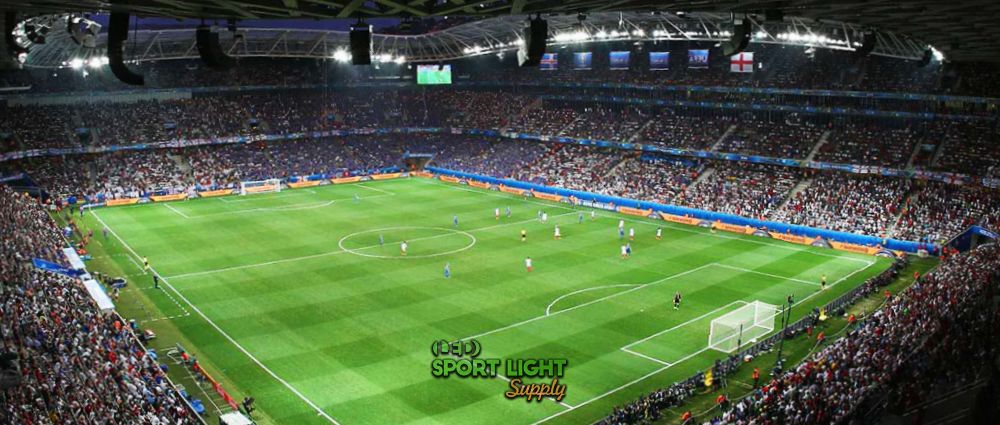
World Cup matches are among the most-watched sporting events on the planet. During the 2022 FIFA World Cup in Qatar, the tournament attracted billions of viewers worldwide, with the final alone drawing an audience of more than 1.5 billion people. Such enormous viewership places considerable demands on venue infrastructure, especially lighting.
For television broadcasters, lighting directly affects image quality. Cameras capturing fast-moving action need consistent illumination across the entire playing surface. Any shadows, dark spots, or uneven brightness can reduce picture quality and affect replay analysis. Modern broadcasting standards often require lighting levels that exceed 2,000 lux, particularly for premium international competitions.
Players also benefit from uniform lighting conditions. Accurate depth perception, ball tracking, and spatial awareness become much easier when illumination remains consistent from one end of the pitch to the other. Goalkeepers, in particular, rely on clear visibility when dealing with long-range shots, crosses, and aerial challenges.
From the spectator perspective, lighting contributes to the overall matchday experience. Beyond illuminating the field, modern systems are capable of creating synchronized pre-match shows, victory celebrations, and entertainment sequences that help transform football matches into large-scale live events.
The Main Components of a FIFA World Cup Lighting System
LED Sports Floodlights
The most recognizable element of any stadium lighting installation is the floodlight system itself. Over the past decade, LED technology has largely replaced traditional metal-halide fixtures due to its superior efficiency, flexibility, and performance.
A typical FIFA World Cup venue may utilize anywhere from 250 to more than 600 high-output LED luminaires, depending on stadium size, roof configuration, and target illumination levels.
These fixtures are strategically positioned around the roof structure to deliver consistent light coverage across the entire playing surface. Advanced optical systems allow engineers to precisely direct light where it is needed while reducing glare for players, spectators, and television cameras.
Individual stadium-grade LED floodlights often produce between 80,000 and 200,000 lumens each. Some premium models designed specifically for international sporting events can exceed these figures.
Pricing varies significantly depending on output, optics, controls, and manufacturer specifications. High-performance sports floodlights generally cost between USD $3,000 and $10,000 per fixture, while premium broadcast-grade models may exceed $12,000 each.
For larger venues with capacities above 70,000 spectators, the lighting equipment alone can easily represent an investment of $2 million to $5 million or more before installation costs are considered.
Beyond illumination, LED technology offers additional advantages. Compared with older metal-halide systems, LEDs can reduce energy consumption by approximately 40% to 70%, reach full brightness almost instantly, and provide operational lifespans exceeding 50,000 hours.
Lighting Control Systems
Modern World Cup lighting systems function much more like sophisticated digital networks than traditional electrical installations.
Centralized lighting control platforms allow operators to manage every fixture within the stadium from a single interface. Brightness levels can be adjusted in real time, while customized lighting scenes can be programmed for different events and operational requirements.
For example, a World Cup venue may use one lighting configuration for training sessions, another for media activities, and a separate high-output mode for televised matches. During opening ceremonies or pre-match presentations, operators can create dynamic lighting sequences synchronized with music, video displays, and special effects.
Many modern systems support DMX, DALI, Ethernet, and cloud-based communication protocols, providing flexibility for future upgrades and integration with other stadium technologies.
Depending on system complexity, lighting controls and automation infrastructure can cost anywhere from $150,000 to over $1 million. In larger venues that feature extensive entertainment and event-production capabilities, costs may exceed this range.
Electrical Infrastructure
Some of the largest stadium lighting expenses are not immediately visible to spectators.
Behind the scenes, a substantial electrical infrastructure network is required to support high-performance lighting systems. This includes transformers, switchgear, distribution boards, power cabling, conduits, monitoring equipment, and protection systems.
A World Cup stadium lighting installation can require several megawatts of electrical capacity. In some cases, older venues may not have sufficient power infrastructure to support modern LED systems and broadcast requirements.
As a result, extensive upgrades may be necessary. These upgrades can involve replacing aging electrical equipment, installing new substations, increasing utility capacity, or constructing additional power distribution networks throughout the facility.
Depending on the condition of the existing infrastructure, electrical upgrades can account for 20% to 40% of the total project budget. For major renovation projects, infrastructure-related costs may range from $500,000 to more than $3 million.
While these investments are less visible than floodlights themselves, they form the foundation that enables the entire lighting system to operate reliably.
Backup Power Systems
Backup power remains one of the most overlooked yet costly elements of FIFA-compliant stadium lighting projects.
World Cup venues must be prepared for a wide range of potential scenarios, including utility failures, equipment faults, and unexpected power disruptions. To maintain operations during these events, stadiums often install extensive backup power infrastructure.
Large diesel generators are commonly used as the primary emergency power source. Depending on venue requirements, a stadium may deploy multiple generators capable of producing several megawatts of electricity.
Battery energy storage systems are also becoming more common. These systems can provide immediate backup power while generators start up, reducing the risk of service interruptions.
Many facilities combine generators, UPS systems, and advanced monitoring software into a fully integrated resilience strategy. This approach helps ensure uninterrupted operation of lighting, broadcasting equipment, security systems, scoreboards, and other key infrastructure.
The cost of backup power systems varies considerably based on venue size and redundancy requirements. Smaller projects may invest several hundred thousand dollars, while major World Cup venues can allocate $1 million to $5 million or more toward emergency power infrastructure.
Although these systems represent a substantial investment, they provide an additional layer of protection for events that attract global audiences measured in the hundreds of millions or even billions.
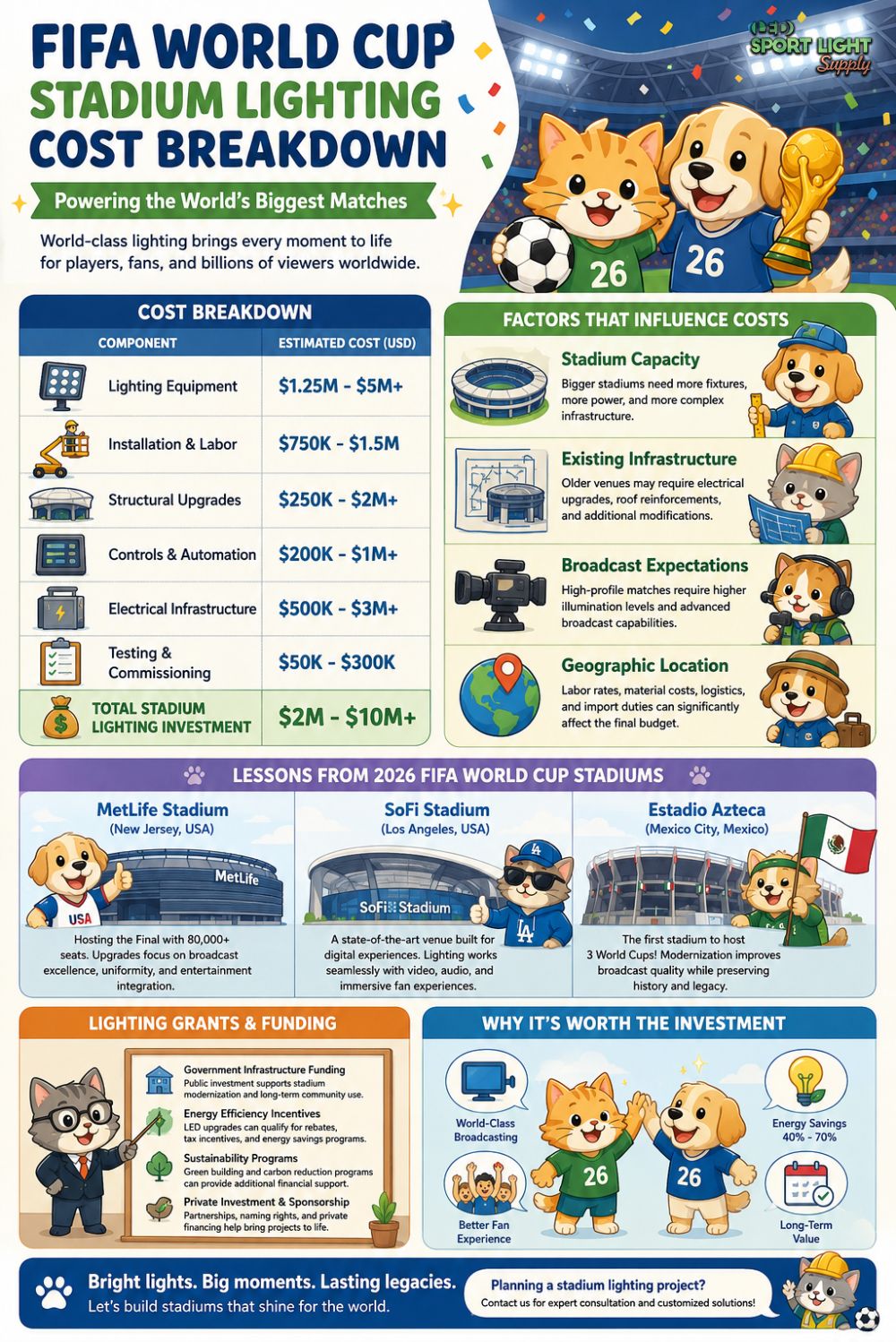
FIFA World Cup Stadium Lighting Cost Breakdown
| Component | Estimated Cost |
|---|---|
| Lighting Equipment | $1.25M – $5M+ |
| Installation & Labor | $750K – $1.5M |
| Structural Upgrades | $250K – $2M+ |
| Controls & Automation | $200K – $1M+ |
| Electrical Infrastructure | $500K – $3M+ |
| Testing & Commissioning | $50K – $300K |
| Total Stadium Lighting Investment | $2M – $10M+ |
Lighting Equipment Costs
For most FIFA World Cup venues, LED floodlights represent one of the largest individual investments within the overall lighting budget. These fixtures are responsible for delivering the illumination levels required for players, spectators, match officials, broadcasters, and the billions of viewers watching around the world.
The exact number of fixtures varies depending on stadium size, roof design, and FIFA lighting requirements. A medium-sized World Cup stadium with a capacity of 40,000 to 60,000 spectators may require between 250 and 500 high-output LED floodlights, while larger venues hosting semifinals or finals can require well over 600 fixtures.
Premium sports lighting fixtures typically cost between USD $5,000 and $10,000 per unit, although some advanced broadcast-grade luminaires designed for international tournaments can exceed $12,000 each. These fixtures often incorporate sophisticated optics, glare control technology, flicker-free performance, and smart control compatibility.
Based on these figures, lighting equipment costs alone can range from approximately $1.25 million to $5 million or more. For flagship venues selected to host opening matches, semifinals, or the World Cup Final, the investment may be even higher due to enhanced broadcasting requirements and larger seating capacities.
In many projects, lighting fixtures account for roughly 30% to 50% of the total stadium lighting budget, making them one of the most significant cost drivers.
Installation and Labor Costs
Installing a FIFA-compliant stadium lighting system involves far more than simply mounting floodlights around the roof structure.
Specialized contractors must coordinate electrical installations, structural work, safety systems, access equipment, testing procedures, and project scheduling. Much of the work takes place at considerable heights, often requiring cranes, elevated work platforms, rope access teams, and highly trained technicians.
The complexity increases further when renovations are performed on operational stadiums. Contractors may need to work around sporting schedules, concerts, and other events, which can extend project timelines and increase labor expenses.
Labor costs vary significantly depending on the host country, local wage levels, union requirements, and project complexity. As a general benchmark, installation-related expenses often account for 15% to 30% of the overall lighting project budget.
For example, a stadium lighting project valued at $5 million could incur labor costs ranging between $750,000 and $1.5 million. In higher-cost markets such as the United States, Canada, or parts of Western Europe, labor expenses can represent an even larger portion of the total investment.
Structural Modifications
One area that is often underestimated during budgeting is the cost of structural upgrades.
Many existing stadiums were originally designed around older lighting technologies and may not provide the optimal mounting locations required for modern FIFA-compliant LED systems. To achieve the necessary illumination levels and uniformity ratios, engineers frequently need to modify the stadium structure.
These modifications can include roof reinforcements, new mounting frames, catwalk extensions, maintenance access systems, and additional support structures. In some cases, entirely new lighting platforms must be constructed to achieve the correct beam angles and fixture positioning.
Although LED fixtures are generally lighter than traditional metal-halide systems, FIFA lighting requirements often demand more precise fixture placement and increased fixture quantities. As a result, structural work remains a significant budget consideration.
Depending on the age and condition of the venue, structural modification costs can range from approximately $250,000 to more than $2 million. Complex retrofit projects involving older stadiums may exceed these figures if extensive reinforcement work becomes necessary.
Control and Automation Systems
Modern FIFA World Cup stadiums rely on sophisticated lighting control systems that extend far beyond basic on-and-off functionality.
Today’s venues use centralized digital platforms that allow operators to manage thousands of lighting parameters from a single interface. These systems control brightness levels, lighting zones, energy consumption, maintenance diagnostics, and dynamic event lighting effects.
Many World Cup stadiums also integrate their lighting systems with video boards, audio systems, broadcast infrastructure, and entertainment technology. This enables synchronized pre-match presentations, opening ceremonies, player introductions, and post-match celebrations.
The software and hardware supporting these capabilities require substantial investment. Costs typically include control servers, networking equipment, programming services, user interfaces, communication protocols, cybersecurity measures, and system integration.
For large-scale FIFA venues, automation and control system expenses commonly range between $200,000 and $1 million, while highly advanced entertainment-focused stadiums may invest even more.
Although these systems represent a relatively small percentage of the total project budget, they provide valuable operational flexibility and help maximize the functionality of the lighting infrastructure.
Electrical Infrastructure Upgrades
In many World Cup stadium projects, electrical infrastructure represents one of the least visible yet most expensive components.
Modern sports lighting systems require substantial electrical capacity to support hundreds of high-performance fixtures operating simultaneously. Existing infrastructure may not always be capable of meeting these demands, particularly in older venues undergoing renovation.
Electrical upgrades can include new transformers, switchgear, power distribution panels, substations, cable networks, conduit systems, grounding systems, and monitoring equipment. Additional utility connections may also be required to ensure adequate power availability during major events.
For large venues hosting World Cup matches, electrical infrastructure costs can range from $500,000 to more than $3 million, depending on the extent of the required upgrades.
In some cases, infrastructure improvements account for 20% to 40% of the total lighting project budget, particularly when existing electrical systems require significant modernization.
Testing and Certification
Before a stadium can officially host FIFA World Cup matches, the lighting system must undergo extensive testing and verification procedures.
Specialized engineers conduct detailed measurements across the entire playing surface to confirm compliance with FIFA standards. These assessments include horizontal and vertical illuminance measurements, uniformity calculations, glare evaluations, color rendering verification, and flicker testing.
Broadcasters may also participate in testing to ensure that television production requirements are fully satisfied. Camera trials are often performed to evaluate image quality under actual operating conditions.
In addition to technical testing, stadium operators must complete documentation, commissioning reports, compliance reviews, and system acceptance procedures before final approval is granted.
Testing and commissioning expenses typically range between $50,000 and $300,000, although larger or more complex venues may incur higher costs.
While testing represents a relatively small percentage of the overall budget, it provides assurance that the stadium can deliver the lighting performance expected for one of the world’s most watched sporting events.
Total Project Cost Estimates
When all major components are combined, including lighting equipment, installation, structural modifications, electrical upgrades, control systems, backup power infrastructure, and certification costs, the total investment required for a FIFA World Cup stadium lighting project can vary considerably.
For smaller World Cup venues with existing modern infrastructure, costs may begin at approximately $2 million to $4 million. Mid-sized stadium modernization projects often fall within the $4 million to $8 million range.
Large flagship venues selected to host opening matches, semifinals, or finals can easily exceed $10 million, particularly when extensive infrastructure upgrades, advanced entertainment systems, and enhanced broadcast capabilities are included.
While these figures may seem substantial, they reflect the scale of infrastructure required to support global broadcasts, accommodate tens of thousands of spectators, and deliver the level of performance expected from a FIFA World Cup venue.
Factors That Influence World Cup Stadium Lighting Costs
Stadium Capacity
One of the biggest factors affecting stadium lighting costs is the size and capacity of the venue itself. Larger stadiums generally require more lighting fixtures, greater electrical capacity, and more extensive infrastructure to achieve FIFA’s required illumination standards.
For example, a stadium with a capacity of around 40,000 spectators may require significantly fewer luminaires than an 80,000-seat venue selected to host a World Cup semifinal or final. Larger venues often feature wider roof spans, taller mounting heights, and more complex architectural designs, all of which can influence lighting layouts and installation requirements.
Higher-capacity stadiums also tend to accommodate larger media operations and broadcasting facilities. This often results in stricter lighting specifications, requiring additional fixtures to achieve the uniformity and brightness levels expected for global television coverage.
As a result, it is not uncommon for lighting budgets at flagship World Cup venues to be several million dollars higher than those of smaller host stadiums, even when both facilities use similar lighting technologies.
Existing Infrastructure
The condition of a stadium’s existing infrastructure can have a major impact on project costs.
Retrofitting an older venue is often far more complicated than installing lighting systems in a newly constructed stadium. Existing structures may require electrical upgrades, cable replacements, roof reinforcements, mounting modifications, and compliance improvements before new lighting equipment can even be installed.
In many cases, engineers discover additional challenges once renovation work begins. Aging electrical systems, outdated distribution equipment, limited roof access, or structural constraints can increase costs beyond initial projections. Some older stadiums may also require extensive rewiring to support modern LED lighting controls and communication networks.
By comparison, newly constructed World Cup venues can incorporate lighting requirements during the design phase. Electrical infrastructure, mounting locations, maintenance access routes, and control systems can all be planned from the outset, helping reduce installation complexity and improve long-term efficiency.
For this reason, renovation projects sometimes cost more than expected, even when the stadium itself already exists.
Broadcast Expectations
Broadcasting requirements play a significant role in determining the overall lighting budget for a World Cup venue.
Not every match receives the same level of television production. Group-stage fixtures generally have lower broadcasting demands than opening matches, knockout rounds, semifinals, and the World Cup Final. The most high-profile matches often involve a larger number of cameras, enhanced replay systems, ultra-high-definition broadcasts, and more sophisticated production setups.
To support these requirements, stadiums hosting major fixtures may need higher illumination levels, improved vertical lighting performance, and stricter uniformity standards. Additional lighting fixtures are sometimes installed to ensure every camera angle receives optimal visibility.
Modern broadcasting technology continues to evolve as well. The growing adoption of 4K, HDR, and emerging 8K production standards places greater demands on lighting systems than previous generations of television equipment.
As a result, venues selected for showcase matches often invest more heavily in lighting infrastructure than stadiums hosting only early-stage tournament fixtures.
Geographic Location
Location can influence project costs in several ways, even when two stadiums require similar lighting systems.
Labor rates vary considerably from one country to another. Stadium projects in North America, Western Europe, and certain parts of Asia often involve higher labor costs due to wage levels, regulatory requirements, and specialized contractor availability. In some markets, labor can account for a substantial percentage of the overall project budget.
Material costs can also fluctuate based on local supply chains and economic conditions. If lighting fixtures, control systems, or electrical components need to be imported, transportation expenses and customs duties may significantly increase procurement costs.
Logistics can become another factor, particularly when stadiums are located far from major distribution centers. Shipping hundreds of specialized lighting fixtures, electrical components, and support structures across continents can add hundreds of thousands of dollars to a large-scale project.
Currency exchange rates may also affect budgeting for international tournaments. Since many premium sports lighting products are manufactured by global suppliers, fluctuations in exchange rates can influence final project costs during the planning and procurement process.
Taken together, these geographic factors can create substantial cost differences between otherwise similar FIFA World Cup stadium lighting projects.
Lessons from 2026 FIFA World Cup Stadiums
Stadium Upgrades Across the United States, Canada, and Mexico
Unlike previous FIFA World Cups that relied heavily on newly constructed venues, the 2026 FIFA World Cup takes a different approach. Most host stadiums already serve as major NFL, MLS, or international event venues, meaning the focus has shifted toward modernization and infrastructure upgrades rather than complete new builds.
A significant portion of the investment has been directed toward broadcast technology, digital infrastructure, fan experience enhancements, and stadium lighting improvements. Many venues have been upgrading their existing lighting systems to meet FIFA’s broadcasting standards, particularly as global audiences increasingly expect ultra-high-definition viewing experiences.
For stadium operators, upgrading an existing venue can often be more complex than installing lighting in a newly constructed facility. Engineers must work around existing roof structures, electrical systems, and operational schedules while ensuring the stadium remains functional for regular sporting events throughout the renovation process.
MetLife Stadium
MetLife Stadium in New Jersey, selected to host the 2026 FIFA World Cup Final, highlights the level of preparation required for one of the tournament’s showcase venues.
With a seating capacity exceeding 80,000 spectators, the stadium already possesses world-class infrastructure. However, hosting the final of the world’s largest football tournament requires facilities capable of supporting extensive international broadcasting operations, enhanced security measures, and premium spectator experiences.
Lighting upgrades are expected to focus on achieving exceptional illumination uniformity, improved broadcast visibility, and integration with entertainment systems used during opening ceremonies, player introductions, and post-match celebrations. For a venue of this scale, lighting and related electrical infrastructure can represent a multi-million-dollar investment even when much of the existing framework is already in place.
SoFi Stadium
SoFi Stadium in Los Angeles is widely regarded as one of the most technologically advanced sports venues in the world. Opened in 2020, the stadium was designed with modern digital infrastructure and large-scale event capabilities from the beginning.
Its enclosed roof design and extensive audiovisual systems create unique opportunities for integrating stadium lighting with immersive fan experiences. Advanced LED lighting can be synchronized with video displays, music, and live entertainment, allowing the venue to deliver experiences that extend far beyond the football match itself.
Because many modern FIFA World Cup venues are increasingly expected to function as entertainment destinations, investments in lighting often support both sporting and non-sporting events, improving the long-term return on infrastructure spending.
Estadio Azteca
Mexico City’s Estadio Azteca occupies a unique place in World Cup history and will become the first stadium to host matches in three separate FIFA World Cups.
As one of the tournament’s most iconic venues, the stadium has undergone extensive modernization efforts ahead of 2026. Lighting improvements form part of a broader renovation strategy designed to enhance broadcast quality while preserving the character and heritage of the historic venue.
Upgrading lighting systems in older stadiums often presents additional engineering challenges compared with newer facilities. Existing structures may require electrical enhancements, revised mounting systems, and infrastructure modifications to accommodate modern LED technology. These factors can increase project costs but help ensure the stadium remains capable of meeting current FIFA requirements while continuing to serve future generations of fans.
What 2026 Reveals About Modern Stadium Lighting Investments
The 2026 FIFA World Cup demonstrates how stadium lighting has evolved from a purely functional necessity into a sophisticated technology platform. Modern venues are expected to support global broadcasting, energy efficiency goals, interactive fan experiences, and year-round event operations.
Whether the project involves upgrading a historic venue such as Estadio Azteca or preparing a state-of-the-art facility like SoFi Stadium, lighting investments increasingly focus on flexibility, sustainability, and long-term value. For host stadiums, the objective is no longer simply meeting tournament requirements but creating infrastructure that continues delivering benefits long after the World Cup has ended.
Funding Opportunities and Lighting Grants for FIFA World Cup Stadium Projects
Are There Specific FIFA Lighting Grants?
One question that frequently arises during stadium modernization projects is whether FIFA provides dedicated grants specifically for stadium lighting upgrades. In most cases, FIFA does not offer standalone grants exclusively for lighting systems. Instead, lighting improvements are often funded as part of broader stadium development, infrastructure modernization, or tournament preparation programs.
For FIFA World Cup host venues, lighting upgrades are typically incorporated into larger renovation budgets that may also include seating improvements, broadcast facilities, security enhancements, pitch upgrades, and fan experience infrastructure. As a result, funding is usually secured through a combination of government support, venue ownership investment, private financing, and tournament-related infrastructure programs.
Government Infrastructure Funding
For FIFA World Cup host nations, public-sector funding often plays a significant role in stadium modernization efforts.
National, regional, and municipal governments frequently allocate budgets for transportation, venue improvements, energy infrastructure, and sporting facilities in preparation for major international events. Stadium lighting upgrades may qualify as part of these broader infrastructure investments, particularly when the improvements contribute to long-term community use after the tournament.
For example, venues selected for the FIFA World Cup 2026 in the United States, Canada, and Mexico have generally relied on a mixture of public and private investment to support stadium improvements and surrounding infrastructure development.
Energy Efficiency Incentives
Many countries offer financial incentives designed to encourage energy-efficient building upgrades, including LED lighting projects.
Because modern stadium lighting systems can reduce electricity consumption by 40% to 70% compared with older technologies, operators may qualify for utility rebates, energy-efficiency grants, tax incentives, or sustainability funding programs. The exact incentives available depend on the country, state, province, or local jurisdiction where the stadium is located.
In some cases, utility companies provide rebates based on projected energy savings, while government agencies may offer grants that support carbon reduction initiatives and sustainable infrastructure projects.
Although these programs are not specifically designed for FIFA World Cup stadiums, they can help offset a portion of the investment required for LED lighting upgrades.
Sustainability and Green Building Programs
As environmental performance becomes a larger consideration in stadium development, some venues pursue additional funding through sustainability-focused programs.
Projects that incorporate energy-efficient lighting, smart controls, renewable energy integration, or broader sustainability measures may qualify for green infrastructure funding opportunities. Stadium operators may also pursue certifications such as LEED or other sustainability frameworks, which can improve eligibility for certain grants or financing programs.
For large venues where lighting represents a significant portion of overall energy consumption, these programs can provide meaningful financial support while helping owners achieve long-term operational savings.
Private Investment and Sponsorship Opportunities
In addition to public funding, many stadium owners explore private-sector financing options to support modernization projects.
Corporate sponsorship agreements, naming-rights partnerships, infrastructure investors, and venue development funds can all contribute toward capital improvement budgets. In some cases, technology providers and lighting manufacturers may also participate in financing arrangements that spread project costs over multiple years.
Because modern lighting systems improve both broadcast quality and fan engagement, they are often viewed as revenue-generating investments rather than purely operational expenses.
Planning Ahead for Available Funding
Funding opportunities for FIFA World Cup stadium lighting projects vary significantly depending on location, ownership structure, and project scope. While dedicated FIFA lighting grants are uncommon, many venues successfully combine government infrastructure funding, energy-efficiency incentives, sustainability programs, and private investment to support major lighting upgrades.
For stadium owners and project stakeholders, identifying potential funding sources early in the planning process can help reduce capital expenditure and improve project feasibility. Working with experienced lighting consultants and infrastructure specialists can also uncover grant opportunities, rebate programs, and financing solutions that may not be immediately apparent during the initial budgeting phase.
Looking Ahead
As broadcasting technology continues to evolve, stadium lighting requirements are likely to become even more demanding. Future World Cups may involve greater use of 8K broadcasting, advanced player-tracking systems, immersive fan experiences, and AI-driven venue management tools.
These developments will continue shaping how stadium lighting systems are designed, installed, and operated. While project costs can range from roughly $2 million to more than $10 million depending on venue size and complexity, the investment supports broadcast quality, operational reliability, and fan engagement on a global scale.
For stadium owners, sports organizations, developers, and host city planners evaluating FIFA-compliant lighting solutions, working with experienced specialists can make a significant difference during both planning and implementation. If you’re exploring stadium lighting upgrades, sports venue development, or large-scale LED lighting projects, feel free to contact our team for professional consultation and tailored recommendations based on your specific project requirements.