
Sports lighting does a lot more than make a field or court bright after sunset. It helps players follow fast-moving balls, gives referees a clearer view of the action, makes playing surfaces easier to judge, and allows spectators to enjoy a match without constantly squinting at the lights. When the lighting system is poorly designed, however, even a well-maintained sports facility can become uncomfortable to use.
The tricky part is that different sports have different lighting problems. A baseball batter needs to see a fast pitch clearly, while a tennis player must follow a ball that can travel high above the court. Basketball players deal with reflections from polished floors, and swimmers have to contend with glare from the water. A lighting arrangement that works reasonably well for one sport may create several headaches for another.
There is also the financial side of the problem. Poor lighting can lead to unnecessary electricity costs, frequent maintenance, complaints from nearby residents, and expensive upgrades that could have been avoided with better planning. In the United States, a sports lighting project may cost several thousand dollars for a small installation or hundreds of thousands of dollars for a full-size outdoor field. Larger venues with demanding competition and broadcast requirements can cost substantially more.
The good news is that most sports lighting problems can be identified, measured, and addressed. The key is to understand what is going wrong, why it happens, and which changes will deliver a genuine improvement rather than simply adding more powerful lights.
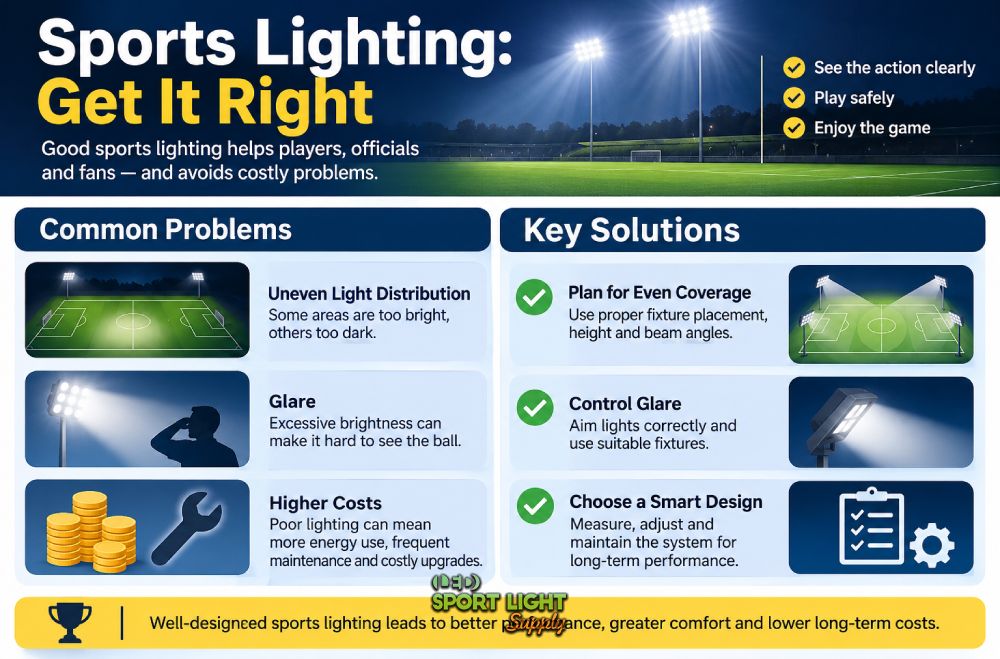
Understanding the Most Common Problems of Sports Lighting
Before looking at individual sports, it helps to understand the problems that appear across many types of facilities. Some are easy to spot, such as a failed floodlight or an obviously dark corner. Others are less noticeable until players start complaining about glare, balls become difficult to track, or the electricity bill arrives.
Uneven Light Distribution Across the Playing Area
Uneven illumination is one of the most common problems in sports lighting. It occurs when certain parts of a field or court receive plenty of light while other areas remain noticeably darker. A soccer pitch may look bright from the stands, for example, yet have poorly illuminated corners or touchlines. On an indoor basketball court, the area beneath the baskets may be brighter than the center of the floor.
The problem is not simply that some areas have less light. The sudden change between bright and dark areas can make visual tasks more difficult, particularly when players are moving quickly and following a ball across the playing surface.
Several factors can contribute to uneven illumination. Fixtures may be spaced too far apart, mounted at unsuitable heights, or aimed incorrectly. The optical distribution of the luminaires may also be poorly matched to the dimensions of the field. In some older installations, individual fixtures have failed over time, leaving gaps that were not obvious when the system was first commissioned.
Consider a rectangular outdoor field measuring approximately 100 meters by 64 meters. If floodlights are concentrated near the center of the field, the middle may receive plenty of light while the corners receive much less. Increasing the output of the central fixtures might raise the average illumination, but it would not necessarily solve the darker corners. It could even make the contrast between areas more noticeable.
A better approach is to assess the entire playing surface using a lighting calculation and a grid of measurement points. The grid should cover the center, edges, corners, and any areas with special requirements. The designer can then adjust fixture positions, beam angles, mounting heights, or output levels to distribute light more evenly.
For an existing facility, a nighttime lighting survey can reveal whether the problem comes from the original design, failed equipment, dirty lenses, or incorrect aiming. This matters because replacing every fixture is not always necessary. Sometimes, a targeted adjustment can solve much of the problem at a lower cost.
Glare That Makes Players Lose Sight of the Ball
Glare occurs when a light source is excessively bright within a person’s field of view or creates uncomfortable visual contrast. In sports, it can become a real nuisance because players regularly look upward, turn their heads quickly, or track objects against dark backgrounds.
A soccer goalkeeper may lose sight of a high ball when a floodlight sits directly behind its flight path. A tennis player might struggle to follow a lob under poorly positioned fixtures. Basketball players can experience similar discomfort when looking toward the ceiling to contest a rebound.
Glare is not always caused by fixtures that are too bright overall. The problem may come from the angle at which the light reaches a player’s eyes, the apparent brightness of the luminaire, or the contrast between the fixture and the surrounding area. A powerful light aimed incorrectly can be more troublesome than a lower-output fixture with suitable optics.
Fixture aiming is therefore a major part of glare control. Designers need to consider where players stand, which directions they face, and how their lines of sight change during play. Shielding, narrower or more suitable beam distributions, carefully selected mounting positions, and reduced output where appropriate can all help.
There is a useful distinction between reducing glare and simply reducing brightness. If a facility lowers the output of every fixture, the field may become too dark. If the luminaires are repositioned or fitted with better optical control, players may enjoy better visual comfort without sacrificing the illumination needed for the sport.
Insufficient Illumination for the Level of Play
A lighting system can be adequate for casual recreation but unsuitable for a tournament, school competition, or televised match. This often happens when a facility is upgraded in stages without reassessing its actual use.
A community field may originally have been designed for evening training. Later, it begins hosting regional competitions, but the lighting remains unchanged. The field might still appear reasonably bright to someone standing on the sideline, yet the system may not deliver the uniformity, vertical illumination, or visual performance required for the new level of play.
Illuminance is measured in lux or foot-candles. One foot-candle is approximately 10.764 lux, while 1 lux equals 1 lumen of light arriving on each square meter of a surface. These measurements help describe how much light reaches the playing area, although they do not tell the whole story about glare, contrast, or visibility.
For example, a facility may target an average horizontal illuminance of 200 lux for a particular use, while another venue requires 500 lux or more because of its competition category and governing-body requirements. These are illustrative planning figures, not universal requirements. The actual target must be selected for the sport, venue, playing level, and applicable standard.
The right solution begins with confirming the intended use. A designer should establish whether the venue will host training, recreational play, organized competition, spectator events, or broadcast matches. Each use can lead to a different lighting specification and budget.
Excessive Brightness and Poor Visual Contrast
More light does not automatically produce better visibility. A field can have a high average illuminance and still be uncomfortable if the light is distributed poorly or the brightest areas are far brighter than the surrounding surfaces.
Visual contrast also matters. A ball must stand out from its background, and players need to distinguish teammates, opponents, boundary lines, and surface changes. If a bright fixture creates a washed-out background, the extra light may actually make an object harder to see.
This issue is especially noticeable in sports involving fast-moving balls. A white ball crossing a bright or reflective background can be difficult to follow, even when the general playing area appears well illuminated. The same problem can occur with a shuttlecock against a pale indoor ceiling or a dark puck against an ice surface with reflections.
Improving contrast may involve changing the fixture position, reducing direct glare, selecting a more suitable lighting distribution, or reviewing the colors and reflectance of nearby surfaces. Indoor venues may also need to consider ceiling brightness, wall finishes, and the location of large reflective objects.
Flickering and Stroboscopic Effects
Flicker is another issue that may not be obvious during a quick inspection. Some LED lighting systems exhibit noticeable changes in light output because of driver performance, power quality, dimming compatibility, or control-system settings.
In ordinary play, visible flicker may be subtle. During high-speed video recording, however, it can appear as dark bands, inconsistent brightness, or uneven-looking footage. Stroboscopic effects can also alter the apparent movement of fast-moving objects under certain lighting conditions.
This makes flicker performance worth checking in facilities used for livestreaming, slow-motion recording, training analysis, or professional broadcasting. A luminaire should not be selected based on its wattage or brightness alone. Its driver and dimming behavior also deserve attention.
When replacing existing fixtures, venue managers should request suitable flicker-performance information from the manufacturer and confirm that the proposed equipment meets the needs of the intended recording system. A dimmer that works with one LED driver may perform poorly with another, so compatibility testing is useful before a large installation proceeds.
Shadows That Interfere With Play
Shadows occur when objects block light from reaching a surface. In sports facilities, these objects may include players, goalposts, nets, structural beams, protective screens, or equipment.
Some shadows are unavoidable, but poorly planned lighting can make them unusually dark or extensive. A player running through a dark patch may find it harder to judge a ball’s movement against the playing surface. Referees can also have difficulty seeing markings or player contact in poorly illuminated areas.
The problem often appears when most of the light comes from one direction. If a facility uses only a small number of concentrated light sources, objects may cast long shadows across the field. A better distribution of light from several directions can soften those shadows, although the exact arrangement depends on the sport and venue.
Indoor facilities need to consider structural obstructions as well. Large roof beams can block light from fixtures mounted above them, while suspended equipment can create localized dark areas. A computer-based lighting model should account for these obstacles rather than treating the venue as an empty rectangle.
Poor Color Rendering and Inconsistent Color Appearance
Color rendering affects how naturally objects appear under artificial light. It can influence the visibility of uniforms, surface markings, balls, equipment, and other visual details.
The color rendering index, commonly called CRI or Ra, is one way of describing how closely a light source renders colors compared with a reference. For many general lighting applications, a CRI of 80 or higher is a common specification, although sports venues should select the appropriate performance for their use rather than rely on a single number.
Broadcast venues may have additional requirements for color consistency and camera performance. Two fixtures with similar color temperatures can still produce noticeably different colors if their spectral characteristics differ. This can make one section of a field appear slightly cooler or greener than another on camera.
A practical approach is to specify color quality consistently across the project and request manufacturer data for the selected luminaires. When upgrading only part of an older installation, the designer should also consider whether new fixtures will match the existing equipment closely enough.
High Electricity Bills and Unnecessary Energy Use
Sports lighting can consume a substantial amount of electricity, particularly when a large field is illuminated for several hours each evening. Older systems may use less efficient light sources, while poorly designed installations sometimes operate at full output even when only a fraction of the playing area is in use.
The problem becomes easier to understand when energy consumption is calculated rather than estimated from fixture count alone.
Suppose a facility operates a lighting system with a total connected load of 30 kilowatts for 5 hours each day, 300 days per year. Its annual electricity consumption would be:
30 kW × 5 hours × 300 days = 45,000 kWh.
At an assumed electricity rate of US$0.15 per kWh, the annual energy cost would be US$6,750. If the same facility used 18 kW to provide the required lighting performance, its annual consumption would fall to 27,000 kWh, costing US$4,050 at the same rate. The modeled difference would be US$2,700 per year.
These figures illustrate a calculation method, not a guaranteed LED saving. The lower-power system must still meet the required illumination, uniformity, and visual performance. Actual results depend on operating hours, electricity tariffs, controls, equipment efficiency, and the condition of the existing installation.
Frequent Equipment Failures and Expensive Maintenance
A sports lighting system may include dozens of luminaires mounted on tall poles or difficult-to-access roof structures. When a fixture fails, repairing it can involve a lift, specialist technicians, access restrictions, and temporary closure of part of the venue.
For that reason, the cost of sports lighting is not limited to purchasing and installing fixtures. Maintenance access, replacement parts, equipment reliability, and the time needed to complete repairs can all affect the long-term budget.
Common problems include failed LED drivers, damaged cables, loose electrical connections, water ingress, corrosion, and declining light output. Dirt on lenses can also reduce the amount of light reaching the playing surface, even when the fixture itself is still operating.
A preventive maintenance schedule helps identify these problems before they cause major disruption. Inspections can be planned around the playing calendar, and lighting measurements can be repeated periodically to check whether the system still meets its performance targets.
Weather Damage and Environmental Exposure
Outdoor sports lighting must withstand the conditions at its site. Rain, humidity, wind, dust, heat, cold, and salt-laden air can affect fixtures and electrical components over time.
A coastal sports facility, for example, may face more corrosion than an inland venue. A field in a hot climate may require particular attention to thermal management, while a facility exposed to freezing temperatures needs equipment rated for its operating conditions.
Ingress protection ratings, often described as IP ratings, indicate how well an enclosure resists the entry of solid objects and water under specified test conditions. They do not automatically guarantee suitability for every environment, so the full product specification should be reviewed.
For outdoor installations, the selection process should also cover wind loading, pole foundations, mounting hardware, cable protection, and access for maintenance. A luminaire with excellent optical performance will not deliver a good result if the mounting structure is poorly designed or the enclosure deteriorates prematurely.
Light Spill and Complaints From Nearby Residents
Outdoor sports lighting can affect properties beyond the boundary of the facility. Light that travels into bedroom windows, shines toward nearby roads, or escapes upward into the night sky may cause complaints even when the playing surface itself is well lit.
The problem is particularly common where sports grounds are close to housing. A floodlight aimed slightly beyond the field can send unnecessary light toward a neighboring property, and a fixture that is too bright for the application may increase the problem.
The solution is not necessarily to switch the system off earlier or reduce all lighting levels. Better optical control, shielding, careful aiming, appropriate mounting heights, and operating schedules can often improve the situation.
Before construction or a major upgrade, designers should check local planning conditions and any applicable restrictions on obtrusive light. They should also consider how lighting changes as viewed from nearby homes, roads, and other sensitive locations.
Poor Lighting Controls and Inadequate Commissioning
Even a well-designed lighting system can perform badly if the controls are confusing or the final installation does not match the design.
A multipurpose sports complex may need different settings for practice, league matches, tournaments, cleaning, and maintenance. If every luminaire switches on at full power regardless of the activity, the facility may consume more electricity than necessary.
Poor commissioning can create additional problems. Fixtures may be aimed incorrectly, dimming settings may be unsuitable, and some control zones may not operate as intended. These issues can remain unnoticed if the installer tests only whether the lights turn on.
A proper handover should include functional checks, verification of aiming, lighting measurements where required, control-system testing, and clear operating instructions. Facility staff should know how to select the correct scene and whom to contact when something stops working.
Common Sports Lighting Problems by Sport
The general problems described above can affect almost any venue, but the way they show up depends heavily on the sport. Ball speed, viewing angles, playing surface, ceiling height, and the distance between players and fixtures all influence the final lighting design.
A useful way to approach sports lighting is to start with the visual task. What does the player need to see? Where will the object move? Which direction will the player face? Once those questions are answered, the lighting designer can identify the most likely trouble spots and plan around them.
Different sports may share the same general lighting defects, but the effects on play can vary considerably. The following table summarizes the main areas that deserve attention during an assessment.
| Sport | Common lighting problem | Main design focus |
|---|---|---|
| Soccer | Uneven pitch lighting and glare on high balls | Uniformity and vertical visibility |
| American football | High-ball tracking and dark sidelines | Full-field coverage |
| Baseball and softball | Batter glare and fly-ball visibility | Viewing angles and outfield coverage |
| Basketball | Overhead glare and floor reflections | Low-glare optics and floor reflectance |
| Tennis | Glare on lobs and dark court edges | Ball tracking and uniformity |
| Badminton | Shuttlecock visibility | Ceiling contrast and fixture placement |
| Volleyball | Overhead glare | Vertical visibility and uniformity |
| Table tennis | Tabletop reflections | Reflection control and contrast |
| Swimming | Water reflections and corrosion | Visibility and environmental protection |
| Track and field | Uneven track and event-zone coverage | Zone-specific lighting |
| Golf | Poor target visibility and light spill | Targeted illumination |
| Ice hockey | Ice reflections and puck contrast | Glare and visual contrast |
| Cricket | Uneven outfield lighting | Large-area uniformity |
| Rugby | High-kick glare and dark boundaries | Whole-field coverage |
| Gymnastics | Shadows and overhead glare | Landing-zone visibility |
| Pickleball | Glare and neighboring-court spill | Court-specific aiming |
The table is a starting point rather than a substitute for a design assessment. Two venues hosting the same sport may need different solutions because of their dimensions, ceiling heights, mounting arrangements, local surroundings, and intended level of competition.
Football (Soccer) – Uneven Pitch Lighting and Glare During High Balls
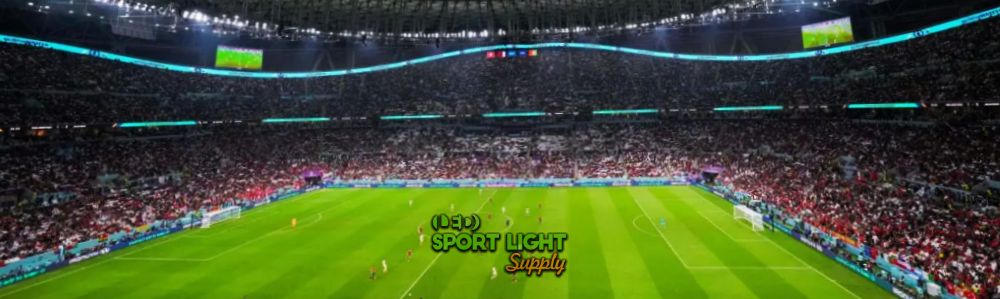
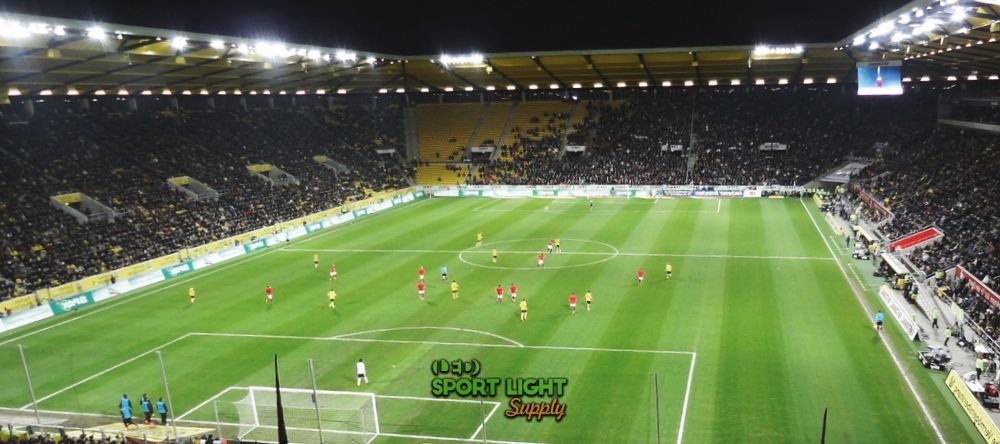
Soccer fields cover a large area, and the action can move from one end to the other in seconds. Players need to see the ball, teammates, opponents, field markings, and changes in movement across the entire pitch. A lighting system that performs well in the center but leaves the corners dim can make the field feel inconsistent, particularly during evening matches.
One common problem is uneven illumination between the center circle, penalty areas, touchlines, and corners. The issue may be caused by poor fixture spacing, unsuitable beam angles, or a design that does not account for the actual dimensions of the pitch. On a large field, even a small design error can affect a substantial area.
Glare is another familiar complaint. Goalkeepers must judge crosses, defenders track aerial passes, and attackers follow high balls while moving at speed. If a floodlight sits in the player’s line of sight, the ball may temporarily blend into the surrounding brightness. This is especially troublesome when a player must react quickly rather than pause and adjust their viewing angle.
Soccer venues also need to consider vertical illumination. Horizontal illuminance describes light reaching the playing surface, while vertical illuminance describes light arriving at a vertical plane. Both can matter because players and the ball must be visible from different directions. Vertical lighting performance becomes even more relevant when spectators or cameras need a clear view of players across the pitch.
For a recreational soccer field, the solution may involve adjusting a few existing fixtures and correcting dark areas. A facility used for formal competition may need a more detailed photometric redesign, new luminaires, or upgrades to poles and electrical infrastructure. If televised matches are planned, the design must also account for camera positions and the visual requirements of the intended broadcast format.
The facility should not choose a lighting level based on field size alone. A youth training field and a higher-level competition pitch may have similar dimensions but very different performance requirements. The intended use should determine the specification.
American Football – High-Ball Tracking and Sideline Visibility
American football presents a different set of challenges because the action includes long passes, punts, kickoffs, and rapid changes of direction. Receivers and defensive players often need to follow a ball traveling high through the air, while coaches, officials, and players along the sidelines need clear visibility of the action.
A common problem is poor illumination near the end zones and sidelines. These areas can be missed when fixture layouts focus mainly on the center of the field. The result may be a bright midfield with less consistent lighting near the boundaries, where players still need to judge catches, foot placement, and whether they have remained in bounds.
Glare during high kicks and long passes is another concern. A player looking upward may have a floodlight positioned behind the ball, making it harder to follow its flight. The challenge is not solved by simply adding more light. Fixture aiming and the position of the lighting towers must be planned around typical viewing directions.
American football fields also need to accommodate the visual needs of officials and spectators. On venues used for video recording, coaching analysis, or television coverage, the system may need better vertical illumination and tighter control of flicker than a basic recreational installation.
A useful design review should examine the entire field, including end zones, sidelines, and areas around the goalposts. It should also check the visibility of players from common spectator and camera positions. These checks can reveal whether the problem lies in horizontal coverage, vertical illumination, glare, or a combination of factors.
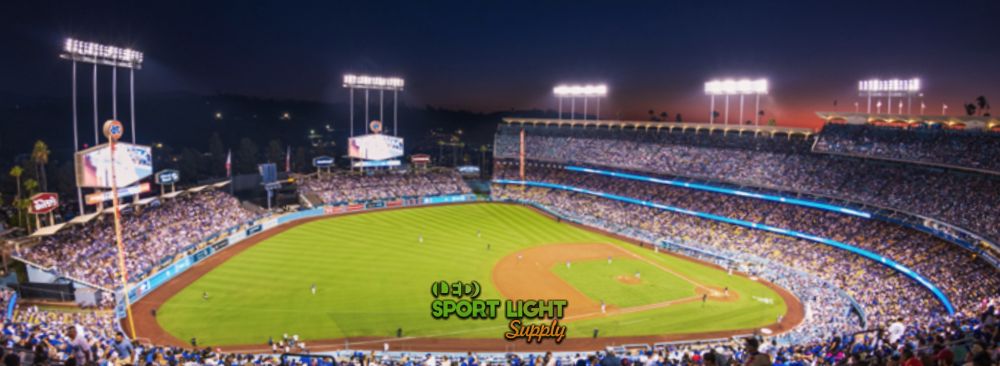
Baseball and Softball – Batter Glare and Fly-Ball Visibility
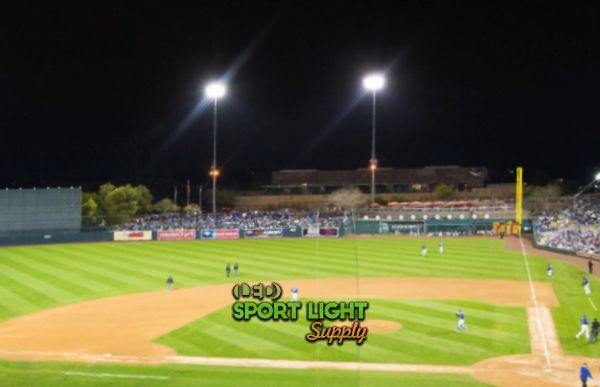 Baseball and softball are particularly sensitive to lighting quality because players must track a small ball moving quickly against changing backgrounds. A batter watches a pitch approaching from the pitcher, while fielders may need to follow a high fly ball against the night sky.
Batter glare and poor fly-ball visibility are among the most troublesome lighting issues in these sports. A batter may find it difficult to follow a pitch if a bright luminaire is positioned within the relevant line of sight. Outfielders face a different challenge when a ball travels high and passes near the visual direction of a floodlight.
The field also has several distinct lighting zones. The pitcher’s mound, batter’s box, bases, infield, outfield, warning track, and bullpen do not necessarily share the same visual demands. If the lighting design treats the entire baseball field as one simple rectangle, it may overlook areas where the action is concentrated.
For example, the infield may receive strong illumination while the outfield remains less consistent. A fly ball can then move between areas with different brightness, making it harder for fielders to judge its trajectory. Poor lighting near the bases can also affect visibility during close plays.
Fixture placement needs to be coordinated with the geometry of the diamond and the viewing directions of batters, pitchers, catchers, and fielders. The design should consider how the ball appears against both the sky and the surrounding structures. Backstops, netting, and light poles can create additional obstructions or shadows.
Baseball lighting can also become expensive when a facility requires new poles, electrical infrastructure, and specialized fixture arrangements. Before committing to a complete replacement, venue managers should determine whether the existing poles and foundations can be reused safely. A photometric redesign may reveal opportunities to improve performance without rebuilding every part of the installation.
Basketball – Glare, Reflections, and Uneven Court Lighting
Basketball involves frequent overhead viewing. Players look up to track rebounds, attempt jump shots, receive passes, and defend shots near the basket. As a result, glare from ceiling-mounted luminaires can be particularly uncomfortable.
The polished wooden floor introduces another issue – reflected light. A fixture may produce an unpleasant reflection on the floor even when it is not directly in a player’s line of sight. These reflections can reduce visual comfort and create bright patches that distract players during quick movements.
Uneven illumination is also common in older gymnasiums. The middle of the court may receive plenty of light, while the areas around the baskets, sidelines, or baseline remain darker. In multipurpose halls, fixtures may have been installed to serve general activities rather than basketball alone, leaving the court without a layout designed for its specific needs.
A good basketball lighting design should account for fixture positions, ceiling height, floor reflectance, and the viewing directions of players. It should also consider how the court looks from the stands and from cameras positioned at different heights.
The best solution is not always a higher-output luminaire. A better optical distribution, a different mounting position, or a change to the lighting layout may reduce reflections while maintaining suitable illumination. If the venue is used for televised games, the designer should also review color rendering, color consistency, and flicker performance.
Tennis – High-Ball Glare and Court-Edge Dark Areas
Tennis players regularly track lobs, overhead shots, and serves that move above the net and into the upper field of view. Poorly aimed floodlights can interfere with that task, especially when a ball travels close to a bright fixture.
The problem becomes more noticeable when the player must react immediately. During a rally, there may be little time to adjust position or look away from the glare source. A lighting layout that appears acceptable to someone standing outside the court can therefore feel uncomfortable during actual play.
Another common issue is uneven illumination near the baselines and sidelines. Tennis courts have clearly defined boundaries, and players frequently move close to the edges while returning difficult shots. Dark patches around these areas can make foot placement and ball tracking less comfortable.
Outdoor tennis facilities may also face light spill complaints because courts are often located near homes, parks, schools, or other recreational spaces. A row of floodlights that illuminates the court effectively may still send unnecessary light beyond the property boundary.
A well-planned tennis system uses suitable optics and carefully selected mounting positions to maintain coverage across the playing area while limiting glare. Designers should consider the ball’s flight path, player viewing angles, neighboring properties, and the position of adjacent courts. Where several courts share a site, the layout should prevent one court’s lights from creating glare or unwanted brightness on another.
Badminton – Shuttlecock Visibility Under Indoor Lighting
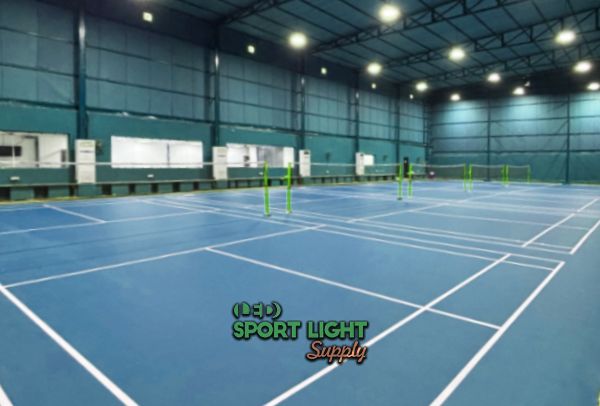 Badminton may look straightforward from a lighting perspective because the court is relatively small, but the shuttlecock moves quickly and often travels high above the players. The ceiling and upper background can have a strong influence on how easily the shuttlecock is seen.
A common problem is glare from overhead luminaires when players look up to follow clears and smashes. The shuttlecock may pass near a bright fixture or disappear briefly against a bright ceiling. This can affect a player’s ability to judge the shuttle’s position and respond in time.
Badminton halls also frequently contain multiple courts. If the lighting arrangement was designed for general indoor activities, it may create inconsistent conditions from one court to another. Roof beams, suspended equipment, and poorly positioned fixtures can produce dark patches or reflections.
The playing surface should receive reasonably consistent illumination, but floor brightness is only part of the picture. The designer also needs to consider the ceiling, background contrast, player viewing directions, and the location of luminaires relative to each court.
A practical improvement may involve relocating fixtures outside the most troublesome viewing zones, using lower-glare optical designs, or adjusting output to reduce discomfort. Before making changes across an entire hall, it is worth testing a representative court to see how the proposed arrangement performs during real play.
Volleyball – Overhead Visibility and Uneven Court Coverage
Volleyball players spend much of a match looking upward. Setters track the ball as it rises, attackers time their approach, and blockers watch the ball near the net. This makes glare and overhead visibility particularly relevant.
One of the most common problems occurs when bright luminaires sit within the viewing direction used to track the ball. The problem can be more noticeable in facilities with low ceilings or fixtures positioned directly above the main playing area.
Uneven illumination may also appear between the center of the court and the sidelines. In multipurpose sports halls, the lighting may have been arranged for several activities rather than volleyball specifically. Structural beams, suspended equipment, and net supports can add to the problem.
A volleyball lighting assessment should look beyond the average lux reading. It should examine uniformity, glare, vertical illumination where required, and the visual environment above the court. The aim is to create conditions in which players can follow the ball throughout its trajectory without unnecessary visual discomfort.
For venues hosting multiple sports, adjustable lighting scenes may be useful, but controls should not be used to compensate for a fundamentally unsuitable fixture layout. A well-designed system should provide appropriate conditions for each activity within the limits of the venue.
Table Tennis – Reflections and Fast-Ball Tracking
Table tennis places intense demands on visual tracking. The ball is small, moves quickly, and changes direction frequently. Players need to distinguish it clearly from the tabletop, background, and surrounding environment.
Reflections from overhead lighting can create uncomfortable bright patches on the table surface. Even if the ball remains visible, the reflection may distract players or reduce contrast in the area where the ball is expected to bounce.
A second problem is inconsistent illumination between tables in larger training halls. Some tables may sit directly beneath fixtures, while others fall between lighting rows. The difference can become noticeable when players move between tables or when several matches are played at once.
Fixture selection and positioning should reduce direct glare and control reflections from the tabletop. Designers should also consider table color, wall finishes, background contrast, and the viewing positions of players on both sides of the table.
A table tennis hall used for tournaments may need a more carefully controlled environment than a general recreation room. Lighting requirements should reflect the intended competition level and any applicable rules rather than relying on a generic indoor lighting specification.
Swimming Pools – Water Reflections and Corrosion
Swimming pools create a special lighting environment because the water surface constantly changes the way light is reflected and distributed. Ripples can produce moving patterns of brightness, while poorly positioned fixtures may create glare for swimmers, lifeguards, and spectators.
Visibility is not limited to the water itself. Lifeguards need to observe swimmers, pool edges, lane markings, starting blocks, and areas where people enter or leave the pool. A lighting design that produces attractive reflections but leaves parts of the pool difficult to observe is not a good trade-off.
Indoor pools also present environmental challenges. High humidity, condensation, and chemicals used to maintain water quality can contribute to corrosion or equipment deterioration. Outdoor pools may face additional exposure to rain, sunlight, and changing temperatures.
The design should distinguish between lighting above the pool, lighting around the deck, and any underwater lighting required for the facility. Each has different installation and maintenance considerations. Electrical equipment near water must comply with applicable safety requirements and be installed by qualified professionals.
Fixture enclosures, mounting arrangements, maintenance access, and corrosion resistance all deserve attention during the selection process. A pool operator should also schedule inspections to identify moisture ingress, damaged seals, and other problems before they affect the wider system.
Track and Field – Lighting the Track and Event Areas
Track and field facilities combine several activities within one venue. Runners use straightaways and curves, while field athletes may compete in long jump, high jump, pole vault, discus, shot put, or other events. Each area creates a different lighting challenge.
A common problem is uneven illumination along the track, particularly around bends and transition areas. Runners need to see lane markings and the surface clearly throughout the lap, not just near the start and finish lines.
Field-event areas may be overlooked when a lighting system focuses mainly on the oval track. Jumping pits, throwing sectors, run-up areas, and landing zones each need suitable visibility for athletes and officials. A lighting design should account for the complete competition layout rather than treating the track as the only illuminated surface.
Glare may also affect runners looking forward during a race, while high-mounted fixtures can create shadows around structures and equipment. Venues used for competition recording may require additional attention to vertical illumination and camera performance.
A practical approach is to divide the facility into lighting zones. The track, field-event areas, spectator spaces, and access routes can then be assessed separately while maintaining a coordinated overall design. Controls can allow selected areas to operate when only one event or training activity is taking place.
Golf Courses and Driving Ranges – Targeted Light and Environmental Control
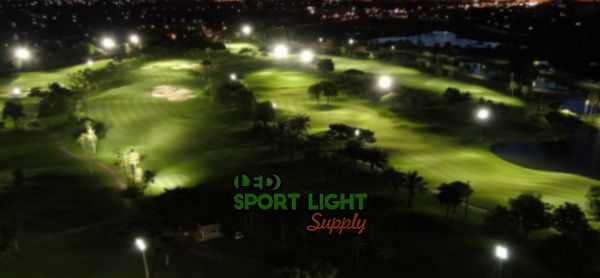 Golf lighting presents a different challenge because the playing area can extend across a large distance. Driving ranges may need illumination at the tee line and selected landing areas, while putting greens and short-game facilities have different visual requirements.
One common problem is poor visibility of the ball against a dark background. Another is uneven lighting between the hitting area and the zone where players expect to observe the ball. Simply illuminating the tee line may not provide the visual experience that users expect from a night-time driving range.
Glare is also worth considering because golfers often stand relatively still before a shot and look toward the target. A fixture positioned directly in that viewing direction can cause discomfort. Outdoor facilities must additionally consider light spill into nearby properties and natural areas.
A targeted lighting layout can help limit unnecessary illumination. Instead of lighting every available surface, the designer can identify which areas are intended for night-time use and direct light accordingly. This can reduce energy consumption and help manage environmental impacts.
Golf courses are especially sensitive to the balance between useful illumination and light spill because of their large outdoor footprint. Fixture aiming, shielding, operating hours, and the site’s surrounding environment should all be considered during planning.
Ice Hockey and Ice Skating – Ice Reflections and Puck Visibility
Ice surfaces reflect light differently from many other sports flooring materials. Bright reflections may appear across the ice, creating visual discomfort or making the playing surface look uneven from certain positions.
Ice hockey introduces an additional challenge because the puck is relatively small and dark. Players must track it quickly against a pale background, often while moving at speed and looking across the rink from different angles.
Glare can occur when fixtures are visible within players’ lines of sight. Uneven lighting can also affect the apparent contrast between the puck, the ice, the boards, and the surrounding players. Venues used for television coverage need to consider color quality and flicker performance as well.
Environmental conditions can influence equipment reliability. Indoor ice rinks may experience condensation and temperature differences that affect electrical components and enclosure performance. Maintenance procedures should reflect the actual conditions of the building.
The lighting layout should be designed around the rink dimensions, the reflective properties of the ice, and the viewing needs of players and spectators. A system that produces a high average lux reading may still require changes if reflections or glare interfere with play.
Cricket – Ball Tracking Across a Large Playing Area
Cricket lighting needs to support a large playing area and the movement of a fast ball between bowler, batter, and fielders. Depending on the format and venue, the ball may travel across the pitch, into the outfield, or high above the field.
One of the main challenges is maintaining consistent illumination across the pitch and outfield. The central playing strip has different visual demands from the wider field, and the boundary area should not be overlooked. Poor coverage can make the ball more difficult to track as it moves between zones.
Glare is another concern for batters, bowlers, and fielders, particularly when following high shots. Vertical illumination can also matter when spectators and cameras need to see players clearly from different directions.
A suitable cricket lighting design should reflect the format of play, the dimensions of the ground, the expected level of competition, and any broadcast requirements. A practice ground does not necessarily need the same arrangement as a venue used for televised matches.
Fixture placement should be evaluated using photometric calculations that cover the entire intended playing area. The design should also consider maintenance access, structural requirements, and the effect of light on surrounding properties.
Rugby – Whole-Field Coverage and High-Kick Visibility
Rugby combines long passes, high kicks, rapid changes of direction, and physical play across a broad field. Players need to track the ball while also reading the movement of teammates and opponents.
A frequent problem is inconsistent illumination between the central pitch, touchlines, and in-goal areas. When the action moves toward a boundary, players should not encounter a sudden drop in visibility. The same applies to goal areas where scoring attempts and close-range play take place.
High kicks can create glare problems when the ball travels near a floodlight. Poor fixture aiming may also make players harder to distinguish from the background, particularly at a distance.
A rugby lighting design should account for the full field, including the areas behind the goal lines. If the venue is used for broadcast matches, the design should also address vertical illumination, color consistency, and camera-related requirements.
Outdoor durability matters as well. Poles, brackets, electrical enclosures, and luminaires must be suitable for the local climate and site conditions. A system that is difficult to maintain may lead to prolonged outages if equipment access has not been considered from the start.
Gymnastics and Indoor Training Facilities – Shadows and Depth Perception
Gymnastics involves fast movements, aerial rotations, and landings that require athletes to judge position and distance accurately. Lighting that produces glare or uneven shadows can make the visual environment less comfortable during training and competition.
A common problem is glare from overhead fixtures when gymnasts look toward the ceiling during a routine. Shadows may also appear beneath apparatus or around landing zones, particularly when the lighting comes predominantly from one direction.
Mirrors introduce another challenge in dance studios and multipurpose training rooms. Reflections from bright fixtures can distract users or make parts of the room uncomfortable to look toward. Shiny equipment may produce similar effects.
The design should consider apparatus placement, ceiling height, reflective surfaces, and the visual tasks performed in each zone. Landing areas and training spaces should receive suitable illumination, while fixture positions should avoid unnecessary glare in the athletes’ usual viewing directions.
Facilities that host several activities may benefit from separate lighting scenes. However, changes in output should preserve the required visual conditions for each activity rather than simply creating a brighter or dimmer version of the same layout.
Pickleball and Other Multi-Court Facilities – Glare and Court Conflicts
Pickleball has expanded the range of lighting demands at community recreation centers, parks, and converted tennis facilities. Although the court is smaller than a tennis court, players still need to track a moving ball, judge its position near the boundary lines, and react quickly at the net.
Glare can be uncomfortable when players look upward to follow a lob. Uneven illumination near the sidelines and baselines can also affect visibility, particularly when courts are installed close together.
Shared facilities create another challenge. Lights serving one court may spill onto a neighboring court or shine into a player’s line of sight. In some installations, the original tennis lighting layout is reused without checking whether the altered court arrangement and operating pattern still work well.
A proper assessment should consider court spacing, fixture aiming, the surrounding environment, and how many courts will operate simultaneously. Where courts are close to residential properties, light spill and operating schedules should be reviewed before installation.
The same approach applies to multi-sport outdoor facilities. A layout designed for one activity may not provide the best results for another, so designers should confirm the actual use of the site rather than assume all sports have interchangeable requirements.
Sports Lighting Design – How to Get the Numbers Right
Good sports lighting starts with a design that matches the venue, rather than a shopping list of high-powered floodlights. A designer needs to understand the playing area, the required lighting performance, the mounting positions, and the conditions in which the facility will operate.
A few calculations can help explain why two projects with similar dimensions may require different equipment and budgets. They also make it easier for facility owners to compare proposals and spot areas that deserve further investigation.
Illuminance – How Much Light Reaches the Playing Surface?
Illuminance measures the amount of light arriving at a surface. It is expressed in lux or foot-candles, and it is one of the main measurements used in sports lighting design.
A common mistake is to focus only on the average lux value. Suppose one field has an average horizontal illuminance of 300 lux, with reasonably consistent lighting throughout the playing area. Another field also averages 300 lux, but some locations are much brighter than others. The two fields have the same average, yet players may experience very different conditions.
The target should reflect the sport, the level of play, the applicable standards, and the actual viewing requirements. A school training field, a community competition venue, and a professional stadium should not automatically receive the same specification.
The following figures are examples of values that might appear in early design discussions. They are not universal compliance targets.
| Example application | Illustrative average horizontal illuminance |
|---|---|
| Casual outdoor recreation | 50 to 150 lux |
| Organized training | 100 to 300 lux |
| Local or regional competition | 200 to 500 lux |
| Higher-level competition | 500 to 1,000 lux or more |
| Specialized broadcast venue | Project-specific, potentially above 1,000 lux |
These ranges overlap because the requirements depend on the sport and competition category. Some venues need higher levels, while others can operate satisfactorily at lower levels. Broadcast lighting may also require specific vertical illuminance and camera-related performance that cannot be described by one horizontal lux figure.
For a real project, the designer should use the applicable sport-specific recommendations and verify the target before equipment is selected. The figures above are suitable only for preliminary discussion.
Uniformity – Why Average Lux Does Not Tell the Whole Story
Lighting uniformity describes how evenly light is distributed across an area. A common measure compares the minimum illuminance with the average illuminance.
For example, if a playing surface has an average illuminance of 300 lux and a minimum illuminance of 180 lux, the minimum-to-average uniformity ratio is:
180 ÷ 300 = 0.60.
If another field averages 300 lux but has a minimum reading of only 90 lux, the ratio becomes:
90 ÷ 300 = 0.30.
The first example has a more consistent distribution under this particular measure. Whether either result satisfies a project requirement depends on the sport, lighting class, measurement method, and applicable standard.
Designers may also evaluate other uniformity measures, including minimum-to-maximum ratios or statistical measures of variation. The correct metric should be stated clearly in the lighting specification so that the design and the final measurements can be compared fairly.
Uniformity is especially relevant for large playing surfaces. A field with a bright center and dark corners can achieve a respectable average lux reading while still producing uncomfortable conditions. Improving the distribution may deliver a better result than increasing the output of every fixture.
Horizontal and Vertical Illumination
Horizontal illuminance describes light reaching a horizontal plane, such as the playing surface. Vertical illuminance describes light reaching a vertical plane and can help assess how well players and objects are illuminated from particular viewing directions.
The distinction matters because sports are not played entirely on the ground. Balls travel through the air, players turn toward different directions, and spectators or cameras may view the action from the side.
Soccer, cricket, American football, and baseball all involve balls moving above the playing surface. Indoor sports such as volleyball and badminton also require players to follow objects overhead. In these cases, the designer should consider whether the lighting supports visibility throughout the object’s movement, rather than concentrating only on floor or field measurements.
For broadcast facilities, the specification may include vertical illuminance in several directions, along with other camera-related measurements. The exact requirements depend on the sport, camera arrangement, production format, and governing-body rules.
Pole Height, Fixture Spacing, and Beam Angles
Pole height influences how light reaches the field and how much of the playing area each luminaire can cover. Taller poles may allow light to be distributed across a wider area, but they can increase structural and installation costs.
Fixture spacing also affects uniformity. If luminaires are positioned too far apart, dark patches may appear between their beam patterns. If too many fixtures are concentrated in a small area, the field may have excessive brightness in some locations while other areas remain underlit.
Beam angle is another factor. A narrow beam concentrates light into a smaller area, while a wider distribution spreads it over a larger region. The most suitable option depends on the mounting height, target area, fixture position, and required lighting performance.
For example, a designer might compare a four-pole layout with a six-pole arrangement for the same field. The four-pole option could involve fewer foundations and less structural work, while the six-pole option might provide more flexibility in distributing light. Neither layout is automatically better. The final decision should be based on photometric calculations, glare performance, structural feasibility, and overall project cost.
Why Photometric Simulation Saves Time and Money
Photometric simulation uses lighting data from selected luminaires to estimate how the proposed system will perform across a playing surface. It helps designers compare different layouts before fixtures are purchased or installed.
A simulation can identify dark areas, assess uniformity, estimate illuminance, and reveal whether the proposed fixture arrangement is likely to create unwanted light spill. Depending on the software and input data, it can also help evaluate glare-related considerations and other performance measures.
Imagine a field project with a preliminary equipment budget of US$100,000. If a design review reveals that the proposed layout needs substantial additional equipment after installation, the facility could face extra fixture purchases, lifting costs, and labor charges. Finding the problem before procurement may avoid some of those expenses.
Simulation is not a substitute for measurements on the finished site. The result depends on accurate input data, including fixture photometry, mounting heights, aiming angles, surface dimensions, and maintenance assumptions. The installed system must still be checked against the agreed specification.
A useful design package should therefore include the proposed fixture schedule, mounting layout, aiming information, calculated performance, and assumptions used in the model. That gives the venue owner something concrete to review before approving the project.
How to Fix Common Sports Lighting Problems
Once the main problems have been identified, the next step is choosing a solution that addresses the cause. Replacing fixtures may be appropriate, but it is not always the first or most economical option.
A lighting audit can help determine whether the issue comes from equipment failure, poor aiming, unsuitable optics, outdated controls, or a design that no longer matches the facility’s use.
Start With a Lighting Audit
A lighting audit should examine the condition and performance of the existing system. It normally includes a review of the fixtures, poles, electrical equipment, controls, and playing surface, along with measurements where appropriate.
The assessment should begin by establishing what the facility needs to support. A tennis court used for casual recreation has different requirements from a tournament venue. Similarly, a school football field may have no broadcast requirement, while a stadium used for televised matches may need a more detailed evaluation.
The audit should record the current arrangement, including the number of luminaires, their wattages, mounting heights, aiming directions, and operating hours. Any failed fixtures or visibly damaged components should also be noted.
Lighting measurements can then be taken at defined points across the playing area. The results should be compared with the intended performance requirements, rather than judged only by whether the field looks bright from the stands.
An audit may reveal that the facility needs a complete upgrade. In other cases, the findings may point toward a smaller intervention, such as correcting fixture aiming, replacing failed drivers, cleaning lenses, or adjusting control settings.
Correct Fixture Aiming Before Adding More Lights
Incorrect aiming is a common source of glare, uneven illumination, and light spill. A fixture may produce enough light but send too much of it toward the wrong part of the field.
The solution is to review the aiming plan and verify the installed positions. Designers or qualified technicians can assess whether the beam is reaching the intended target and whether adjustments would improve coverage.
For outdoor sports, aiming should also consider nearby properties and roads. A fixture that illuminates the playing surface but sends unnecessary light toward a neighboring home may need a different angle or optical arrangement.
Changes should be checked using appropriate measurements. Moving one fixture can improve a local dark area while affecting illumination elsewhere, so adjustments should be evaluated across the full playing surface.
If a facility has several similar lighting towers, the team should not assume that every fixture needs the same adjustment. Each luminaire’s position and target area may differ.
Replace Unsuitable Fixtures With Better Optical Designs
When aiming changes are not enough, the problem may lie in the fixture itself. Some luminaires are designed for general outdoor floodlighting rather than the specific requirements of a sports field or court.
Sports lighting fixtures are available with different optical distributions, shielding options, mounting arrangements, and output levels. Choosing the right configuration can improve the way light is delivered to the playing area.
The selection should consider more than the nominal lumen output. A high-lumen fixture may send a large amount of light outside the intended target, while a lower-output model with suitable optics may distribute light more effectively.
Other specifications deserve attention as well. These include input power, driver performance, color quality, environmental protection, warranty terms, and the availability of replacement parts.
A venue owner should request photometric data for the exact luminaire being proposed. A product brochure showing wattage and total lumens alone does not demonstrate that the fixture will achieve the required uniformity or control glare on a particular site.
Upgrade Controls and Use Different Lighting Scenes
Sports facilities rarely operate under the same conditions every day. A field might host a training session on Monday, a league match on Wednesday, and a tournament on Saturday. Operating every luminaire at full output for every activity may consume unnecessary electricity.
Zoning and dimming controls can allow the facility to use only the areas and lighting levels needed for a particular activity. A multi-court complex, for example, may be able to illuminate one group of courts while leaving the others switched off.
Controls should be selected to match the luminaires and the facility’s operating requirements. Poor compatibility can cause flicker, unreliable dimming, or unexpected switching behavior.
It is also worth keeping the operating interface simple. If staff need several complicated steps to select a training scene, they may end up using the full-output setting all the time. Clear labels, straightforward procedures, and suitable access permissions can make energy-saving features easier to use consistently.
Establish a Preventive Maintenance Schedule
Even a well-designed lighting system can lose performance over time. Dirt, moisture, damaged components, and failed fixtures can change the distribution of light across the playing surface.
A maintenance schedule should reflect the environment and operating hours. A busy outdoor field exposed to dust and rain may need different inspection intervals from a lightly used indoor gymnasium.
The maintenance plan can include visual inspections, cleaning where appropriate, checking electrical connections, inspecting enclosures, testing controls, and recording failed components. Structural inspections should follow the relevant engineering and safety requirements.
Lighting measurements should also be repeated when there is reason to suspect that performance has changed, after significant repairs, or at intervals defined by the facility’s maintenance program. This helps determine whether the system continues to meet the agreed requirements.
Keeping a record of measurements, repairs, operating hours, and replacement parts makes future decisions easier. It also provides useful evidence when evaluating warranty claims or planning a larger upgrade.
Give Your Sports Lighting System a Proper Check
Sports lighting problems rarely have a single universal solution. A dark corner on a soccer pitch, glare above a basketball court, and reflections across a swimming pool may all require different design changes, even when the underlying complaint sounds similar. The best starting point is to identify the actual problem, measure the existing performance, and compare the results with the requirements for the sport and venue.
For facility owners, a well-planned lighting project can improve player visibility, reduce unnecessary energy consumption, and make maintenance more manageable over time. A realistic budget should cover the complete installation, while the design should account for uniformity, glare, controls, environmental conditions, and future operating needs. A system that is properly designed and verified can deliver better playing conditions without relying on brightness alone.
If you are planning a new sports lighting installation, upgrading an existing field, or dealing with glare, uneven illumination, high electricity bills, or frequent fixture failures, contact our team for a sports lighting consultation. We can help you review your venue’s requirements, assess suitable lighting options, and develop a project plan with clear performance targets and a realistic cost estimate. Get in touch to discuss your sports lighting needs and find an approach that fits your facility, budget, and intended level of play.