
Football fields can look surprisingly different once the sun goes down. A small community field might use a few modest lighting poles, while a major stadium can have towering structures carrying large arrays of LED floodlights. So, how tall is a football light pole?
There is no single standard height that works for every field. In practice, football light poles are often somewhere around 40 to 90 feet (12 to 27 meters) tall, with some large professional venues using higher mounting positions or integrating lights into stadium structures. The right height depends on the size of the field, the required lighting level, the number of poles, their location, and how the fixtures are aimed.
For a new installation, simply choosing the tallest pole available is not the answer. Lighting needs to be designed as a complete system so the field receives reasonably even illumination without creating unnecessary glare, spill light, structural loads, or maintenance headaches.
How Tall Is a Football Light Pole?
A football light pole can range from roughly 40 feet for smaller recreational facilities to 70, 80, or even 90 feet for larger stadiums. Some professional installations can use even higher mounting positions, particularly when the lighting is integrated into stadium roofs, catwalks, or other elevated structures.
There is no single height that works for every football field. The right choice depends on the size of the playing area, the level of competition, the number of poles, the type of floodlights being used, and the lighting level the football facility needs. A 40-foot pole might be perfectly suitable for a local training field, while a large college stadium could need mounting heights closer to 80 or 90 feet.
Cost is another factor worth considering. A football light pole itself can cost anywhere from a few thousand dollars to well over $10,000, depending on its height, steel construction, wind-load requirements, finish, and mounting configuration. However, the pole is only one part of the project. Foundations, LED floodlights, electrical work, installation equipment, wiring, controls, and labor can push the total cost of a complete football field lighting system much higher.
A useful starting point is to look at the level of play, because the lighting demands and potential project costs can change quite a bit from one type of facility to another.
| Football Field Type | Typical Light Pole Height | Approx. Height in Meters | Typical Pole Setup | General Lighting Focus | Rough Pole Cost* |
|---|---|---|---|---|---|
| Youth & Community Fields | 40–50 ft | 12–15 m | 4–6 poles | Training, recreation, basic competition | ~$2,000–$6,000 each |
| High School Stadiums | 50–70 ft | 15–21 m | Often 6 poles | Game visibility, uniform lighting, spectators | ~$4,000–$10,000 each |
| College & University Stadiums | 60–90 ft | 18–27 m | 6–8+ poles or elevated systems | Higher lighting levels, uniformity, video | ~$7,000–$15,000+ each |
| Professional (NFL) Stadiums | 70–100+ ft | 21–30+ m | Specialized pole or stadium-mounted systems | Broadcast quality, uniformity, glare control | Highly site-specific |
*These are broad planning estimates for the pole structure only, not the complete lighting system. Actual prices can vary substantially based on steel prices, engineering, wind conditions, foundation design, transportation, installation, and supplier.
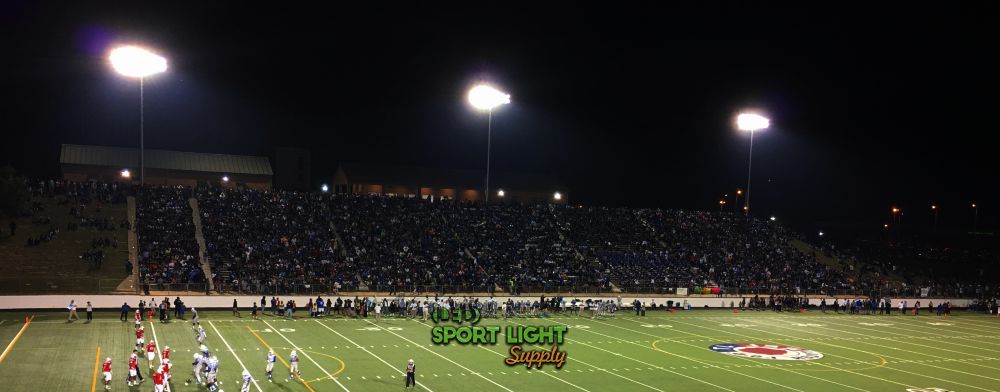
Youth & Community Fields
Youth, recreational, and community football fields generally do not need the same lighting performance as a major stadium. Smaller fields and training areas may use poles around 40 to 50 feet (12 to 15 meters) high, although the actual design can vary considerably depending on the field dimensions and the layout of the site.
For a community facility, the goal is usually pretty straightforward: provide enough light for players and spectators to see comfortably while keeping the installation practical and affordable. The Football Association (FA), for example, gives 120 lux as a recommended level for training pitches in its floodlighting guidance. Its guidance also shows that a full-size entry-level competition pitch can use four to six masts, which illustrates how pole quantity and lighting requirements work together rather than being determined by pole height alone.
For smaller fields, lower poles can sometimes work well because the area being illuminated is smaller. However, there is a trade-off. If a fixture is mounted too low, its light has to travel across a wider angle to reach the opposite side of the field. That can make it harder to achieve even illumination and may create brighter areas near the poles and darker areas farther away.
Pole height and pole placement really need to be considered together. A well-positioned 45-foot pole can sometimes produce a better result than a poorly positioned 55-foot pole. That is why lighting designers normally look at the entire field rather than choosing a height in isolation.
From a budgeting perspective, a community project may find that the poles themselves are only part of the expense. For example, six poles at $4,000 each would already represent about $24,000 in pole structures, before adding foundations, floodlights, electrical infrastructure, installation, controls, and other site work.
High School Stadiums
High school football stadiums typically need more lighting than a simple practice field. Games can involve larger crowds, evening events, and higher expectations for visibility, particularly when the stadium hosts regular Friday-night games throughout a season.
A common range is approximately 50 to 70 feet (15 to 21 meters), although some facilities use different heights depending on the field layout, fixture technology, and local requirements. Six-pole systems are also common because spreading the fixtures across more mounting locations can help distribute light more evenly across the playing surface.
The difference can be noticeable when a field is poorly designed. If the poles are too short or too close together, the fixtures may need to be aimed at steep angles to reach the far side of the field. This can contribute to glare and uneven lighting. On the other hand, placing fixtures higher gives designers more room to direct the light across the field without relying on extreme aiming angles.
School athletic associations may also have their own standards covering lighting performance and installation. These requirements can involve much more than brightness alone, including electrical safety, structural design, operating conditions, and the way the field is illuminated.
That is a useful reminder that pole height is only one piece of the puzzle. A 60-foot pole with poorly aimed fixtures can produce a worse result than a properly designed system using somewhat different mounting heights.
The overall budget can also rise quickly. A six-pole high school installation might involve tens of thousands of dollars in pole structures alone, while the complete lighting project can be substantially more once LED fixtures, concrete foundations, electrical work, controls, labor, and equipment are included.
College & University Stadiums
College football stadiums usually step up another level. The playing field is generally surrounded by larger spectator areas, and many facilities host events where lighting quality matters well beyond what the average spectator sees from the stands.
For these facilities, 60 to 90 feet (18 to 27 meters) is a reasonable general range for standalone lighting poles, although stadium architecture can change the picture completely. Some college venues use roof-mounted lighting, elevated structures, or other architectural features instead of relying entirely on conventional poles.
Why go higher? One reason is coverage. A football field is 360 feet long when the two 10-yard end zones are included, so fixtures need to illuminate a fairly large surface. Higher mounting positions allow the light to reach farther across the field and give designers more flexibility when aiming multiple fixtures at different areas.
There is another factor that becomes more noticeable at the college level: lighting uniformity. A field that averages 500 lux, for example, does not necessarily look well lit if some areas are significantly brighter than others. Players move constantly from one part of the field to another, so sudden changes in brightness can be distracting and can also affect how the game looks on camera.
Television and video production add another layer. Modern cameras can capture far more detail than older broadcast equipment, which means lighting designers have to think about how players will appear from different camera angles. Vertical illumination, glare control, and consistent lighting across the field can all become part of the design.
Naturally, these higher performance requirements can affect the budget. A college stadium may need larger poles, more powerful LED fixtures, additional equipment, stronger foundations, and more sophisticated controls. A pole that costs several thousand dollars at a smaller facility can become a much larger investment once height, structural requirements, and equipment loads increase.
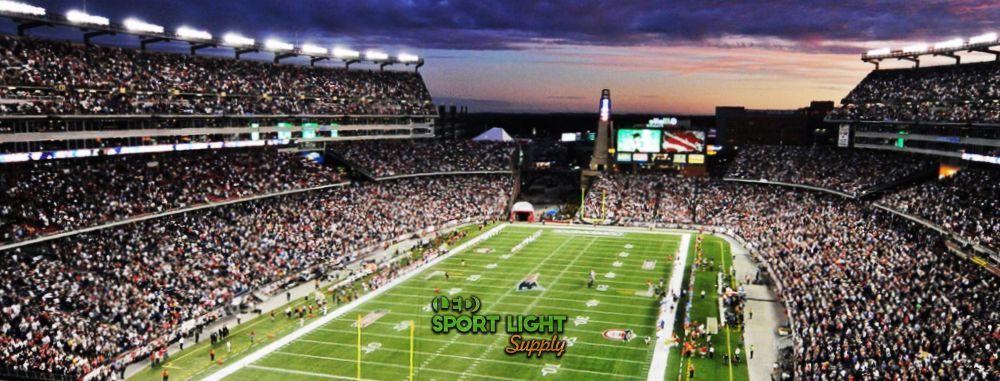
Professional (NFL) Stadiums
Professional NFL stadiums are a different beast. The playing field has standardized dimensions of 360 feet by 160 feet, including the end zones, so the lighting system has a substantial area to cover. On top of that, professional games can involve thousands of spectators, multiple camera positions, slow-motion replays, and high-definition or ultra-high-definition broadcasts.
Standalone poles in professional installations may reach 70 to 100 feet or more, while some stadiums use roof structures, catwalks, or other elevated mounting arrangements. Because of this, asking for the exact height of an NFL light pole can be a little misleading. A modern stadium may not use traditional standalone poles in the same way that a high school field does.
At the professional level, lighting has to do much more than make the field look bright. Players need to remain clearly visible while running at full speed, catching passes, and tracking the ball overhead. At the same time, cameras need consistent lighting across the field so that images do not suddenly become darker or brighter as the action moves from one area to another.
This is why professional football lighting is usually designed around performance rather than pole height alone. A 90-foot pole is not automatically better than a 70-foot pole. What matters is whether the entire combination of mounting height, fixture output, beam angle, aiming direction, and pole location produces the required result.
Cost at this level is also highly site-specific. A conventional steel pole is only one component of the project, and professional stadiums can use specialized structural systems that are integrated into the building itself. High-output LED fixtures, broadcast requirements, controls, structural engineering, access systems, and installation can all contribute to a much larger project budget.
How Much Does a Football Light Pole Cost?
The price of a football light pole depends heavily on its height and construction. As a broad planning figure, a 40- to 50-foot pole may cost around $2,000 to $6,000, while a 50- to 70-foot pole may fall around $4,000 to $10,000. Taller 70- to 90-foot structures can reach roughly $7,000 to $15,000 or more.
These numbers should not be treated as fixed retail prices. A pole designed for a high-wind location with several heavy LED fixtures can require substantially more material and engineering than a basic recreational-field pole.
There is also a big difference between the cost of the pole and the cost of installing the pole. Concrete foundations, anchor bolts, excavation, cranes, electrical connections, cabling, labor, transportation, and permits can all add to the final bill.
For example, six 60-foot poles might cost $30,000 to $50,000 or more as a rough pole-only allowance, but the completed lighting project could be several times that amount once the rest of the system is included. The floodlights themselves can represent a significant portion of the budget, particularly when a field requires high-output LED fixtures and precise optical control.
For that reason, anyone budgeting a football lighting project should ask for a complete installed-system quotation, rather than comparing pole prices alone. A cheap pole does not necessarily lead to a cheap project if it requires more fixtures, more electrical work, or a more complicated foundation.
Ultimately, the right football light pole is a balance between height, lighting performance, structural requirements, and long-term cost. A well-designed 50-foot system can make more financial sense than an unnecessarily tall 80-foot system, while a large stadium may have little choice but to invest in taller or more specialized structures. The smartest approach is to determine the required lighting performance first and then select the pole height and equipment that can deliver it efficiently.
Why Are Football Light Poles So Tall?
The basic reason is light distribution, but there is a little more to it than simply trying to make the field brighter.
Imagine holding a flashlight very close to a large table. You can make one small area extremely bright, but the light falls away quickly around it. Raise the flashlight higher and the beam can cover a much larger area. Football lighting works on a much bigger scale, with poles sometimes standing 50, 70, or 90 feet above the ground and floodlights projecting light across a field hundreds of feet long.
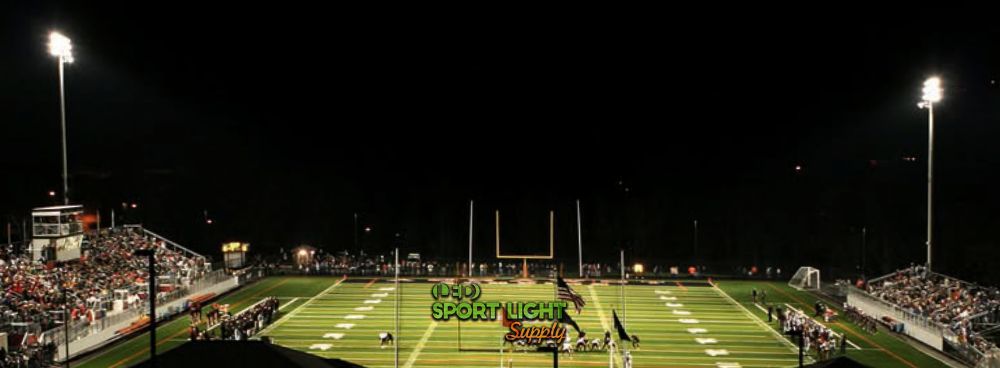
Higher Poles Help Spread Light
A higher mounting position gives the lighting designer more room to distribute light across the playing surface. Instead of aiming a fixture sharply downward from a nearby pole, the fixture can project light across a larger portion of the field.
This becomes particularly useful when several floodlights are mounted on each pole. A single 70-foot pole might carry multiple fixtures, with each one aimed at a different section of the field. One fixture could focus on the near side, another on the middle, and another farther across the playing surface.
The result is a more controlled lighting pattern rather than simply flooding the field with as much light as possible.
Even Lighting Matters More Than Maximum Brightness
The goal is not simply to make the field bright. It is to make it evenly usable. That distinction is easy to overlook.
Players need to track the ball, recognize teammates, and react quickly. Spectators need to follow the action from their seats. Coaches and officials need to see what is happening across the entire playing area. If one section is extremely bright while another is noticeably darker, the field may technically have plenty of light but still feel poorly illuminated.
For example, imagine one part of a field receiving around 800 lux while another area receives only 300 lux. The average might look acceptable on paper, but players moving between those areas could experience a noticeable change in brightness. A carefully designed system tries to keep those differences under control.
Pole Height Can Affect Glare
Another reason designers pay attention to mounting height is glare. When floodlights are mounted too low or positioned poorly, players may find themselves looking directly toward bright fixtures when trying to track a high ball.
A higher pole does not automatically eliminate glare, but it can give designers more options for positioning and aiming the fixtures. Combined with appropriate beam angles and shielding, the system can direct light toward the field while reducing unwanted light entering players’ and spectators’ lines of sight.
This matters particularly for football because the ball can travel high into the air. A player looking upward toward a pass or punt does not want a powerful floodlight sitting directly in their field of vision.
Bigger Fields Need More Planning
The larger the playing area, the more carefully the lighting system needs to be planned. A small youth field might only need a relatively simple arrangement, while a full-size football stadium may have dozens of individual LED fixtures working together.
The field’s 360-foot overall length is a good example of why simply increasing fixture brightness is not always the answer. Throwing more light from a small number of low poles can create hotspots, shadows, and glare. Raising the mounting height and distributing fixtures across multiple locations can provide much better control.
Modern LED Lighting Changes the Equation
LED floodlights have also changed how football fields are illuminated. Modern fixtures can provide high output while offering different beam patterns, aiming options, and control capabilities. Some systems can also be dimmed or adjusted for different activities.
A field may not need the same lighting level for a professional game, a high school practice, and routine maintenance. Being able to adjust the lighting system can reduce unnecessary energy use and give operators more flexibility.
That does not mean LED fixtures make pole height irrelevant. Quite the opposite. The fixture and pole need to work as a team. A powerful LED mounted at the wrong height or aimed poorly can still produce an uneven result.
The Right Height Is a Balance
Ultimately, football light poles are tall because the lighting system needs to cover a large playing area from carefully selected positions. But there is a point where adding more height stops providing useful benefits and starts creating additional costs and engineering challenges.
A 40-foot pole, a 60-foot pole, and a 90-foot pole can all be suitable in different situations. The answer depends on what is happening below the pole, how the fixtures are arranged, and what level of lighting performance the field needs.
For that reason, the best pole height is not necessarily the tallest or the shortest option. It is the height that allows the fixtures to illuminate the field evenly, control glare, meet the required lighting levels, and work reliably for years without making installation and maintenance unnecessarily complicated.
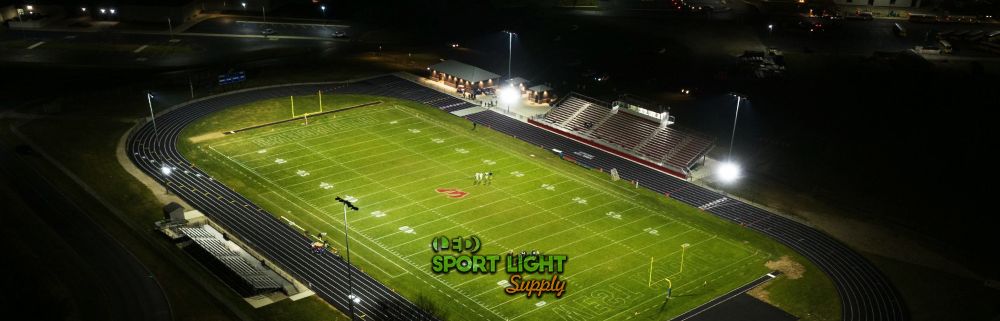
What Determines Football Light Pole Height?
Football light pole height is rarely chosen by simply looking at a chart and picking a number. It is usually part of a broader lighting design that considers the field, floodlights, pole locations, required brightness, surrounding area, and even future maintenance.
A pole that works beautifully on one field may be completely unsuitable for another. For example, a 45-foot pole may be more than enough for a small community training field, while a full-size stadium with demanding competition or broadcast requirements could need mounting heights of 70 feet, 80 feet, or more.
The interesting part is that pole height affects almost every other part of the lighting system. Change the height, and you may also need to change the fixture type, beam angle, number of lights, pole spacing, or aiming direction.
Field Size and Layout
The dimensions of the playing area are among the first things lighting designers look at. A smaller training field simply does not present the same challenge as a full-size football stadium.
A full-size football field is about 360 feet (109.7 meters) long, including the two 10-yard end zones, and 160 feet (48.8 meters) wide. That is a sizeable area to illuminate evenly, especially when the field is surrounded by seating, buildings, walkways, and other structures.
The position of the poles matters just as much as the field dimensions. A pole installed close to the sideline has a different lighting challenge from one positioned farther away. Designers need to consider how far each fixture must throw its light and which parts of the field it is intended to cover.
For example, if a fixture is mounted 50 feet high but has to illuminate an area far across the field, it may need a different beam angle from a fixture mounted 70 feet high. Height, distance, and aiming angle are closely connected, so changing one can affect the others.
The layout of the surrounding property also comes into play. A pole might look ideal on a drawing, only for the proposed location to turn out to be close to a road, building, drainage area, underground utility, or property boundary. Good lighting design considers these practical details before installation begins.
Lighting Level and Uniformity
The required lighting level has a direct effect on the design. Illuminance is commonly measured in lux or foot-candles, but looking at the average number alone does not tell the whole story.
Think of it like filling a room with lamps. You could have a very bright lamp in the middle and still have dark corners. A football field works in much the same way. The average lighting level might look impressive on paper, but players still need reasonably consistent visibility across the entire playing surface.
The FA’s floodlighting guidance, for example, considers both average illuminance and uniformity when setting football lighting recommendations. For certain full-size facilities, its guidance calls for more than 200 lux along with a minimum-to-average uniformity above 0.6.
That distinction matters because a field with bright spots and dark patches is not necessarily well lit. Players move quickly from one area to another, so large changes in brightness can make it harder to follow the ball and judge what is happening.
For higher-level football, uniformity becomes even more noticeable. A field that looks fine to someone sitting in the stands may still present problems for players or cameras if certain areas are substantially darker than others.
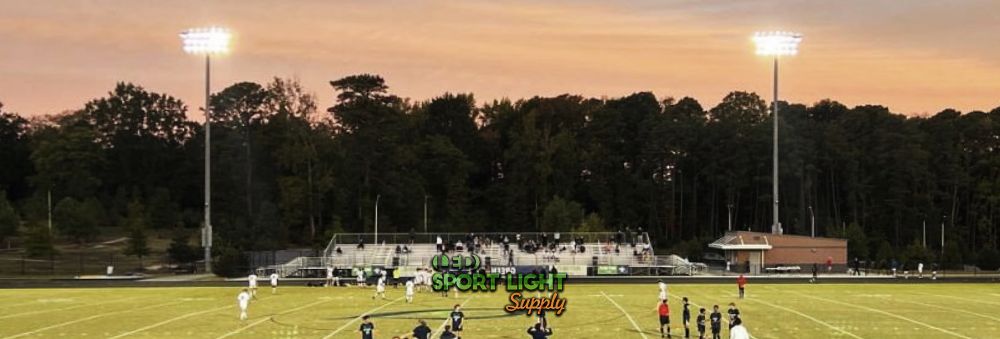
Number of Poles
The number of poles can change the entire lighting calculation. A four-pole arrangement asks each pole to cover a relatively large section of the field, while a six- or eight-pole arrangement gives designers more mounting positions from which to distribute the light.
For smaller facilities, a four-pole system may be practical. Larger football venues may use six, eight, or even more mounting positions depending on the field, lighting targets, and stadium layout.
Published football lighting guidance commonly places smaller training and recreational installations around 40 to 50 feet, with high school systems often falling somewhere around 40 to 70 feet and college or professional facilities potentially reaching 50 to 90 feet or more. These figures are useful starting points, not universal rules.
There is a simple reason for that flexibility. Suppose a field uses four poles, each carrying several powerful floodlights. Those fixtures have to cover more territory from each location. Adding two or four more poles can spread the lighting load across additional points and may allow a different mounting height or fixture configuration.
In other words, more poles do not automatically mean shorter poles, and taller poles do not automatically mean fewer poles. The two decisions need to be designed together.
Fixture Technology
The floodlights themselves have changed considerably over the years. Modern LED football floodlights can provide high output while offering different beam patterns and more precise aiming options.
A designer can select a narrow beam for a long throw, a wider beam for broader coverage, or a mixture of beam patterns depending on where each fixture needs to send its light. This gives modern systems much more flexibility than simply installing the same fixture everywhere.
That means a modern LED system may achieve good results with a different pole arrangement from an older metal-halide installation. The fixture technology and mounting height need to work as a pair.
LED systems can also provide practical operating advantages. Depending on the equipment, they may offer instant switching, dimming, and improved control compared with older lighting technologies. This can allow a facility to use different lighting levels for training, matches, cleaning, or other activities rather than operating every fixture at full output all the time.
Still, better LEDs do not magically fix poor pole placement. Even a powerful LED floodlight can create glare, shadows, or uneven illumination if it is mounted at the wrong height or aimed incorrectly.
Local Conditions
The surrounding environment can have a surprisingly large influence on pole height and placement. Nearby homes, roads, buildings, trees, spectator stands, and neighboring properties may all affect where lighting equipment can go.
Light spill is one concern. A football field may need strong illumination, but nearby residents do not necessarily want powerful floodlights shining toward their windows at night. Careful fixture selection, aiming, shielding, and pole placement can help control unwanted light.
Wind is another major consideration. A tall pole effectively acts like a large lever when strong winds push against it, creating forces that the pole and foundation need to withstand. The taller the structure and the larger the fixture arrangement, the more attention needs to be paid to structural design.
The ground itself matters too. Soil conditions can affect the foundation required for a pole. Access for construction equipment, underground utilities, electrical connections, drainage, and local planning requirements can all influence the final layout.
That is why a 90-foot pole is not simply a 50-foot pole with another 40 feet added on top. The structural, foundation, installation, and maintenance requirements can change significantly as the height increases.
What Happens If Football Light Poles Are Too Short?
Shorter poles are not automatically bad. In fact, a 40- or 50-foot pole can be exactly right for a particular field when the fixtures and layout have been designed around it.
The problem begins when poles are too short for the field and fixture arrangement.
Uneven Lighting
One of the most common problems is uneven illumination. Fixtures mounted too low may struggle to spread light across the full playing surface, particularly when the poles sit around the perimeter.
The area close to a pole may receive plenty of light while areas farther away receive less. Designers can sometimes compensate by adding more fixtures or selecting different beam angles, but that may increase equipment costs and make the lighting pattern harder to manage.
Imagine trying to light a 360-foot-long field from several relatively low points around the edges. The fixtures have to work harder to reach the opposite side while maintaining a sensible distribution of light. Raising the mounting position can give the designer more room to spread that light.
More Glare for Players
Glare can become another issue when fixtures are mounted too low or positioned poorly.
Football players frequently look upward to track passes, punts, and kicks. If a bright floodlight sits directly in their line of sight, it can be uncomfortable and distracting. This is particularly noticeable when players are looking toward the opposite end of the field at night.
A higher mounting position can provide more flexibility when aiming the fixtures. It does not eliminate glare by itself, but it can help the designer create better angles between the light source, playing surface, and players’ lines of sight.
More Fixtures May Be Needed
There is also a practical cost issue. If the poles are too short to provide the desired coverage, the lighting designer may need additional fixtures to compensate.
That can mean more equipment, more electrical load, more wiring, and more components to maintain. So while choosing a shorter pole may appear cheaper at the beginning, the overall lighting system may not actually cost less.
A good design therefore looks at the total installation rather than the price of the pole alone.
What Happens If Football Light Poles Are Too Tall?
Going taller has its own drawbacks. It is tempting to think that a higher pole must automatically produce better lighting, but that is not how football field lighting works.
Higher Structural and Foundation Costs
A taller pole generally requires more careful structural engineering. The foundation must be capable of supporting the pole, floodlights, and other equipment under the expected environmental loads.
Wind is particularly relevant because the fixtures themselves can present a large surface area. As the mounting height increases, the forces acting on the structure can become more demanding.
The installation process can also become more complicated. A 40-foot pole and a 90-foot pole are very different jobs when it comes to transportation, lifting equipment, construction access, and site preparation.
Maintenance Can Become More Difficult
Maintenance is another factor that is easy to overlook when everyone is focused on initial installation.
Lights eventually need inspection, cleaning, repair, or replacement. Even modern LED fixtures can require attention over their service life. When equipment is mounted 80 or 90 feet above the ground, getting technicians and equipment to it can be more involved than maintaining a system at 40 or 50 feet.
Over a lighting system’s expected service life, those maintenance requirements can add up. The FA’s guidance notes that football floodlighting systems require regular testing and maintenance and discusses service lives that can extend to roughly 20 to 25 years, depending on the system and equipment.
That means pole height should be considered from a long-term perspective, not just during construction.
Taller Does Not Automatically Mean Better Lighting
There is also a technical limit to the benefits of simply going higher. A taller mounting position can help spread light, but the fixtures still need to be correctly selected and aimed.
If the beam angles are wrong, the fixtures are poorly positioned, or the lighting calculation is inadequate, a 90-foot pole can still produce an unsatisfactory result.
In some cases, going higher may even create new challenges with aiming, light spill, structural loads, and access. The sweet spot is the height that works with the complete lighting layout, not the maximum height that the site can physically accommodate.
Light Spill and Surrounding Areas
Higher poles can also change how light interacts with the surrounding area. Depending on the fixture optics and aiming angles, unwanted light may reach places outside the football field.
This is especially worth considering when a stadium sits close to homes, public roads, schools, or other properties. Good design aims to put light where it is needed while keeping spill and glare under control.
Ultimately, choosing football light pole height is a balancing act. A pole that is too short can make it harder to achieve even lighting and control glare, while a pole that is unnecessarily tall can increase structural, installation, maintenance, and environmental challenges.
The best height is the one that fits the field, fixtures, pole layout, lighting targets, and site conditions as one complete system. Looking at those factors together is a much better approach than choosing a pole based on height alone.
A Better Way to Think About Football Light Pole Height
So, how tall is a football light pole? Usually somewhere in the 40-to-90-foot range, with professional facilities potentially going higher or using integrated stadium lighting.
But the number on the tape measure is only part of the story. A well-designed lighting system balances pole height with fixture output, beam distribution, pole spacing, field dimensions, uniformity, glare, structural requirements, maintenance, and local conditions.
For a small community field, a 40- or 50-foot system may do the job nicely. A high school stadium might need something closer to 60 or 70 feet, while a large college or professional venue can require substantially higher mounting positions and a much more sophisticated lighting layout.
In the end, the right football light pole is not the tallest one you can install. It is the one that gives the field the lighting performance it needs without creating unnecessary cost, glare, structural demands, or maintenance problems. Getting that balance right is what turns a collection of floodlights into a properly designed football lighting system.