

Softball field lighting does more than make a field playable after sunset. It affects how clearly players see the ball, how comfortably spectators watch the game, how much energy a facility consumes, and how much money an owner spends on maintenance over the years. Whether you’re developing a new softball complex, upgrading an existing high school field, or planning a community sports facility, choosing the right lighting system can make a noticeable difference to the entire playing experience.
LED technology has changed the way softball fields are illuminated. Compared with older metal halide and high-pressure sodium systems, modern LED sports lights offer better energy efficiency, more flexible lighting controls, faster start-up, and a longer service life. However, buying powerful LED floodlights alone doesn’t guarantee a good result. Pole locations, mounting heights, beam angles, fixture output, glare control, and lighting uniformity all need to work together.
Budget is another major consideration. A small recreational softball field may require a relatively straightforward lighting installation, while a competitive school or tournament facility can involve substantial spending on high-output LED fixtures, structural poles, foundations, electrical infrastructure, and professional engineering. The final price can vary considerably depending on the existing site conditions and the performance level required.
So, what should you look for when choosing softball field lights? How many poles does a typical field need? How much illumination is enough, and what kind of budget should you prepare?
Let’s take a closer look at the technology, design decisions, installation process, and purchasing considerations that go into a successful softball field lighting project.
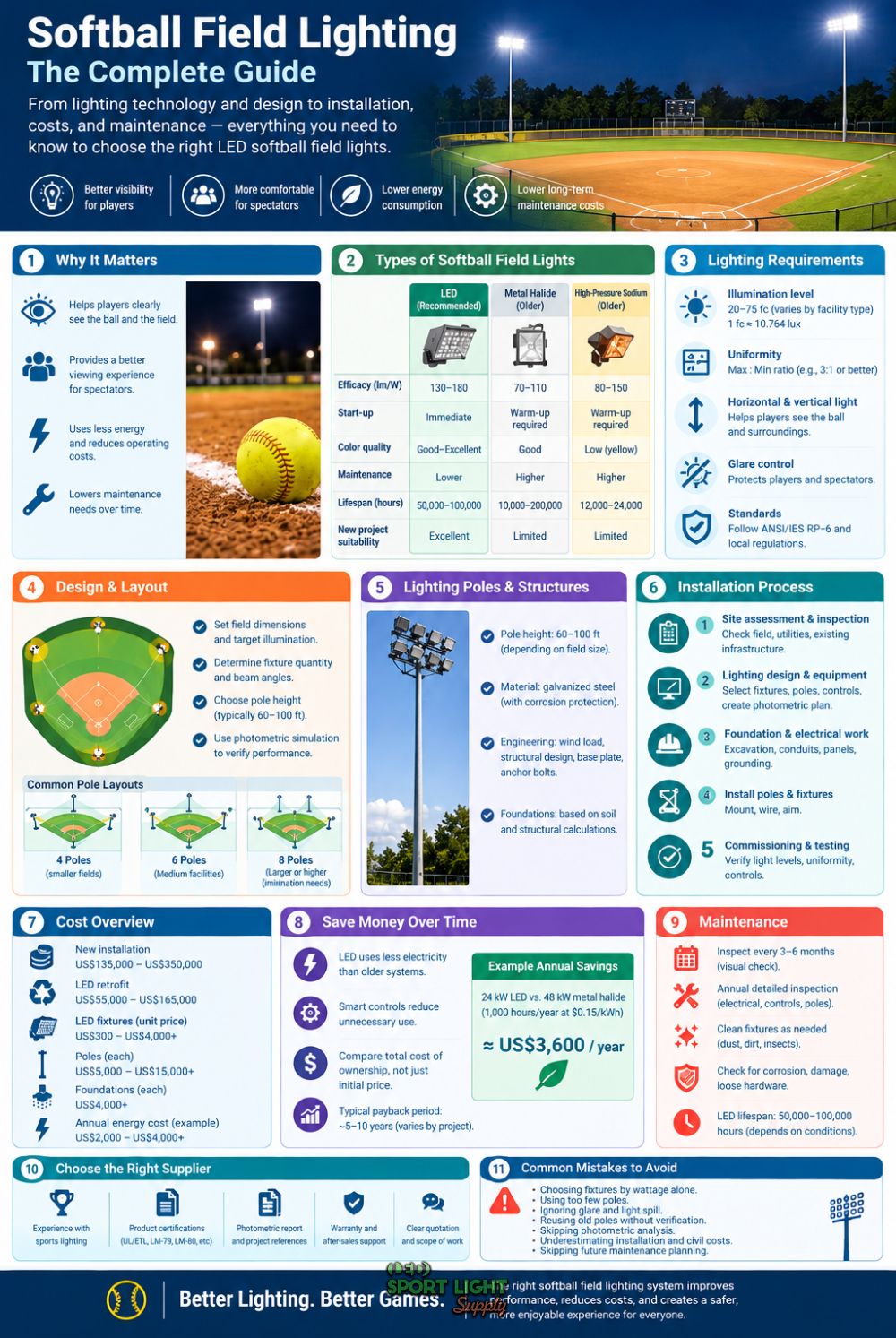
Softball field lighting is a purpose-designed system of luminaires, mounting poles, electrical equipment, and lighting controls used to illuminate the playing area during evening and low-light conditions. Unlike ordinary outdoor floodlighting, sports lighting must provide controlled illumination across a relatively large area while allowing players to follow a fast-moving ball.
A softball field has several visually demanding areas. Players need to see the ball clearly when batting, pitching, fielding, running between bases, and catching fly balls. A lighting system that produces bright patches around home plate but leaves the outfield unevenly illuminated will not provide a comfortable playing environment.
The design also needs to account for different viewing directions. A batter looks toward the pitcher, an outfielder watches the ball against the sky, and an infielder may need to follow a fast ground ball while moving across the field. Each situation creates different visual requirements.
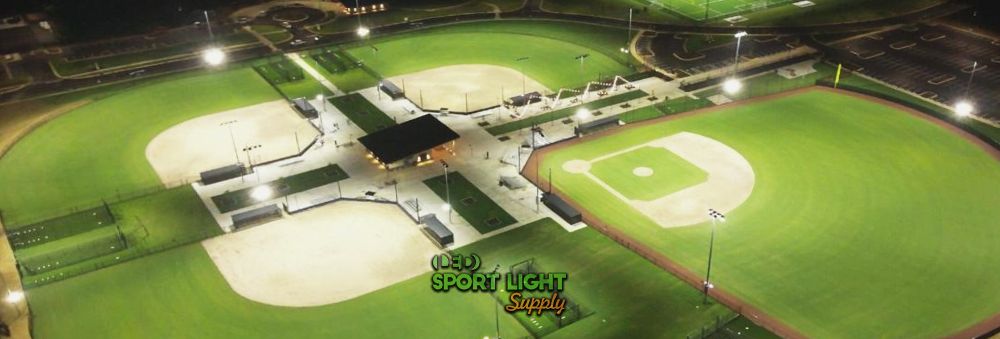
The infield and outfield receive most of the attention during lighting design, but they are not the only areas that need consideration. Home plate, the pitcher’s mound, base paths, foul territory, dugouts, and spectator spaces all contribute to the overall lighting plan.
The infield usually requires a relatively high level of illumination because many plays happen quickly within a compact area. Pitching, batting, catching, and ground-ball fielding all demand good visibility. The outfield covers a much larger area, so the designer must balance adequate brightness with consistent coverage.
Home plate deserves particular attention. The batter, catcher, and umpire all need a clear view of the ball, while the pitcher needs sufficient illumination to maintain visual contact with the batter. The lighting arrangement should avoid placing bright fixtures directly within the players’ main viewing directions.
Base paths also need suitable illumination. Players move quickly between bases, sometimes changing direction while watching the ball or another player. Dark patches around first, second, and third base can make the field feel inconsistent, even if the center of the infield looks bright.
Dugouts, walkways, entrances, and spectator seating should be considered as separate lighting zones. Their requirements are different from those of the playing surface, and they may need lower-output fixtures or dedicated lighting controls.
| Field area | Main lighting consideration | Design focus |
|---|---|---|
| Infield | Fast ground-ball and batting visibility | Uniform horizontal and vertical illumination |
| Outfield | Tracking high and long-distance hits | Broad, consistent coverage |
| Home plate | Batter, pitcher, catcher, and umpire visibility | Controlled glare and suitable vertical illumination |
| Pitcher’s mound | Clear ball visibility | Balanced light from multiple directions |
| Base paths | Visibility during running and fielding | Avoid dark patches |
| Spectator areas | Comfortable viewing and movement | Separate lighting zones |
A common mistake is to assume that a few powerful floodlights can illuminate a softball field effectively. In practice, sports lighting is much more complicated.
A standard outdoor floodlight may produce plenty of light in one direction, but it might not distribute that light evenly across the field. It may also create excessive glare for players looking toward the sky. Sports lighting fixtures are designed with specific optical distributions that allow designers to direct light toward target areas and control unwanted spill.
The difference becomes even more noticeable when a facility hosts competitive games. Recreational players may be comfortable with a relatively simple lighting arrangement, while higher-level competitions require more carefully controlled illumination, uniformity, and visibility.
The goal is not simply to make the field look bright from the parking lot. The goal is to create a lighting environment that works from the players’ and spectators’ viewing positions.
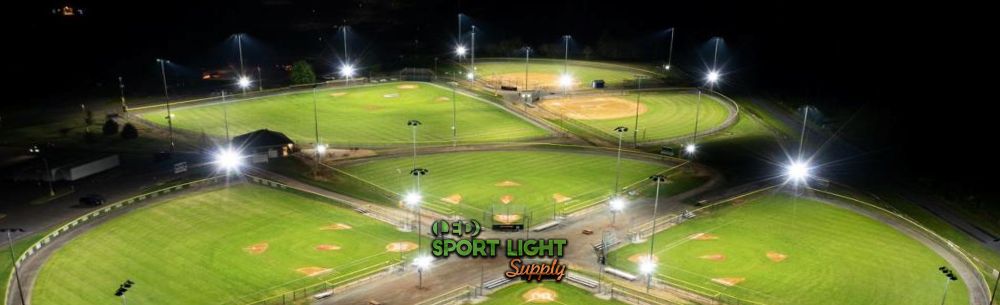
Choosing the right type of softball field light is one of the first purchasing decisions. Older facilities may still use metal halide or high-pressure sodium lamps, but LED technology has become the preferred option for many new installations and renovation projects.
Each lighting technology has different characteristics in terms of energy consumption, maintenance, light quality, operating life, and initial cost.
LED softball field lights use light-emitting diodes to produce illumination. They are widely used in modern sports facilities because they offer strong light output with relatively low energy consumption.
One of the biggest advantages is efficiency. Depending on the fixture design and operating conditions, modern sports LED luminaires commonly achieve approximately 130 to 180 lumens per watt. This means a 1,000-watt LED fixture operating at 150 lumens per watt can produce approximately 150,000 lumens.
That figure is useful when comparing products, but it should not be treated as a direct measure of field performance. Two fixtures with identical lumen output can produce very different results depending on their beam distributions, mounting positions, optical efficiency, and aiming angles.
LED fixtures also start almost immediately. Older discharge lamps may require a warm-up period before reaching full output, while LEDs can generally reach their operating brightness within seconds. They can also be dimmed more easily when paired with compatible drivers and controls.
Another advantage is reduced maintenance. Quality LED sports lights can have rated lifetimes of 50,000 to 100,000 hours, depending on the product and the manufacturer’s stated lifetime criteria. For example, an LED fixture rated for 80,000 hours and operated for 4,000 hours annually has a theoretical operating life of 20 years. Actual service life will depend on temperature, driver performance, electrical conditions, and maintenance.
When comparing LED products, pay attention to the complete fixture rather than focusing only on the LED chips. The driver, heat sink, lens, housing, surge protection, and thermal management system all affect long-term performance.
Metal halide lighting was widely used in older sports facilities. These lamps produce a relatively bright white light and were once a common choice for baseball and softball fields.
However, metal halide systems have several disadvantages when compared with modern LEDs. They typically consume more electricity for a similar lighting result, require more frequent lamp replacement, and lose output as they age.
Another drawback is warm-up and restrike time. After switching on, a metal halide lamp takes several minutes to reach full brightness. If the system is switched off or experiences a power interruption, it may need additional time before it can operate normally again.
Metal halide lamps also experience lumen depreciation over time. A facility may initially receive an acceptable illumination level, but the field can gradually become darker as the lamps age.
These systems may still be found in existing facilities, and replacing them is not always an immediate requirement. However, when a field reaches the point of major equipment replacement, LED conversion is often worth evaluating.
High-pressure sodium, commonly known as HPS, is another older lighting technology used in outdoor sports and industrial applications.
HPS lamps are known for their relatively high luminous efficacy, but their yellow-orange appearance makes them less suitable for applications where accurate color recognition is desirable. Their color rendering is generally lower than that of modern white LED sports fixtures.
For softball, this can affect the visual experience of players and spectators. The ball, uniforms, field markings, and surrounding environment are easier to distinguish when the lighting provides suitable color quality.
HPS systems also have warm-up requirements and ongoing lamp replacement costs. As a result, they are less commonly selected for new softball field projects.
The following table provides a general comparison of the three technologies. Actual specifications vary by manufacturer and product model.
| Feature | LED | Metal halide | High-pressure sodium |
|---|---|---|---|
| Typical system efficacy | 130–180 lm/W | 70–110 lm/W | 80–150 lm/W |
| Start-up | Almost immediate | Warm-up required | Warm-up required |
| Dimming | Generally flexible | Limited | Limited |
| Color quality | Good to excellent | Good | Relatively low |
| Maintenance | Lower | Higher | Higher |
| Lumen depreciation | Gradual | More pronounced | More pronounced |
| New project suitability | Excellent | Limited | Limited |
There is no single wattage that works for every softball field. The appropriate fixture output depends on the field dimensions, target illumination, pole height, fixture quantity, beam angle, and photometric performance.
For example, a 500-watt LED sports floodlight producing 75,000 lumens may be suitable for certain mounting positions, while another project may require 1,000-watt or 1,500-watt fixtures with different optical distributions.
A larger wattage does not automatically mean better lighting. If the fixture is poorly aimed or has an unsuitable beam angle, a large portion of its output may miss the intended playing area.
Instead of asking only how many watts each fixture uses, buyers should request a photometric design showing the expected illumination at different points across the field.
A good LED softball field light should have a well-documented technical specification sheet. Buyers should look beyond the advertised wattage and examine the actual light output, efficacy, color temperature, color rendering, beam distribution, ingress protection, surge protection, and operating temperature range.
For most outdoor softball applications, 5,000K is a common neutral-to-cool white color temperature. Some projects may prefer 4,000K, especially where a slightly warmer appearance is desired. The final selection should consider the applicable lighting design recommendations and the facility’s visual preferences.
A color rendering index of 70 or higher may be suitable for many outdoor sports applications, although higher values can be specified where color recognition or broadcast requirements justify them.
The fixture should also have an appropriate IP rating. IP66 is commonly specified for outdoor LED sports floodlights because it provides protection against dust and powerful water jets. However, the IP rating alone does not establish overall product durability or corrosion resistance.
Surge protection is another specification worth checking. Outdoor lighting systems can be exposed to electrical surges caused by lightning activity and switching events. A suitable surge protection arrangement should be selected based on the local electrical environment and applicable codes.
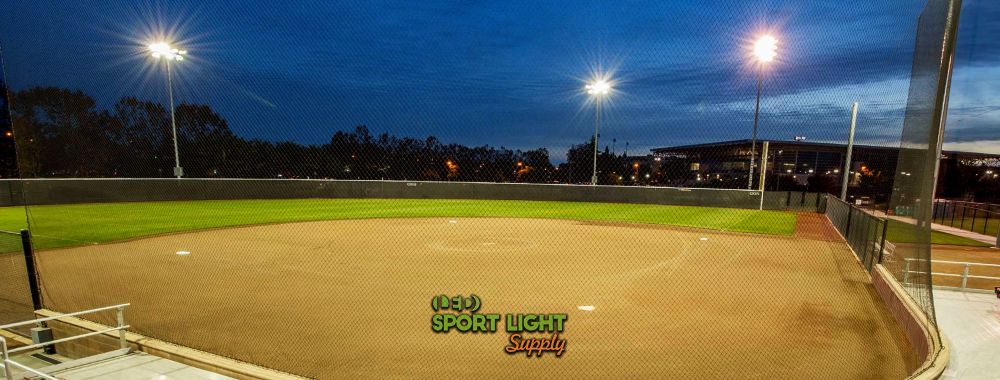
Softball field lighting requirements depend on the level of play, the number of spectators, the type of competition, and whether the facility is used for recreational, school, collegiate, or tournament games.
A neighborhood field does not necessarily need the same lighting performance as a college softball stadium. Designing every field to the highest competition level can result in unnecessary equipment and energy costs, while underdesigning a competitive venue can lead to poor visibility and expensive upgrades later.
Two common units used to describe illumination are foot-candles and lux.
A foot-candle measures the amount of light reaching a surface. One foot-candle equals one lumen per square foot. Lux measures the same general concept using square meters.
The conversion is straightforward:
1 foot-candle = approximately 10.764 lux.
For example, a field receiving an average horizontal illuminance of 30 foot-candles has approximately 323 lux. A field receiving 50 foot-candles has approximately 538 lux.
These measurements are taken at the playing surface or another defined measurement plane. The actual design may also require vertical illuminance calculations to assess how well players can see the ball and other objects above the field.
Lighting targets should be selected according to the relevant edition of ANSI/IES RP-6 and the rules of the organization governing the competition.
The 2024 edition of ANSI/IES RP-6 provides recommendations for sports and recreational area lighting. The applicable class of play, field requirements, and design criteria should be checked before establishing the final specification.
As an example of a published recreational design benchmark, certain U.S. federal facility criteria specify average horizontal illuminance of approximately 30 foot-candles for the infield and 20 foot-candles for the outfield, with different uniformity limits for the two areas. These figures are not universal softball requirements and should not replace the current sports-lighting standard or the requirements of the relevant competition authority.
For preliminary planning, the following ranges can help illustrate how project expectations may differ. They are indicative planning bands, not a substitute for a project-specific standard or approved photometric design.
| Facility type | Illustrative average horizontal illuminance |
|---|---|
| Basic recreational field | 20–30 fc |
| School and community competition | 30–50 fc |
| Higher-level competitive facility | 50–75 fc |
| Advanced event or broadcast application | 75–100+ fc |
A project may require different values for the infield and outfield. Vertical illuminance, uniformity, glare, and spill-light limits must also be evaluated.
Lighting uniformity describes how evenly light is distributed across the playing area.
A field can have a high average illumination level but still perform poorly if some locations are extremely bright while others are much darker. This is why lighting designers calculate uniformity ratios rather than relying on average foot-candle values alone.
A commonly used maximum-to-minimum uniformity ratio is calculated by dividing the highest measured or calculated illuminance by the lowest.
For example, if the brightest point on the field measures 60 foot-candles and the darkest point measures 20 foot-candles, the ratio is 3:1.
A lower ratio generally indicates more consistent illumination. The acceptable target depends on the applicable design criteria and the playing class.
Uniformity should be evaluated separately for relevant areas where the design standard calls for different zones. A single overall average can hide weak lighting around the bases or in the outfield corners.
Horizontal illuminance measures the light reaching a horizontal surface, such as the playing field. It is commonly used to evaluate how well the turf and infield are illuminated.
Vertical illuminance measures light reaching a vertical plane. It helps assess visibility of objects above the playing surface, including the ball, players, and other moving objects.
This is particularly relevant in softball because players regularly look upward to track fly balls. A field can have acceptable horizontal illuminance but still provide an unsatisfactory visual experience if the lighting arrangement does not produce enough useful vertical illumination.
The direction of light also matters. Multiple lighting angles can help make the ball easier to distinguish against different backgrounds, provided that the arrangement does not create uncomfortable glare.
Glare occurs when an excessively bright light source interferes with a person’s ability to see comfortably. For softball players, this can happen when a fixture enters the field of view while they are watching a pitch or tracking a fly ball.
A designer should evaluate the likely viewing positions of batters, pitchers, catchers, infielders, and outfielders. Fixture placement and aiming angles should be adjusted to reduce direct glare.
Light trespass is another concern. Sports lighting can affect nearby homes, roads, parks, and other properties if too much light escapes beyond the field.
Modern LED systems can use optical lenses, shields, louvers, and carefully selected beam distributions to control spill light. The design should also consider local curfew requirements and environmental restrictions.
Before purchasing equipment, check the local regulations governing outdoor lighting. Some jurisdictions impose limits on property-line illuminance, operating hours, upward light, or the use of sports lighting near residential areas.
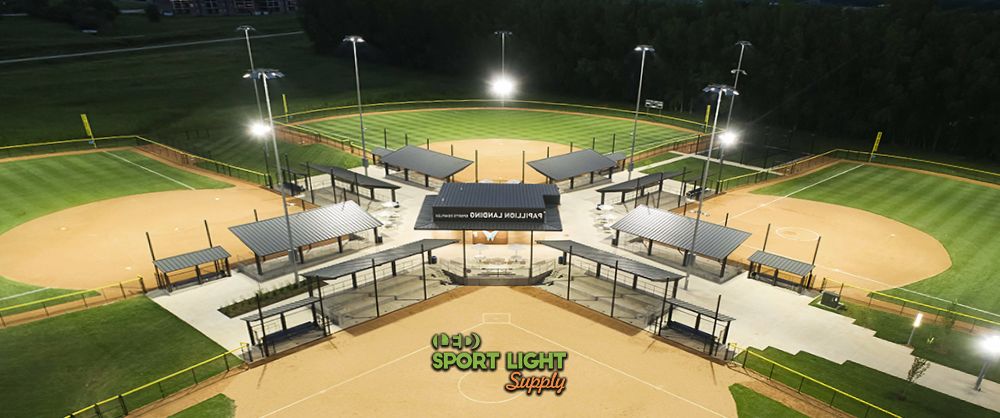
A good softball field lighting design begins with the field itself, not with a product catalogue. The designer needs to understand the playing dimensions, target illumination, pole locations, mounting heights, viewing angles, surrounding properties, and electrical infrastructure.
A photometric lighting simulation is usually the best way to evaluate the proposed arrangement before equipment is purchased.
The first task is to obtain an accurate site plan. Softball fields come in different layouts depending on age group, competition level, and facility design.
Many adult fastpitch softball fields use approximately 60-foot base paths and an outfield fence distance that can vary around 200 to 250 feet. Some facilities use larger or smaller dimensions depending on their intended use.
The lighting plan should include the complete playing area, not just the infield diamond. The outfield corners, foul territory, and surrounding spaces can significantly affect the number and location of the fixtures.
For example, assume a field has a playing area approximately 300 feet wide and 300 feet deep. The total rectangular planning area would be:
300 ft × 300 ft = 90,000 square feet.
That does not mean every point requires the same illuminance, but it gives the designer a starting point for understanding the scale of the project.
The next step is to determine the desired lighting level.
Suppose a recreational softball field uses an illustrative target of 30 foot-candles across the infield and 20 foot-candles across the outfield.
If the infield area is approximately 25,000 square feet and the outfield area is approximately 65,000 square feet, the simplified lumen requirement reaching those surfaces would be:
Infield – 25,000 × 30 = 750,000 lumens.
Outfield – 65,000 × 20 = 1,300,000 lumens.
Total – 2,050,000 lumens reaching the target areas.
This is a simplified calculation, not the number of lumens that must be purchased. Real lighting systems experience optical losses, and some light does not reach the intended measurement plane. The design must account for fixture distribution, aiming, mounting height, maintenance factors, and overlapping light patterns.
The actual installed fixture output may therefore be substantially higher than the simplified surface calculation suggests.
The number of fixtures depends on the output of each luminaire and the photometric performance of the complete arrangement.
For a preliminary example, suppose a proposed system uses 24 LED floodlights, each producing 150,000 lumens.
Total initial fixture output:
24 × 150,000 = 3,600,000 lumens.
If the fixtures operate at 1,000 watts each, the total connected lighting load is:
24 × 1,000 W = 24,000 W, or 24 kW.
This gives the project team a rough idea of the equipment scale and electrical demand. However, 24 fixtures are not automatically enough for every field. The final quantity must be established using photometric calculations.
A 24-fixture layout with unsuitable beam angles may perform worse than a 30-fixture layout using more appropriate optics.
Beam angle determines how widely light is distributed from a fixture.
A narrow beam concentrates light into a smaller area, while a wider beam distributes it over a larger area. Sports lighting systems often use several optical distributions within the same project.
For example, fixtures aimed at distant outfield areas may need a different distribution from those illuminating the infield.
The designer should avoid assuming that wide beams are always better. A very wide beam may produce unwanted spill light, while a very narrow beam may create bright spots and dark areas if it is not aimed correctly.
LED sports lights with asymmetric optics can help direct light toward the field while limiting unwanted illumination outside the playing area.
Pole height affects the coverage area, aiming angle, glare characteristics, and the number of fixtures required.
For a typical outdoor softball project, mounting heights may fall somewhere around 60 to 100 feet, although actual requirements depend on the field geometry and design approach.
A smaller recreational field may use lower poles, while a larger competitive venue may require taller structures to distribute light more effectively.
Taller poles can help create flatter aiming angles and reduce the number of extremely steep fixture angles. However, they also increase structural requirements, foundation loads, installation complexity, and project cost.
The final pole height should be selected through engineering and photometric analysis rather than a general rule of thumb.
Photometric software allows designers to model how fixtures distribute light across the field.
The simulation typically uses the photometric data of the actual LED fixture, along with the field geometry, mounting heights, pole positions, and aiming angles.
A useful report should show the average illuminance, minimum and maximum readings, uniformity ratios, and illumination levels across the different field zones. It should also show the proposed fixture schedule and aiming information.
For projects near residential properties, the design should include spill-light calculations at relevant property boundaries.
A buyer should request a complete photometric report before approving the fixture quantity or layout. A simple product list containing wattages and lumen outputs is not enough to confirm that the field will meet its lighting targets.
Let’s look at a simplified example for a community softball facility.
Assume the project uses 24 LED floodlights rated at 1,000 watts each, with an average fixture output of 150,000 lumens.
The connected load is 24 kW.
If the lights operate for 4 hours per day and 200 days per year, the annual operating time is:
4 × 200 = 800 hours.
Annual electricity consumption is:
24 kW × 800 hours = 19,200 kWh.
If the electricity rate is US$0.15 per kWh, the estimated annual energy cost is:
19,200 × US$0.15 = US$2,880.
This estimate covers the lighting load only. It excludes electricity used by other facility equipment, demand charges, taxes, and any additional electrical losses.
The example also shows why fixture efficiency and operating schedules deserve attention. A facility that operates its lights for 1,500 hours annually would consume substantially more electricity than one operating for 800 hours.
| Design item | Example specification |
|---|---|
| LED fixture quantity | 24 |
| Fixture wattage | 1,000 W |
| Fixture output | 150,000 lm |
| Total connected load | 24 kW |
| Daily operation | 4 hours |
| Annual operating days | 200 |
| Annual energy use | 19,200 kWh |
| Electricity rate | US$0.15/kWh |
| Estimated annual energy cost | US$2,880 |
The figures are illustrative rather than a recommended universal design. A professional lighting simulation should establish the actual fixture quantity, wattage, aiming positions, and resulting field performance.
Glare and shadows are two problems that can make an otherwise powerful lighting system uncomfortable to use.
Glare is often associated with fixture placement and aiming. If a light source sits directly within a player’s viewing direction, the player may struggle to follow the ball.
Shadows can appear when light comes predominantly from one direction. Using several appropriately positioned lighting poles helps distribute illumination across the field and reduces the dependence on a single lighting angle.
The designer should also consider the relationship between pole locations and common ball trajectories. Outfielders frequently look upward toward the sky, so fixture positions must be evaluated from those viewing angles.
Good optical control can make a noticeable difference. Fixtures with appropriate shielding and asymmetric distributions help direct more light toward the playing area while reducing unnecessary brightness outside it.
A softball complex with two, four, or more fields introduces additional design considerations.
The designer needs to account for the overlapping coverage of adjacent fields, shared poles, access roads, parking spaces, spectator areas, and electrical infrastructure.
A shared pole arrangement may reduce the total number of structures, but it does not automatically reduce overall project cost. The poles may need to be taller or stronger, and the fixtures may require more complicated aiming arrangements.
Each field should also have its own lighting control zones. This allows one field to operate without switching on all the others.
For a four-field complex, separate controls can help facility managers avoid powering four complete lighting systems when only one or two fields are being used.
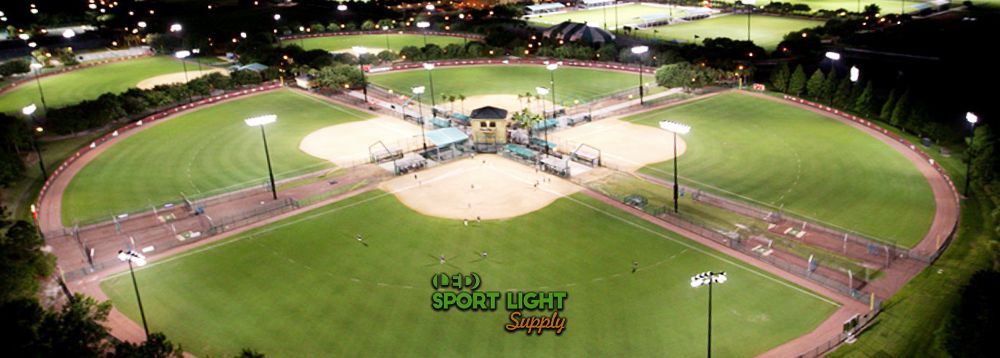
Pole layout is one of the biggest decisions in an outdoor softball lighting project. The number of poles, their positions, mounting heights, and fixture arrangements all affect the final lighting result.
Some facilities use four main lighting poles, while others use six or eight. Larger complexes may use even more structures, particularly when the playing area is unusually wide or when surrounding facilities need separate illumination.
There is no universal pole configuration for every softball field. The right arrangement depends on the required lighting level, field dimensions, fixture output, optical distribution, and the location of areas where glare must be controlled.
A four-pole layout generally uses one lighting pole near each corner or at selected positions around the outfield perimeter.
This arrangement can work for smaller recreational fields where the lighting requirements are relatively modest and the field geometry allows suitable coverage from four directions.
The main advantage is the lower number of structures. Fewer poles can mean less foundation work, fewer electrical connections, and a simpler installation process.
However, four-pole systems may require more powerful fixtures and careful aiming to cover the entire playing area. The outfield corners and certain infield locations can be difficult to illuminate evenly, particularly when pole positions are restricted by property boundaries or spectator facilities.
Another consideration is glare. With fewer lighting directions, some fixtures may need to be aimed from less favorable angles. The designer should check how those fixtures appear to players looking toward the pitcher or tracking a high ball.
A six-pole layout offers more flexibility. It provides additional mounting positions, allowing the designer to distribute fixtures across more directions.
This can help improve lighting uniformity and reduce the amount of light required from individual fixtures. It may also make it easier to illuminate the infield and outfield separately.
For medium-sized facilities, six poles can provide a useful balance between structural cost and lighting performance. The arrangement is particularly worth evaluating when a four-pole design produces uneven coverage or requires excessive fixture output.
However, adding two poles also means additional foundations, electrical connections, and structural components. Whether the extra poles are worthwhile depends on the complete project cost and the resulting photometric performance.
An eight-pole layout provides even more flexibility for fixture placement.
It may be considered for larger softball facilities, higher illumination targets, or sites where the available pole positions make it difficult to achieve suitable coverage with fewer structures.
The additional mounting positions can allow the designer to distribute light more evenly and use different fixture distributions for specific field zones.
That said, eight poles are not automatically better than six. More poles increase the number of structures and may introduce additional visual obstructions, maintenance requirements, and installation costs.
A properly designed six-pole arrangement may outperform a poorly designed eight-pole arrangement. The photometric results matter much more than the pole count alone.
The following table provides a general comparison. These configurations are planning options rather than fixed standards.
| Layout | Main advantage | Potential limitation | Typical consideration |
|---|---|---|---|
| 4 poles | Fewer structures and foundations | More demanding fixture aiming | Smaller or simpler projects |
| 6 poles | Flexible coverage and aiming | Higher structural cost than four poles | Medium-sized facilities |
| 8 poles | More fixture positions | More foundations and electrical work | Larger or more demanding projects |
Pole placement should be based on the field geometry and player viewing angles.
In many outdoor designs, poles are positioned around the perimeter of the playing area. The exact locations depend on the available space, fence lines, spectator seating, access roads, and other site restrictions.
Designers should avoid placing poles where they obstruct normal field operations or create uncomfortable glare. They should also consider the location of dugouts, foul territory, and areas where players may track the ball toward the sky.
The pole arrangement needs to be evaluated from the batter’s box, pitcher’s mound, bases, and outfield positions. A layout that looks symmetrical on a site plan may not provide the best visual conditions from the actual playing positions.
Outdoor softball lighting poles commonly fall within an approximate range of 60 to 100 feet, although smaller facilities and specialized designs may use different heights.
The choice of pole height depends on the field dimensions, fixture quantity, beam distribution, target illumination, and glare restrictions.
For example, a 60-foot pole may be suitable for a relatively compact field with carefully selected LED optics. A larger facility may require 80-foot or 90-foot mounting heights to distribute light over a wider playing area.
Taller poles can improve the aiming geometry by allowing fixtures to project light over greater distances at less aggressive angles. They can also reduce the need for extremely high-output fixtures in certain applications.
However, taller poles cost more to manufacture, transport, and install. Their foundations may also require more concrete and reinforcement because of increased wind loading and structural demands.
Galvanized steel is widely used for outdoor sports lighting poles because of its strength and corrosion resistance. Depending on the project, poles may also use other protective finishes or specialized structural designs.
Buyers should request documentation covering the pole height, material grade, wall thickness, base plate, anchor bolts, design loads, and corrosion protection.
Wind speed is a major factor in structural engineering. A pole carrying several large LED floodlights has a significant projected surface area, and the fixtures themselves add wind resistance.
The structural engineer must consider the applicable wind design criteria, exposure category, pole geometry, fixture arrangement, and local building requirements.
It is not enough to select a pole based only on its advertised height. The complete pole-and-fixture assembly must be structurally suitable for the installation site.
Pole foundations transfer the structural loads into the ground. Their dimensions depend on soil conditions, pole height, wind loads, and the total weight and surface area of the mounted equipment.
Some projects use reinforced concrete foundations with embedded anchor bolts, while others require specialized foundation designs based on geotechnical conditions.
For example, a foundation designed for an 80-foot pole may need a substantially different diameter and depth from one designed for a 50-foot pole. The exact dimensions should come from the structural calculations rather than a generic sizing chart.
Soil testing can also affect the budget. Weak or unstable soil may require deeper foundations, additional reinforcement, or other engineering measures.
Before construction begins, the project team should identify underground utilities, drainage lines, electrical routes, and existing structures. This helps avoid costly changes once excavation has started.
Indoor and outdoor softball facilities have different lighting requirements, even though both need to provide good visibility for players and spectators.
Outdoor fields have to deal with weather, wind, sunlight, rain, dust, and surrounding properties. Indoor facilities are protected from most weather conditions, but their lighting systems must work with the building’s ceiling height, roof structure, wall surfaces, and interior layout.
Choosing between indoor and outdoor lighting is not simply a matter of selecting a waterproof or non-waterproof fixture. The optical design, mounting arrangement, illumination targets, and operating environment are different.
Outdoor softball fields generally use pole-mounted LED floodlights installed around the playing area.
These fixtures need to distribute light across a large open space, often from mounting heights of 60 feet or more. The design must account for wind exposure, rain, temperature changes, corrosion, and electrical safety.
Outdoor sports lights commonly use IP66-rated housings. This rating indicates protection against dust and powerful water jets, making it suitable for many exposed installations.
The housing material and surface treatment also matter. Aluminum housings with suitable corrosion-resistant finishes are commonly used, although coastal locations may require additional protection because of salt exposure.
Outdoor lighting design also needs to consider neighboring properties. A field located near homes may require additional shielding and more careful aiming to reduce unwanted light.
Indoor softball facilities are often designed for batting practice, pitching practice, fielding drills, training sessions, and sometimes full-scale indoor competition.
The required lighting depends on the activities taking place and the size of the building.
A small indoor batting cage may use relatively simple high-bay LED fixtures, while a large indoor training complex may need a more advanced sports lighting arrangement with multiple fixture rows and carefully controlled illumination.
Ceiling height plays a major role. A facility with a 20-foot ceiling has different optical requirements from one with a 50-foot ceiling.
Fixtures mounted too low can create uncomfortable glare and uneven illumination. Fixtures mounted too high may require greater output or different beam distributions to achieve the required light levels at the playing surface.
Indoor facilities should also consider the reflectance of ceilings and walls. Light-colored surfaces can reflect some light back into the playing area, while darker surfaces absorb more of it.
| Feature | Indoor softball facility | Outdoor softball field |
|---|---|---|
| Fixture type | High-bay or sports LED luminaires | Pole-mounted LED floodlights |
| Mounting location | Ceiling or roof structure | Steel lighting poles |
| Weather exposure | Limited | High |
| Common environmental rating | Depends on interior conditions | Often IP65 or IP66 |
| Main design concern | Ceiling height and glare | Pole layout, glare, and spill light |
| Structural requirements | Roof and mounting support | Poles and foundations |
| Lighting controls | Training and activity zones | Separate field and event zones |
Indoor softball facilities commonly use LED high-bay fixtures or specialized sports luminaires.
High-bay lights are designed for spaces with relatively high ceilings. They can provide broad illumination across the training area, while sports-specific optics help manage glare and light distribution.
For a batting cage, the designer may need to pay particular attention to the batter’s viewing direction and the background behind the pitcher. Excessive glare or a poorly positioned fixture can make it harder to see the ball clearly.
For indoor practice fields, the lighting system should provide suitable horizontal and vertical illumination. Flicker performance should also be checked, particularly if the facility records training sessions or uses high-speed cameras.
Energy consumption depends on fixture wattage, quantity, operating hours, and electricity rates.
Consider an indoor training facility using 30 LED fixtures rated at 200 watts each.
The connected load is:
30 × 200 W = 6,000 W, or 6 kW.
If the system operates for 6 hours per day and 300 days per year, annual electricity consumption is:
6 kW × 6 hours × 300 days = 10,800 kWh.
At US$0.15 per kWh, the estimated annual energy cost is US$1,620.
An outdoor softball field may have a much higher connected load because of the larger playing area and greater mounting heights. However, the operating schedule may be shorter, depending on how frequently games and training sessions take place.
The cost of softball field lighting can vary significantly depending on the size of the field, lighting level, fixture quality, number of poles, electrical infrastructure, and installation conditions.
For a new outdoor LED installation in the United States, a broad preliminary planning range is approximately US$135,000 to US$350,000 for a typical complete project. More demanding facilities, difficult sites, and complex electrical upgrades can exceed this range.
A retrofit project that reuses suitable existing poles and foundations may cost substantially less. A preliminary planning range for certain LED retrofit projects is approximately US$55,000 to US$165,000.
These are budgetary examples, not fixed market prices or supplier quotations. A project involving major structural repairs, new underground wiring, difficult soil conditions, or high competition lighting requirements will need a separate estimate.
A complete installation normally includes more than the LED floodlights themselves.
The equipment budget may cover luminaires, poles, control panels, mounting hardware, and electrical components. The construction budget may include pole foundations, excavation, wiring, installation labor, engineering, and commissioning.
The following table illustrates a possible cost breakdown for a project with a total budget of approximately US$135,000 to US$350,000.
| Project component | Indicative cost range |
|---|---|
| LED fixtures, poles, and control system | US$94,500–US$245,000 |
| Pole installation | US$20,250–US$52,500 |
| Fixture installation | US$10,125–US$26,250 |
| Electrical wiring | US$6,750–US$17,500 |
| Structural engineering | US$3,375–US$9,000 |
| Estimated total | US$135,000–US$350,000 |
The breakdown is intended for early budget planning. Actual quotations may group equipment and labor differently, and individual line items should not be added to another supplier’s package without checking for duplicated costs.
The price of an LED sports floodlight depends on its power rating, lumen output, optical distribution, housing, driver, protection features, and certification.
A lower-output LED fixture may cost several hundred dollars, while a high-output sports luminaire designed for tall pole mounting can cost several thousand dollars.
For preliminary purchasing discussions, the following broad allowances can be used:
| LED fixture category | Illustrative unit price |
|---|---|
| 300W–500W LED floodlight | US$300–US$900 |
| 600W–800W LED sports light | US$600–US$1,500 |
| 1,000W–1,200W LED sports light | US$900–US$2,500 |
| 1,500W–2,000W high-output sports light | US$1,500–US$4,000+ |
These are indicative budgeting allowances rather than verified universal retail prices. Premium products, specialized optics, advanced controls, and certified sports lighting systems can cost more.
Buyers should also compare the price per delivered performance, not simply the cost per fixture. A fixture with a lower purchase price may require more units to meet the same lighting target.
Pole costs depend on height, material, structural design, wind-load requirements, and the number of fixtures mounted on each structure.
For preliminary budgeting, a standard galvanized steel sports lighting pole may cost approximately US$5,000 to US$15,000 per unit, with taller or more heavily engineered structures potentially exceeding US$20,000.
The pole price does not necessarily include its foundation, anchor bolts, freight, installation, or electrical connections.
A project with six 80-foot poles, for example, could have a pole equipment allowance of US$30,000 to US$90,000 using the illustrative range above.
However, the final structural package should be based on engineering calculations for the actual site. Two poles with the same height can have very different costs because of differences in wind loading and fixture mounting arrangements.
Foundation costs are influenced by soil conditions, excavation depth, reinforcement, concrete volume, anchor bolt assemblies, and accessibility.
A straightforward reinforced concrete foundation may cost several thousand dollars, while more complex installations can be considerably more expensive.
Suppose a project requires six foundations with an average construction allowance of US$4,000 each.
The total foundation budget would be:
6 × US$4,000 = US$24,000.
This is only an example. The actual cost could change substantially after geotechnical testing and structural design.
Rock excavation, groundwater, poor soil bearing capacity, and underground utility conflicts can all increase construction expenses.
Electrical work is another major budget item.
A softball field may require underground conduits, feeder cables, distribution panels, contactors, control cabinets, grounding systems, and connections at each pole.
The required electrical capacity depends on the connected lighting load. For example, a system with 24 fixtures rated at 1,000 watts each has a connected load of 24 kW before considering other electrical equipment.
The electrician and electrical engineer must determine the appropriate voltage, conductor sizes, circuit arrangement, protective devices, and grounding requirements.
If the existing power supply cannot support the new system, a service upgrade or transformer work may be needed. Such work can add a substantial amount to the project budget.
Professional lighting design should be included in the project budget.
For a straightforward facility, an initial design and photometric analysis may cost approximately US$1,500 to US$5,000. More complicated projects involving several fields, detailed glare analysis, extensive revisions, or additional engineering work may cost US$5,000 to US$15,000 or more.
The scope of work matters. A basic lighting simulation is different from a complete engineered package that includes pole locations, aiming schedules, electrical design, structural coordination, and installation drawings.
A buyer should ask what is included before comparing design fees.
A new installation generally costs more because it requires the complete lighting infrastructure.
An LED retrofit may reuse existing poles, foundations, conduits, and electrical systems, reducing the amount of construction work.
However, existing infrastructure needs to be inspected before assuming that it can be reused. Older poles may not have enough structural capacity for the new fixtures, especially if the LED system uses larger housings or a different mounting arrangement.
The existing foundation condition also needs to be checked. Cracking, corrosion, settlement, or inadequate anchor bolts can make reuse unsuitable.
| Cost factor | New LED installation | LED retrofit |
|---|---|---|
| New lighting poles | Usually required | May be reusable |
| Foundations | Usually required | May be reusable |
| LED fixtures | Required | Required |
| Electrical work | Often extensive | Depends on existing system |
| Structural engineering | Required | Required to verify reuse |
| Initial project cost | Generally higher | Often lower |
| Design work | Full design | Existing-system assessment plus redesign |
A retrofit is worth considering when the existing structures are in good condition and the new fixtures can achieve the required performance without major electrical or structural changes.
The purchase price is only one part of a softball field lighting investment. Electricity, maintenance, replacement parts, inspections, and operating schedules all contribute to the long-term cost of ownership.
A system that costs slightly more upfront may be cheaper to operate over 10 or 15 years. This is why buyers should compare the total cost of ownership rather than focusing entirely on the initial equipment quotation.
LED fixtures generally produce more light per watt than older metal halide systems. As a result, a facility may be able to achieve its target illumination using less electricity after upgrading to LEDs.
Let’s consider a simplified comparison between an older lighting system and a modern LED installation.
Assume an existing metal halide system has a connected load of 48 kW, while a redesigned LED system uses 24 kW to achieve the required field performance.
If both systems operate for 1,000 hours annually, the energy consumption would be:
Metal halide – 48 kW × 1,000 hours = 48,000 kWh.
LED – 24 kW × 1,000 hours = 24,000 kWh.
The difference is 24,000 kWh annually.
At an electricity rate of US$0.15 per kWh, the annual energy savings would be:
24,000 × US$0.15 = US$3,600 per year.
Over 10 years, the simple electricity savings would total US$36,000, assuming the electricity rate and annual operating hours remain unchanged.
Actual savings depend on the existing system’s efficiency, the new design, maintenance factors, and operating conditions. The comparison should use equivalent field performance rather than simply comparing the rated wattage of individual lamps.
A simple electricity cost calculation can help facility managers estimate their annual operating budget.
The formula is:
Annual electricity cost = Total connected load in kW × Annual operating hours × Electricity rate per kWh.
For example, consider a softball field with 30 LED fixtures rated at 800 watts each.
The connected load is:
30 × 800 W = 24,000 W = 24 kW.
If the field operates for 5 hours per day over 180 days each year, annual operating hours are:
5 × 180 = 900 hours.
Annual electricity consumption is:
24 × 900 = 21,600 kWh.
At US$0.14 per kWh, the estimated annual electricity cost is:
21,600 × US$0.14 = US$3,024.
If the facility increases its operating time to 1,300 hours annually, the cost rises to US$4,368 at the same electricity rate.
This is why an accurate operating schedule matters when evaluating a new lighting system.
Modern LED systems can be integrated with lighting controls to give facility managers greater flexibility.
Instead of operating every fixture at full output, the facility can use different lighting scenes for practice, recreational games, competitive games, and maintenance.
For example, a field might use 100% output during a tournament, 70% during routine training, and 30% for certain maintenance activities where the applicable safety requirements permit reduced lighting.
The exact settings should be established through photometric calculations and approved operating procedures. A reduced-output mode should never be used when it causes the field to fall below the required illumination level for the activity taking place.
Automatic scheduling can also help prevent lights from remaining on after games have finished. Astronomical time clocks, photocells, and remote control systems can simplify daily operation.
For facilities with multiple fields, separate control zones are especially useful. A complex with four softball fields should be able to operate only the fields currently in use rather than powering the entire site.
Return on investment, or ROI, helps facility managers understand whether an upgrade is financially worthwhile.
A simple payback calculation divides the initial investment by the annual financial savings.
Suppose an LED retrofit costs US$85,000 and produces annual electricity savings of US$12,000. If maintenance savings are estimated at another US$2,000 annually, the total annual savings are US$14,000.
Simple payback:
US$85,000 ÷ US$14,000 = approximately 6.1 years.
This calculation assumes that annual savings remain consistent and excludes financing costs, taxes, future electricity price changes, and other financial factors.
For a more complete financial assessment, the project team should consider the expected service life, replacement costs, discount rate, electricity price forecasts, and maintenance requirements.
A lighting system may operate for 10 to 20 years or longer, depending on its design, usage, and maintenance. Over that period, the original equipment price becomes only one part of the overall investment.
Consider a hypothetical comparison between two LED systems.
System A costs US$70,000 initially and has annual energy and maintenance expenses of US$7,000.
System B costs US$85,000 initially and has annual energy and maintenance expenses of US$5,000.
Over 10 years, the simplified cost would be:
System A – US$70,000 + (US$7,000 × 10) = US$140,000.
System B – US$85,000 + (US$5,000 × 10) = US$135,000.
Although System B costs US$15,000 more initially, its lower operating expenses result in a lower 10-year total under these assumptions.
This is a useful reminder that the cheapest quotation is not necessarily the cheapest lighting solution over its operating life.
Funding is often one of the biggest challenges when planning a softball field lighting upgrade. Schools, community organizations, local sports clubs, and municipal recreation departments may not have enough money available in their regular operating budgets to cover a complete installation.
Fortunately, there are several ways to approach project financing. The best option depends on who owns the facility, how the field is used, and whether the project can demonstrate community, educational, recreational, or energy-efficiency benefits.
Local governments often invest in public recreation facilities because sports fields provide community access to physical activity and organized events.
A softball field lighting project may be included in a wider park improvement program, sports infrastructure budget, or municipal capital expenditure plan.
When preparing a lighting funding request, it helps to explain how the new lighting system will improve the use of the facility. For example, evening lighting may allow a park to schedule additional community games and youth training sessions without requiring a second field.
The proposal should also include a detailed project budget, preliminary lighting design, expected energy consumption, maintenance estimates, and a construction schedule.
Local eligibility requirements vary, so facility owners should check the relevant municipal and regional funding programs before preparing an application.
Schools and universities may fund softball field improvements through capital improvement budgets, athletics department allocations, or facility modernization programs.
A lighting upgrade can be presented as part of a wider campus improvement plan.
For example, a school district managing three softball fields could evaluate whether upgrading all three fields at once offers better procurement pricing than completing separate projects over several years.
However, a multi-field project also requires a larger initial budget. A phased approach may be more practical when funding is limited.
Schools should also consider how the new lighting system affects electricity expenses and maintenance requirements. A project proposal that includes a 10-year operating cost comparison can provide a clearer financial picture.
Sports associations and community development organizations sometimes provide funding for projects that improve access to recreational facilities.
A softball lighting proposal may be eligible when it supports youth participation, community sports development, accessibility, or the renovation of existing public infrastructure.
Grant programs can have specific rules about eligible costs. Some may cover equipment and installation, while others may exclude routine maintenance, operating expenses, or private facility improvements.
Before applying, read the eligibility criteria carefully and confirm whether the grant supports outdoor lighting infrastructure.
Local businesses may be willing to sponsor improvements to community sports facilities, particularly when the venue attracts regular visitors.
A sponsorship arrangement could involve naming rights, signage, advertising space, or recognition at tournaments and community events.
For example, a softball facility with an annual tournament schedule may offer a sponsorship package that provides local businesses with exposure to players, families, and spectators.
The sponsorship value should be based on realistic audience numbers and clearly defined benefits. It is better to present a practical proposal with transparent costs than to promise exposure that the facility cannot reliably deliver.
Some electricity providers and government energy programs offer incentives for replacing inefficient lighting with energy-efficient LED systems.
The availability of rebates depends on the state, utility company, project type, and equipment specifications.
For a softball field retrofit, the facility may need to submit information about the existing lighting system, proposed LED fixtures, expected energy savings, and installation costs.
Some programs require pre-approval before construction begins. Buyers should check the program conditions before signing a purchase contract or starting installation work.
A utility rebate can reduce the initial project cost, but it should not be included in the financial plan until eligibility and the expected incentive amount have been confirmed.
A public-private partnership may be suitable for larger sports facilities that generate revenue through rentals, tournaments, training programs, or community events.
Under this type of arrangement, a private organization may contribute funding or manage part of the facility’s development in exchange for agreed financial or operational benefits.
For example, a municipality could work with a local sports organization to upgrade an existing softball complex. The agreement might establish responsibilities for equipment ownership, maintenance, operating schedules, and facility access.
These arrangements require careful legal and financial planning, but they can help projects move forward when a single organization cannot cover the full investment.
A strong proposal should explain the existing problem, the proposed improvement, the total project cost, and the expected benefits.
The financial section should separate LED equipment, poles, foundations, electrical work, engineering, installation, and commissioning. If the project involves an LED retrofit, the proposal should also explain which existing structures will be reused and how their condition will be verified.
It is useful to include a preliminary photometric design because it shows how the proposed system is expected to perform. A funding organization can review the target illumination, pole layout, fixture schedule, and projected energy use rather than relying on a general statement that the new lights will be brighter.
For example, a proposal for a US$180,000 lighting project could show the following financial structure:
| Funding component | Example amount |
|---|---|
| Municipal capital budget | US$90,000 |
| Community sports grant | US$35,000 |
| Local business sponsorship | US$25,000 |
| Utility energy rebate, if approved | US$10,000 |
| Community fundraising | US$20,000 |
| Total funding target | US$180,000 |
These figures are only an example of how funding sources can be combined. Actual grant amounts, rebate eligibility, and sponsorship contributions will depend on the project and the organizations involved.
Installing softball field lighting involves several stages, from initial site assessment to final testing.
A new installation can take approximately 3 to 6 months from planning to completion, although complicated projects may take longer. Permitting, structural engineering, equipment lead times, weather conditions, and electrical service upgrades can all affect the schedule.
A retrofit may be completed more quickly if the existing poles, foundations, and electrical infrastructure are suitable for reuse.
The project starts with a detailed assessment of the field and surrounding property.
The site team should measure the playing area, identify potential pole positions, check existing underground utilities, and review the location of spectator seating and neighboring buildings.
For an existing facility, the inspection should include the poles, foundations, electrical equipment, and existing lighting circuits.
If the project involves replacing metal halide fixtures with LEDs, the structural engineer should verify that the existing poles can safely support the new fixtures and mounting hardware.
Once the site assessment is complete, the lighting designer can develop the photometric layout.
The design should establish the target illuminance, uniformity requirements, fixture quantities, pole heights, beam distributions, and aiming positions.
The equipment specification should also include electrical characteristics, surge protection, ingress protection, corrosion resistance, and control compatibility.
At this stage, buyers should compare supplier proposals carefully. A quotation should clearly identify the fixture model, quantity, rated wattage, actual lumen output, pole specifications, and installation scope.
Before poles are installed, the project team needs to prepare the foundations and electrical routes.
This may involve excavation, reinforcement installation, concrete placement, anchor bolt positioning, conduit installation, and grounding work.
The foundation design must follow the structural engineer’s calculations. Pole installation should not begin until the concrete has reached the required strength and the anchor assemblies have been checked.
Electrical contractors can install the underground conduits and prepare the feeder connections during this stage.
After the foundations are ready, the poles can be installed using suitable lifting equipment.
The fixtures are then mounted according to the approved lighting layout. Each unit should be identified by its pole location and aiming reference so that the installation team can follow the photometric design.
For a six-pole system with four fixtures per pole, the installation involves 24 individual luminaires. Each fixture needs to be mounted at the specified angle and connected to the appropriate electrical circuit.
The actual process depends on the pole design. Some systems use lowering devices that allow maintenance crews to access the fixtures without using a specialized elevated work platform every time.
The electrical installation includes connections between the fixtures, poles, control cabinets, and power distribution equipment.
The system should include suitable circuit protection, grounding, and surge protection based on the electrical design.
Lighting controls should be configured before commissioning. This may involve separate field zones, manual switching, automatic schedules, dimming settings, and remote monitoring.
The facility manager should receive clear operating instructions explaining how to switch between approved lighting modes.
After installation, the fixtures need to be aimed and checked.
Even small aiming errors can affect field uniformity, glare, and spill light. The commissioning team should compare the installed arrangement with the approved aiming schedule.
Illumination measurements should then be taken at the specified grid points using calibrated equipment.
The measured results can be compared with the design targets. If certain areas fall below the required values or glare is excessive, adjustments may be needed.
Commissioning should also include electrical testing, control system checks, and verification of the installed equipment.
Choosing a supplier is not just about finding a company that sells high-wattage LED floodlights. A complete softball lighting project requires product knowledge, optical design, engineering coordination, and technical support.
A good supplier should be able to explain how its proposed fixtures will meet the project’s requirements and provide supporting documentation.
Start by reviewing the manufacturer’s experience with outdoor sports lighting.
A company that regularly supplies stadium, baseball, softball, or large recreational field lighting systems may have a better understanding of the optical and installation challenges involved.
Ask whether the company can provide examples of comparable projects, including fixture quantities, mounting heights, field dimensions, and lighting performance.
Project photographs can be useful, but they should not be the only evidence. A photograph taken at night cannot reliably demonstrate average foot-candles, uniformity, or glare performance.
Where possible, request actual photometric reports and project references.
A supplier may recommend a 1,000-watt fixture, while another proposes an 800-watt model.
At first glance, the 1,000-watt product may seem more powerful. However, the comparison is incomplete without checking the fixture output and optical distribution.
For example, an 800-watt fixture producing 144,000 lumens has an efficacy of:
144,000 ÷ 800 = 180 lm/W.
A 1,000-watt fixture producing 150,000 lumens has an efficacy of:
150,000 ÷ 1,000 = 150 lm/W.
The first fixture produces slightly fewer total lumens while using 20% less power. Whether it performs better on the field depends on its optics and placement, but the example shows why wattage alone is not a useful purchasing measure.
Buyers should compare actual fixture data and request a project-specific simulation.
A supplier should provide appropriate product documentation for the market where the system will be installed.
For U.S. projects, buyers may need to check relevant UL or ETL listings, electrical compliance documentation, and applicable safety standards.
Other useful documentation may include LM-79 photometric test reports, LM-80 LED package data, TM-21 lifetime projections, ingress protection test information, and driver specifications.
The precise documentation depends on the product and project requirements. Buyers should verify the reports rather than relying solely on statements in marketing brochures.
Warranty coverage is another purchasing consideration.
Commercial LED sports lighting warranties commonly fall within a range of 5 to 10 years, depending on the product and supplier.
However, a longer warranty does not automatically mean a better product.
Check what the warranty covers, whether it includes drivers and surge protection components, how replacement products are supplied, and whether labor and transportation costs are included.
For example, a 10-year fixture warranty may cover the luminaire itself but exclude installation labor. If a fixture is mounted 80 feet above the ground, the cost of accessing and replacing it could be significant.
A clear warranty document is much more useful than a general promise of long-term support.
A photometric report allows buyers to see how the proposed lighting system is expected to perform before committing to the equipment.
It should identify the fixture models, mounting heights, pole locations, aiming angles, average illuminance, minimum and maximum readings, and uniformity results.
The report should also distinguish between the infield and outfield where separate targets apply.
For projects near residential areas, ask for spill-light calculations as well.
A supplier that can provide a complete project-specific design is generally better positioned to support the purchasing process than one that simply recommends a fixed number of floodlights.
Before signing a contract, buyers should discuss several areas with the supplier.
Ask whether the quotation includes the complete fixture package, mounting accessories, lighting design, controls, and electrical equipment. Confirm whether the poles and foundations are included or priced separately.
The supplier should also explain the projected illumination levels and how the proposed arrangement handles glare and spill light.
It is worth asking whether the existing poles can be reused if the project involves an LED retrofit. If so, request the structural verification process and clarification of any exclusions.
Finally, discuss delivery schedules, installation support, commissioning, warranty coverage, and after-sales service.
A low-priced quotation can look attractive, but it may exclude several items that another supplier has already included.
For example, one quotation may include LED fixtures and poles only, while another includes fixtures, poles, foundations, electrical work, installation, and commissioning.
Comparing the two totals without checking their scope can lead to an inaccurate purchasing decision.
A useful comparison should include the same field dimensions, lighting targets, fixture quantities, pole heights, installation responsibilities, and warranty conditions.
| Comparison item | What buyers should verify |
|---|---|
| LED fixtures | Model, wattage, lumens, optics, and quantity |
| Lighting design | Photometric report and uniformity |
| Poles | Height, material, and structural calculations |
| Foundations | Engineering and construction scope |
| Electrical work | Wiring, panels, grounding, and protection |
| Controls | Dimming, scheduling, and zoning |
| Warranty | Coverage period and exclusions |
| Installation | Labor, lifting equipment, and commissioning |