
Stadium lighting is one of those projects where the price can look simple at first glance, but the final number can change quite a bit once you get into the details. A small community sports field and a professional stadium may both need floodlights, yet their lighting systems can have completely different requirements, equipment, and installation costs.
The stadium lighting cost depends on much more than the price of the LED fixtures. Field size, sport type, pole height, lighting levels, electrical infrastructure, installation conditions, controls, and even local regulations can all affect the budget.
The good news is that a well-planned system does not have to mean an oversized budget. With the right lighting design and equipment selection, stadium owners can achieve good visibility and uniformity while keeping energy and maintenance expenses under control.
What Is the Average Stadium Lighting Cost?
There is no single price tag for stadium lighting. The total cost can vary significantly depending on the size and type of venue, required lighting levels, existing infrastructure, installation conditions, and performance requirements.
A small school or community football field may need a relatively straightforward LED lighting system, while a professional stadium can require hundreds of high-output LED fixtures, tall lighting structures, advanced controls, upgraded electrical infrastructure, and broadcast-quality illumination.
As a general planning guide, stadium and sports-field lighting projects can range from tens of thousands of dollars for smaller installations to several hundred thousand dollars or more for large, high-performance venues. Major professional or broadcast-level projects can reach $1 million or beyond, particularly when new poles, foundations, electrical distribution, controls, and extensive structural work are required. These figures are broad estimates rather than fixed market prices, since every project has different requirements.
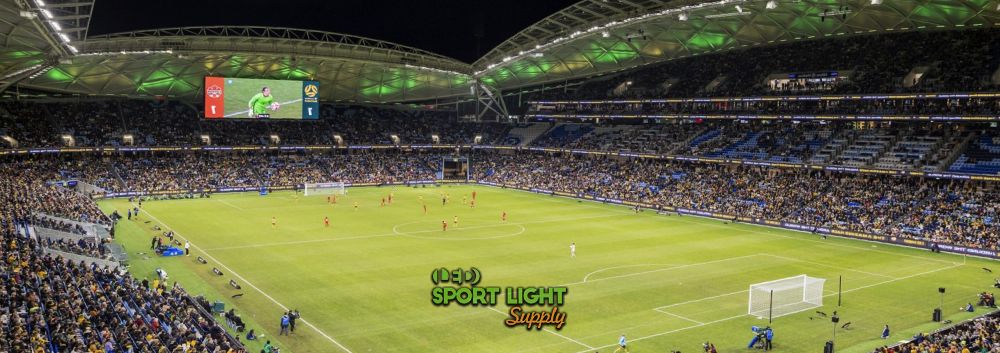
Key Factors Affecting Stadium Lighting Cost
Stadium lighting costs can vary significantly from one project to another. A training ground, professional football stadium, and multi-purpose sports complex may require very different lighting systems. The price of LED floodlights is only one part of the total budget.
Field size, lighting levels, pole height, fixture quantity, electrical infrastructure, installation, controls, regulations, and future maintenance can all affect the final cost. Understanding these factors before selecting equipment helps create a realistic budget and avoid expensive changes later.
1. Lighting Requirements and Illumination Levels
The required lighting level is one of the first factors to establish. A venue used mainly for evening training does not need the same performance as a stadium hosting professional competitions or televised matches.
Lighting levels are commonly measured in lux. Requirements depend on the sport, competition level, venue, and applicable standards. Higher-level events generally require greater illuminance, better uniformity, tighter glare control, and more precise light distribution.
Broadcast venues may also require stronger vertical illumination so players remain clearly visible to cameras from different angles.
For example, if a medium-sized field requires 40 LED floodlights at an average cost of $1,000 each, the fixture portion would be about $40,000. If the required performance increases the fixture count to 60, that figure could rise to $60,000 before mounting hardware, cabling, installation, and electrical work.
Uniformity is also important. A field with bright and dark areas may have an acceptable average lux level but still provide poor visibility and an inconsistent playing environment.
For this reason, lighting performance should be defined before selecting fixtures. Starting with a specific wattage and building the design around it can result in too many fixtures, insufficient light, or unnecessary energy use.
2. Field Size and Stadium Layout
Field size and stadium layout directly affect fixture quantity and placement. However, a larger field does not simply require proportionally more floodlights.
Pole locations, mounting heights, beam angles, stands, roofs, nearby buildings, and the playing area’s shape all influence the design. A photometric simulation helps determine how evenly the proposed system will illuminate the field.
For example, a full-size football or soccer field might use six poles with eight LED floodlights each, for a total of 48 fixtures. At $1,000 per fixture, the luminaires would cost approximately $48,000. A 60-fixture design would add about $12,000 before installation and electrical costs.
Lighting may also be needed for running tracks, warm-up areas, entrances, concourses, parking, walkways, and emergency routes.
Baseball and cricket can require more complex layouts because their playing areas have different shapes and visibility requirements. Beam distribution and aiming must be carefully selected to cover the full area without excessive glare or wasted light.
A detailed site survey is therefore a useful starting point. Accurate field dimensions, pole positions, mounting heights, and surrounding structures help determine how many fixtures are actually required.
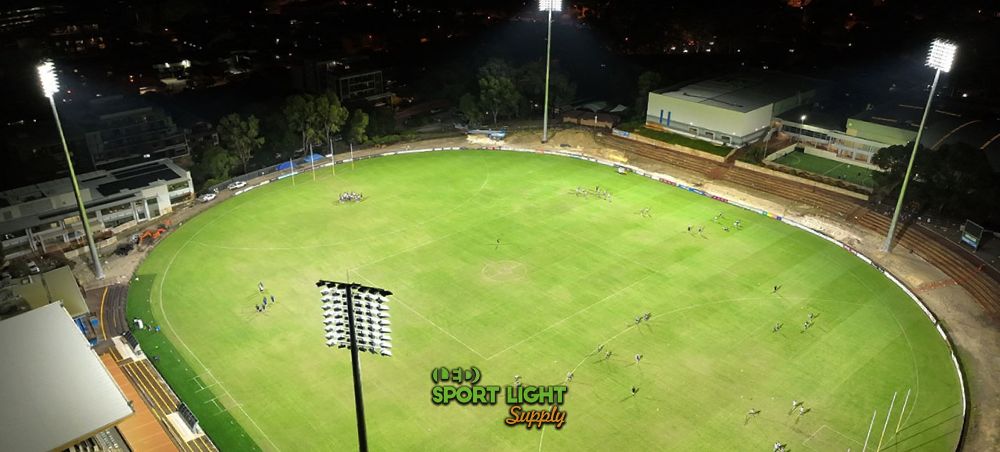
3. Type of Sport
The sport being played has a major influence on lighting cost. Football, soccer, baseball, cricket, basketball, tennis, rugby, field hockey, and athletics all create different lighting challenges.
Football and soccer require consistent illumination across large rectangular fields, often using high-mast poles with powerful sports floodlights.
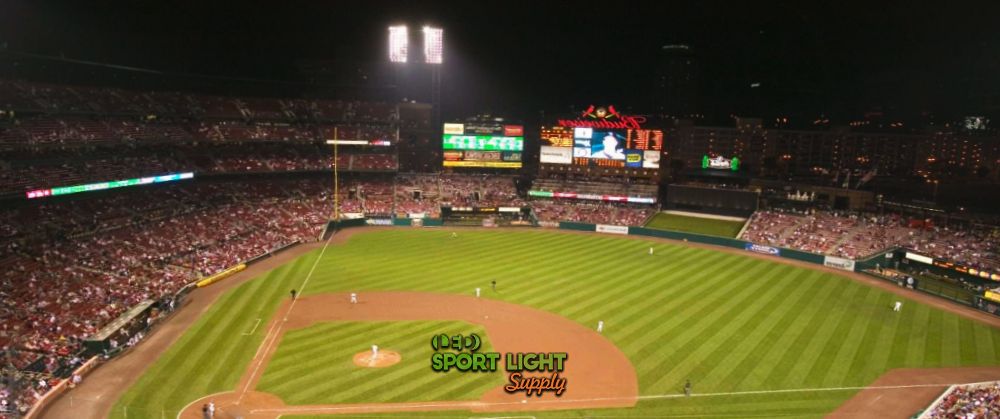
Baseball requires coverage of the infield, outfield, foul areas, and player positions. Glare control is especially important because players must track a fast-moving ball.
Cricket requires broad coverage across an oval-shaped playing area, making pole height and fixture positioning important considerations.
Basketball courts are smaller, but indoor arenas introduce challenges involving cameras, seating, scoreboards, roof structures, and other equipment.
Tennis also requires careful glare control because players frequently look upward to follow the ball. Precise aiming and controlled optical distributions can significantly improve visibility.
Multi-purpose stadiums can be more complex because the lighting may need programmable scenes for different sports and events.
4. Pole Height and Mounting Configuration
Pole height affects both lighting performance and infrastructure costs.
Higher poles can project light over larger areas and may reduce the number of mounting locations required. However, they can also require stronger foundations, additional structural engineering, and specialized lifting equipment.
Outdoor stadium poles can reach 20, 30, or even 40 meters. Installation at these heights requires careful planning and suitable access equipment.
For example, a stadium might use six 30-meter poles or eight shorter poles. The taller option may provide good coverage with fewer structures, while the shorter poles could be simpler to install and maintain.
There is no universal rule that taller poles are cheaper. Higher is not automatically better or more economical. The correct height depends on field dimensions, fixture output, beam angles, pole positions, glare requirements, and uniformity.
Existing poles may also be suitable for LED retrofits, but their structural condition, foundations, corrosion, wind loading, brackets, and cabling should be assessed first.
5. Number and Type of LED Floodlights
The number of floodlights affects the equipment budget, but fixture performance is equally important.
Two 1,000W LED sports floodlights can differ in lumen output, optical efficiency, beam distribution, thermal design, and useful light delivery. A well-designed fixture can direct more light toward the playing surface and reduce unwanted spill.
Stadium systems commonly use narrow, medium, or wide beam optics depending on fixture location.
For example, one design might use 60 fixtures at $1,000 each, costing $60,000. Another could use 50 higher-performance fixtures at $1,250 each, costing $62,500.
Although the second option costs $2,500 more for the luminaires, using 10 fewer fixtures could reduce mounting hardware, cabling, installation, electrical capacity, and maintenance requirements.
Owners should therefore compare useful light delivered to the field and performance per watt, rather than judging fixtures only by purchase price or wattage.
6. Stadium Lighting Design and Engineering
Professional lighting design can significantly influence project cost. Instead of buying fixtures first and adapting them later, the system can be designed around the field, sport, pole arrangement, and lighting requirements.
A photometric design considers fixture location, mounting height, beam angle, aiming direction, lumen output, illuminance, uniformity, glare, and light spill. Specialized software can simulate the proposed system before installation.
For example, an initial design might use 72 floodlights at $1,000 each, giving a fixture cost of $72,000. A detailed simulation could show that 64 better-positioned fixtures achieve the required performance, reducing fixture costs by approximately $8,000.
Additional savings may come from fewer accessories, shorter cable runs, reduced installation work, and lower energy consumption.
Good lighting design should therefore be viewed as part of cost control, not simply another project expense.
7. Electrical Infrastructure
The existing electrical system can have a major effect on stadium lighting costs, especially during LED upgrades.
Older stadiums may have been designed around metal-halide or HID lighting. Although LEDs generally consume less power, distribution boards, breakers, transformers, cables, controls, and protection equipment may still require upgrades.
Suppose the LED fixture budget is $60,000. If the existing electrical infrastructure is suitable, additional work may be limited. If new distribution boards, cables, surge protection, control cabinets, or transformers are needed, electrical costs could add $15,000, $30,000, or more.
Long cable runs can also increase material and labor costs, while underground routes may require excavation, conduits, backfilling, and surface restoration.
An electrical assessment should therefore be completed before finalizing the budget.
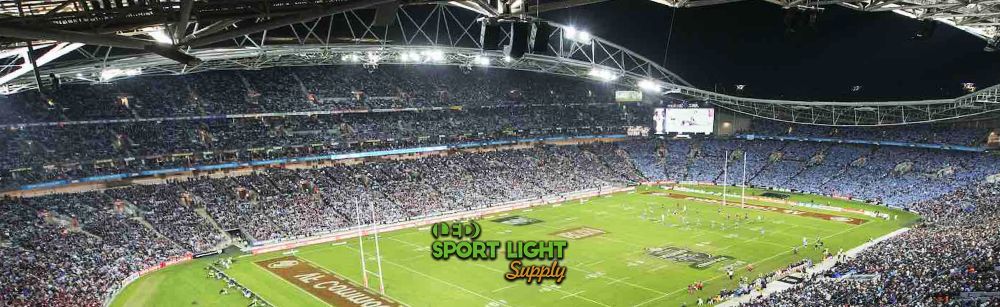
8. Installation and Labor Costs
Installation can represent a substantial portion of the total budget, especially when fixtures are mounted on high poles.
Projects may require electricians, crane operators, lifting crews, structural workers, commissioning engineers, and other specialists.
For example, if a project has 60 floodlights and installation averages $400 per fixture, installation would cost around $24,000. Actual costs depend on local labor rates, pole height, site access, equipment requirements, and project complexity.
Stadiums surrounded by roads, buildings, seating, or other obstacles may require specialized cranes or additional safety measures.
Scheduling can also affect labor costs. If installation must take place between sporting events, contractors may need additional crews or extended working hours.
9. Existing Poles and Infrastructure
Replacing every component during an LED upgrade is not always necessary. Existing poles and infrastructure may be reusable if they pass a proper engineering assessment.
Imagine a stadium with eight existing high-mast poles. If each new pole, including foundation and installation, costs an illustrative $8,000, replacing all eight could add approximately $64,000.
If the existing poles and foundations are suitable, that expense could potentially be avoided. The project may only require new LED floodlights, brackets, electrical upgrades, and related work.
Reuse should not be based on appearance alone. Corrosion, structural integrity, foundations, wind loading, fixture weight, brackets, and cable condition all need to be checked.
10. Lighting Controls and Smart Features
Modern stadium lighting can offer dimming, scheduling, zone control, remote monitoring, and programmable scenes.
A training session may not require the same lighting level as a professional match or televised event. For example, a stadium with 60 LED floodlights rated at 1,000W each has a connected load of approximately 60 kW at full output. Operating at 70% output would reduce the load to around 42 kW during those periods.
If reduced output is used for 500 hours annually, the simplified energy difference would be about 9,000 kWh. At $0.15 per kWh, that represents approximately $1,350 in potential annual savings.
Actual savings depend on operating hours, electricity prices, fixture efficiency, and the control strategy.
Automated schedules can also prevent lights from remaining on unnecessarily, while remote monitoring can help identify faults without inspecting every pole.
11. Local Regulations and Environmental Requirements
Local regulations may require compliance with electrical codes, building requirements, sports lighting standards, energy-efficiency rules, and restrictions on light spill or pollution.
This can be particularly important when stadiums are near residential areas, roads, airports, or environmentally sensitive locations. Tighter optical control may be required to keep unwanted light within the stadium boundary.
Costs may include permits, inspections, engineering documents, lighting measurements, and commissioning tests. These requirements can add several thousand dollars depending on the location and project scope.
Planning for regulations early is much easier than correcting compliance problems after equipment has been purchased.
12. Geographic Location and Site Conditions
Location can affect equipment shipping, labor, engineering, installation, and civil work.
Labor rates vary between regions, and specialist contractors may need to travel from another city or country. Transportation, accommodation, and travel time can increase installation costs.
Shipping dozens of floodlights, brackets, control equipment, and electrical components can also add thousands of dollars.
Environmental conditions matter as well. Strong winds can affect pole and foundation design, while high temperatures make thermal management important. Coastal venues may require enhanced corrosion protection because of salt exposure.
Soil conditions can also increase costs when installing new poles. Rocky ground, unstable soil, groundwater, or underground utilities may require additional foundation and civil work.
International projects may also involve import duties, taxes, currency fluctuations, customs charges, certification, and local electrical requirements.
How to Reduce Stadium Lighting Costs
Reducing stadium lighting costs is not simply about buying cheaper floodlights or installing fewer fixtures. Those shortcuts can sometimes create bigger expenses later through poor illumination, glare, higher energy use, or frequent maintenance.
A better approach is to look at the entire lighting system. Fixture efficiency, photometric design, pole configuration, electrical infrastructure, lighting controls, installation, and maintenance all contribute to the real cost of running a stadium.
For most sports facilities, some of the biggest savings come from putting the right amount of light in the right places. A well-designed LED stadium lighting system can meet the required illuminance and uniformity without covering the venue with oversized or unnecessary fixtures.
When energy consumption, maintenance, and equipment lifespan are included in the calculation, the savings can become much more noticeable over a 10- to 20-year operating period.
Choose High-Efficiency LED Stadium Lights
Replacing older metal-halide, HID, or similar stadium lighting with LED technology is one of the most common ways to reduce long-term operating costs. Traditional sports floodlights can consume a large amount of electricity and may require regular lamp replacement, while modern LED stadium lights can offer higher efficiency, longer service life, and better control over light output.
Consider a simplified example. A stadium using 60 traditional floodlights rated at 2,000W each would have a connected lighting load of approximately 120 kW, before other system losses. If an LED upgrade can achieve comparable lighting performance with 1,000W fixtures, the connected load could potentially fall to around 60 kW.
The actual savings depend on the lighting design, required lux levels, fixture efficiency, operating hours, and other factors. However, when stadium lights operate hundreds or thousands of hours each year, reducing the connected load can have a noticeable effect on electricity costs.
LED technology also makes it easier to control light output. Instead of operating every fixture at full power for every activity, the stadium can use different lighting levels for training, local competitions, professional matches, televised events, cleaning, and maintenance.
Service life is another advantage. Many commercial LED stadium floodlights are designed for 50,000 hours or more of rated life, although actual performance depends on thermal conditions, driver quality, installation, and product design. Fewer replacements can be particularly valuable when fixtures are mounted 20 to 40 meters above the field.
It is worth remembering that LED efficiency is not just about wattage. A 1,000W fixture is not automatically a better choice than a 1,500W fixture. What matters is how effectively the fixture delivers useful light to the playing surface.
Lumens, luminous efficacy, beam angle, optical distribution, glare control, and achieved lux levels all need to be considered together.
Invest in a Comprehensive Sports Lighting Design
A professional lighting design may look like an additional expense at the start of a project, but it can prevent much larger costs during equipment purchasing and installation.
A proper stadium lighting design takes into account field dimensions, pole positions, mounting heights, fixture specifications, beam angles, aiming directions, and required illumination levels. Photometric software can then simulate how the proposed system will perform across the playing surface.
This allows designers to evaluate average illuminance, minimum illuminance, uniformity, glare, light spill, and other requirements before the fixtures are purchased.
For professional and broadcast venues, the design may also consider vertical illumination and camera-facing directions. These details can make a major difference to how players appear on television and how clearly the action can be captured from different camera positions.
Without a detailed simulation, it is easy to compensate for a poor layout by purchasing more powerful fixtures. That increases the initial equipment cost and can also increase electricity consumption for years afterward.
Imagine one stadium design using 80 high-output floodlights based on general assumptions. A second design uses 64 carefully selected LED sports lights with different beam angles and precise aiming positions. If both systems achieve the required lighting performance, the second design could reduce the number of fixtures, mounting hardware, cable runs, and installation work.
The goal is not to install the maximum number of stadium lights. The goal is to achieve the required performance with an efficient lighting layout.
Optimize Pole Height and Fixture Positioning
Pole height has a strong relationship with stadium lighting cost. Raising fixtures higher can allow them to cover larger areas, but taller poles can also require stronger structures, larger foundations, additional engineering, and more complicated installation.
Outdoor stadium lighting poles can commonly reach around 20 to 40 meters, depending on the sport and venue. The right height depends on the field dimensions, surrounding structures, required lighting levels, fixture output, beam distribution, and glare requirements.
A higher mounting position may allow fewer poles or better light distribution, but that does not mean taller is always cheaper. Very tall structures can increase structural and civil costs while making maintenance more difficult.
Fixture positioning matters just as much. A narrow beam may be useful for projecting light from a distant high mast, while a wider distribution may be better for another mounting position.
Poor positioning can send light outside the playing area or create bright and dark zones across the field. The usual response is to add more fixtures, but that treats the symptom rather than the cause.
Getting the pole height, setback distance, aiming angle, and beam distribution right from the beginning can reduce fixture quantities while improving uniformity and visual comfort.
Reuse Existing Poles Where Suitable
For stadium renovation projects, replacing every pole is not always necessary.
Existing high-mast poles may still have plenty of useful structural life. If they can safely support the proposed LED floodlights, reusing them can significantly reduce the scope of an upgrade.
Before making that decision, however, the existing infrastructure should be professionally assessed. Engineers may need to check the condition of the poles, foundations, brackets, cable routes, corrosion, wind loading, fixture weight, and overall structural capacity.
The potential savings can be substantial. A complete pole replacement can involve excavation, concrete foundations, steel fabrication, transportation, cranes, and installation. An LED retrofit that keeps suitable existing poles may avoid much of that work.
Still, reuse should never be based simply on the fact that the poles are already there. Structural suitability comes first. The new LED fixtures may have different dimensions, weights, and wind-load characteristics from the old equipment, so the existing structures need to be checked accordingly.
Use Smart Stadium Lighting Controls
A stadium rarely needs maximum lighting output for every activity. This makes lighting controls a practical way to reduce electricity consumption without reducing the quality of lighting when it is actually needed.
Modern LED stadium lighting systems can use dimming, scheduling, zoning, remote monitoring, and programmable lighting scenes. A training session may require a different lighting level from a professional match, while a televised event may require the highest available setting.
For example, a stadium with 60 LED floodlights rated at 1,000W each has a connected lighting load of approximately 60 kW at full output. If the system operates at 70% output during selected activities, the lighting load during those periods could be around 42 kW.
If lower-output operation is used for 500 hours per year, the simplified energy difference would be approximately 9,000 kWh annually. At an electricity rate of $0.15 per kWh, that represents around $1,350 in potential annual electricity savings.
Actual savings will depend on the operating schedule, electricity tariff, control strategy, and fixture performance. Even so, the example shows how small changes in operating levels can add up over time.
Controls can also prevent lights from being left on unnecessarily. Automated schedules can switch systems off after events, while remote monitoring can help facility managers identify faults without manually inspecting every lighting pole.
Look for Grants, Rebates, and Energy Programs
The upfront cost of a stadium LED retrofit may be easier to manage if the project qualifies for financial assistance.
Depending on the country and local market, sports facilities may have access to energy-efficiency rebates, sustainability programs, facility improvement grants, utility incentives, or public infrastructure funding.
Some programs provide financial support based on energy savings, installed LED capacity, or the number of inefficient fixtures replaced. A stadium replacing an older 2,000W lighting system with a more efficient LED solution may therefore be able to reduce its net project cost.
Eligibility rules vary, and some programs require an energy audit, technical proposal, or approval before equipment is purchased. Checking these requirements early is important because applying after the project has already started may mean missing out on available support.
It can also help to calculate projected energy savings before submitting an application. A clear comparison between the existing system and proposed LED system can strengthen the financial case for the upgrade.
Compare Suppliers Beyond the Fixture Price
Getting several quotations is a good starting point, but stadium lighting should not be purchased based on the lowest fixture price alone.
When comparing LED floodlights, look at lumen output, efficacy, optical performance, beam angles, color rendering, color temperature, glare control, surge protection, ingress protection, thermal management, driver quality, warranty coverage, and expected service life.
The scope of the quotation also matters. One supplier may quote only for the floodlights, while another may include photometric design, mounting accessories, controls, commissioning, technical support, and installation guidance.
For example, saving $100 per fixture sounds attractive when purchasing 60 or 80 lights. But if the lower-priced fixture consumes more electricity, provides poorer light distribution, or requires more frequent maintenance, the initial saving may disappear over time.
A stadium lighting quotation should be judged on total value, not simply the number at the bottom of the fixture price column.
Plan for Maintenance and Long-Term Operating Costs
Maintenance is easy to overlook when the main focus is the initial project budget. Yet high-mounted stadium floodlights can be expensive to access and service.
Fixtures installed above a football field, cricket ground, baseball diamond, or athletics track may require a crane, elevated work platform, lowering system, or other specialized equipment when servicing is required.
LED technology can reduce routine lamp replacement, but the system still needs maintenance. Drivers, electrical connections, control equipment, surge protection, and other components may eventually require inspection or replacement.
When comparing stadium lighting products, consider how easy they are to service and whether replacement components are likely to remain available for years to come. Warranty terms and technical support also deserve attention.
For example, if a crane visit costs $1,500, several unnecessary service visits can quickly add thousands of dollars to the ownership cost. A reliable fixture that costs slightly more upfront may therefore prove more economical over its operating life.
The cheapest installation is not always the cheapest stadium lighting system to own.
A Smarter Way to Approach Stadium Lighting Investment
Stadium lighting does not have to be a battle between performance and budget. In many cases, the two can work quite nicely together when the project is designed from the ground up around the actual needs of the venue.
The biggest cost drivers tend to be connected. Field size affects fixture quantity, sport type affects lighting requirements, pole height affects both coverage and installation, and the existing electrical infrastructure can determine how much additional work is needed.
LED technology, accurate photometric design, smart controls, suitable reuse of existing infrastructure, and available funding programs can all help bring the overall cost down.
Most importantly, look at the whole project rather than the price of the floodlights alone. A system that delivers the right light with fewer fixtures, lower energy use, easier maintenance, and a long service life can be a much better investment than a cheaper system that creates problems later.
If you are planning a new stadium lighting installation, LED retrofit, or sports field lighting upgrade, feel free to approach us for a professional consultation. We can help assess your field size, sport, pole configuration, lighting requirements, and existing infrastructure to develop a lighting solution that balances performance, reliability, and project cost.