
Stadium lighting has a demanding job. It needs to deliver bright, uniform illumination across a large playing area, support high-definition television broadcasts, and keep performing through changing weather conditions. A single electrical fault can leave several floodlights out of action, affect lighting controls, or lead to expensive repairs just when a stadium is preparing for a major event.
One threat that often receives less attention than lighting power or beam angle is electrical surges. Lightning activity, utility switching, and the operation of large electrical loads can produce short voltage spikes that damage LED drivers, control equipment, and other electronic components. For stadiums with dozens or hundreds of high-power luminaires mounted on tall poles or roof structures, the consequences can extend well beyond replacing a single light.
Surge protection of stadium lighting helps reduce the risk of equipment damage, unexpected outages, and unnecessary maintenance costs. However, getting it right involves more than adding a surge protector to a distribution panel. The protection devices, cable routes, earthing and bonding arrangements, lighting controls, and overall electrical design all need to work together.
So, how does stadium lighting surge protection work, when does it activate, and how much should a stadium budget for it? Let’s take a closer look.
Why Does Stadium Lighting Need Surge Protection?
Modern stadium lighting systems rely on more than LED chips and reflectors. Each luminaire may contain an LED driver, control electronics, dimming interfaces, and monitoring components. The wider installation also includes distribution boards, switching equipment, communication networks, and sometimes centralized lighting management software.
These electronic components can be affected by transient overvoltages, even when the surge lasts only a very short time. Unlike a conventional lighting circuit that mainly supplies electrical power to a lamp, an LED luminaire contains sensitive semiconductor components that must operate within defined electrical limits.
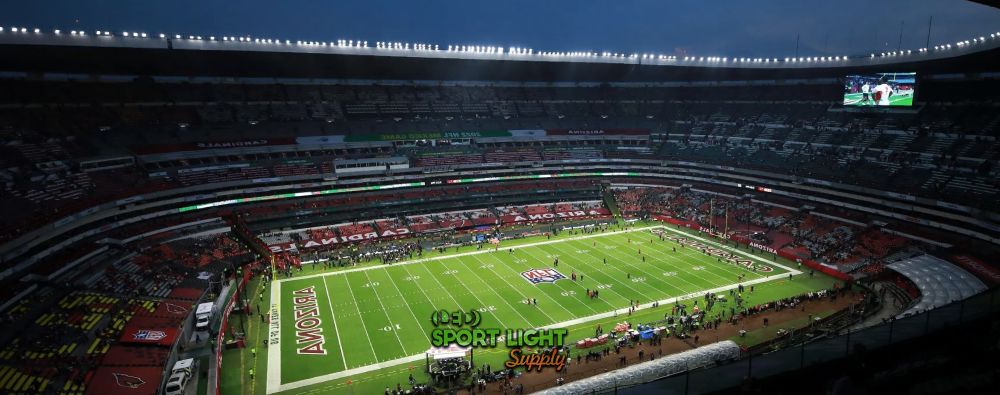
Protecting LED Stadium Floodlights and Drivers
LED floodlights are designed for long operating lives, but their actual service life depends on operating temperature, electrical conditions, component quality, and maintenance. The LED driver is one of the components that can be affected by an electrical surge.
A surge may damage the driver’s input stage, insulation, rectifier, switching components, or control electronics. Depending on the extent of the damage, the floodlight might stop working completely, begin to operate intermittently, or develop a fault that appears only after repeated electrical disturbances.
Consider a stadium using 120 LED floodlights, each rated at 1,500 W. The connected lighting load is approximately 180 kW. If several drivers fail during a thunderstorm, maintenance teams may need to inspect elevated fixtures, arrange access equipment, replace components, and test the lighting system before the next event.
The direct cost of a replacement driver may be relatively modest compared with the cost of accessing a high mast, paying for specialist labor, and arranging an additional maintenance visit.
Surge protection helps reduce the likelihood of surge-related failures, although it cannot guarantee that every driver or luminaire will remain undamaged.
Maintaining Lighting Availability During Matches and Events
A stadium’s lighting requirements can be more demanding than those of an ordinary commercial building. Depending on the venue and event, the system may need to maintain specified illumination levels, uniformity, glare control, and color quality across the playing surface.
If several luminaires fail, the lighting distribution can change. Dark patches may appear on the field, uniformity may fall below the design target, and broadcast cameras may capture inconsistent illumination.
The consequences depend on the number and location of failed fixtures, the lighting design, and the event’s operating requirements. A single failed luminaire does not automatically make a stadium unusable, but a group of failures in the same area can create a more serious operational problem.
Surge protection forms part of a wider reliability strategy that may also include redundant lighting circuits, emergency lighting, backup power, spare drivers, and a maintenance plan.
Reducing Maintenance and Replacement Costs
Stadium floodlights are often installed high above the ground, which makes routine repairs more involved than replacing a lamp in an office.
For example, an outdoor stadium may use floodlight masts approximately 25 to 60 m tall, depending on the venue’s geometry and lighting design. Access may require a specialist maintenance platform, a lifting system, or other approved working-at-height arrangements.
Even when the replacement component is inexpensive, labor and access costs can add up. If a surge damages multiple drivers at once, the maintenance team may need to organize several repairs rather than handle one isolated fault.
A properly designed surge protection system can help reduce the frequency of surge-related maintenance. Its value is best assessed against the site’s exposure, equipment replacement costs, access arrangements, and operational requirements rather than the purchase price of the SPD alone.
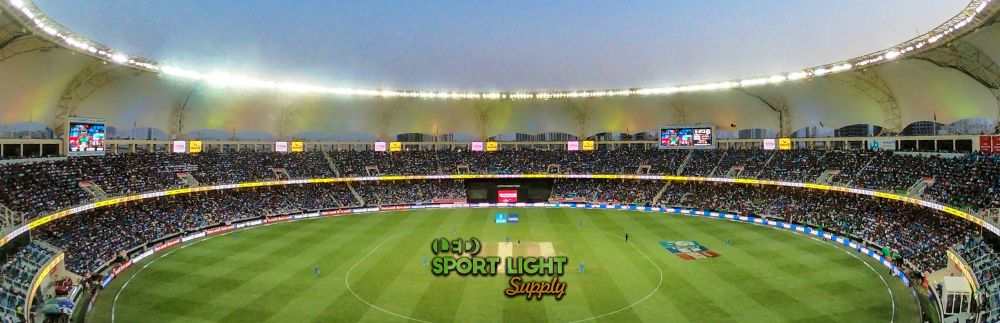
What Causes Electrical Surges in Stadium Lighting Systems?
Electrical surges are short-duration voltage disturbances that can travel through power cables or other conductive connections. They are different from ordinary changes in supply voltage and from sustained overvoltage conditions.
In stadium lighting installations, the most common sources to consider include lightning-related disturbances, switching operations, utility network events, and surges entering through control or communication wiring.
Lightning Strikes and Nearby Lightning Activity
Stadiums often have exposed structures, tall lighting masts, large roof assemblies, and extensive outdoor cable networks. These features make lightning protection a key consideration in the electrical design.
A direct lightning strike can produce very high currents in the structure or lightning protection system. Some of that energy may couple into electrical installations through conductive paths or differences in potential between connected systems.
A nearby strike can also induce voltage transients in long power and communication cables through electromagnetic coupling. The lighting equipment does not need to receive a direct strike to be affected.
The risk depends on several factors, including the local lightning environment, the stadium’s structural design, cable routing, bonding arrangements, and the characteristics of the installed protection system.
An SPD can limit transient overvoltages within its designed operating range, but it is not a substitute for an appropriately designed external lightning protection system.
Switching Surges From Large Electrical Loads
Not every damaging surge comes from a thunderstorm. Electrical switching can also produce transient overvoltages.
Stadiums commonly operate large HVAC systems, water pumps, lifts, ventilation equipment, and other motor-driven loads. Switching these loads, or operating associated electrical equipment, can generate disturbances that travel through the distribution network.
Lighting circuits themselves can also produce switching-related transients, depending on the equipment and switching arrangement.
These disturbances are often associated with the inductive characteristics of electrical loads and the way the wider distribution system responds to switching. Their magnitude and waveform vary, so the protection design should account for the actual installation rather than assume that all surges have the same characteristics.
Utility Grid Disturbances and Power Restoration
Changes in the utility network can expose stadium electrical equipment to transient disturbances. Events involving switching operations, faults, and changes in network configuration may affect the supply.
Power restoration deserves attention, too. When the supply returns after an outage, several systems may restart or reconnect within a short period. The resulting electrical conditions depend on the supply arrangement, connected loads, and switching sequence.
An SPD can help with qualifying transient overvoltages, but it does not provide backup power, stabilize every supply disturbance, or protect against every sustained overvoltage. Those requirements may call for other equipment and control measures.
Surges Through Lighting Control and Communication Cables
Modern sports lighting systems may use DALI, DMX, Ethernet, or proprietary communication interfaces for dimming, scene selection, monitoring, and fault reporting.
These connections introduce additional paths through which a transient can reach sensitive electronics. Protecting the AC power supply alone may not protect a controller if an electrical disturbance enters through a communication cable.
Where the system design calls for it, compatible signal-line SPDs, suitable cable routing, shielding, isolation, and coordinated bonding can help reduce exposure.
The chosen device must match the signal type, operating voltage, data rate, and connection arrangement. An SPD intended for a power circuit should not automatically be assumed suitable for a communication interface.
How Does Surge Protection for Stadium Lighting Work?
A surge protective device, commonly called an SPD, is designed to limit transient overvoltages, divert surge current, or perform both functions. The International Electrotechnical Commission’s IEC 61643-11:2025 specifies requirements and test methods for SPDs connected to AC low-voltage power systems within its stated scope.
The basic principle is straightforward: when a qualifying voltage transient occurs, the SPD provides a protective response that helps limit the electrical stress experienced by downstream equipment.
What Happens When a Surge Occurs?
Under normal operating conditions, the SPD remains connected to the electrical system without significantly interfering with the intended supply. Its internal components respond when the voltage conditions meet their operating characteristics.
When a transient occurs, the SPD may conduct surge current through a designated protective path, limit the voltage across the protected circuit, or use a combination of these behaviors.
As the transient subsides, the device returns to its normal operating condition if it has not been damaged and its components remain within their operating limits.
It is worth understanding that an SPD does not make a surge disappear without a trace. Some residual voltage remains, and the amount that reaches the protected equipment depends on the SPD’s characteristics, installation, wiring, and the nature of the surge.
This is why the voltage protection level, wiring layout, and coordination with other protective devices matter just as much as the headline discharge-current rating.
The Role of MOVs, GDTs, and Other Components
Metal-oxide varistors, or MOVs, are commonly used in SPDs for AC power systems. Their electrical behavior changes with the voltage across them, allowing them to conduct more current during a transient and limit the voltage.
Gas discharge tubes, or GDTs, use a gas-filled gap that becomes conductive under suitable electrical conditions. They may be used in certain power or signal protection arrangements, depending on the device design.
Other SPD designs may incorporate spark gaps, semiconductor components, thermal disconnects, and status indicators.
Not every SPD contains all these components. The internal design varies according to the application and the manufacturer’s specifications. For stadium lighting, the practical questions are whether the device suits the circuit, provides the required protection characteristics, and has been tested for its intended application.
Why Earthing, Bonding, and Wiring Affect Performance
An SPD can have suitable specifications on paper and still perform poorly if it is installed incorrectly.
The conductors connecting the SPD to the electrical system introduce impedance. During a rapidly changing surge current, that impedance can add voltage to the protective path. Longer connecting leads can therefore increase the voltage experienced by the equipment being protected.
NEMA’s Surge Protection Institute explains that SPD performance is affected by connecting-lead length, conductor arrangement, and grounding and bonding conditions.
For stadium installations, the electrical contractor should follow the manufacturer’s wiring instructions, use the specified overcurrent protection, and keep SPD connections as short and direct as the approved installation permits.
The earthing and bonding arrangement also needs to comply with the applicable electrical code and the stadium’s lightning protection design. Adding an SPD without checking these conditions can leave gaps in the overall protection scheme.
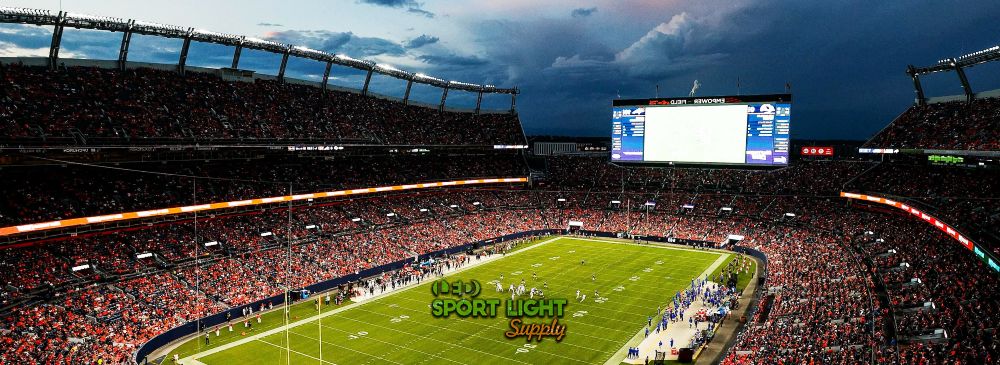
Main Types of Surge Protective Devices Used in Stadium Lighting
SPD selection depends on where the device is installed, the expected surge environment, the electrical system, and the level of protection required. In common IEC terminology, Type 1, Type 2, and Type 3 SPDs serve different roles in a coordinated installation.
| SPD Type | Main Purpose | Typical Installation Location | Stadium Lighting Application |
|---|---|---|---|
| Type 1 | Handles partial lightning current entering the electrical installation. | Main distribution board or incoming supply. | Helps protect the stadium’s electrical system where lightning-current protection is required. |
| Type 2 | Limits residual lightning-related and switching surges. | Main or downstream distribution panels. | Protects lighting circuits supplying floodlights, stands, and other stadium areas. |
| Type 3 | Provides supplementary protection for sensitive equipment. | Close to protected equipment, where appropriate. | Adds protection for LED drivers and lighting control equipment when required. |
Type 1 SPDs for Incoming Electrical Supplies
Type 1 SPDs are designed for applications where partial lightning current may enter the electrical installation. They are selected and tested for the applicable lightning-current duty.
In a stadium, a Type 1 device may be considered at the incoming supply or another suitable point, depending on the lightning protection design and local requirements.
The need for a Type 1 SPD should be established through the installation’s risk assessment, supply arrangement, and applicable standards. Not every stadium requires an identical configuration.
Type 2 SPDs for Distribution Boards
Type 2 SPDs are commonly installed in distribution boards to limit residual lightning-related and switching transients.
A stadium may have several distribution levels serving different stands, lighting masts, concourses, and auxiliary facilities. A Type 2 SPD at a suitable downstream panel can help protect the equipment supplied from that panel.
The choice of device depends on the panel’s electrical characteristics, prospective fault current, protection coordination, and expected surge exposure.
Type 3 SPDs for Additional Equipment-Level Protection
Type 3 SPDs are designed for supplementary protection closer to sensitive equipment, where the installation conditions and manufacturer’s instructions permit their use.
They may be considered where residual transient exposure remains a concern after upstream protection has been installed.
They should not be treated as a replacement for the upstream protection required by the design. In addition, the device must be suitable for the equipment and circuit in question.
The exact classification and application rules depend on the governing standard. IEC and North American UL terminology are not interchangeable in every respect, so project specifications should state the applicable standard and device classification clearly.
Applications of Surge Protection Across Stadium Lighting Systems
A stadium’s lighting network usually extends beyond the floodlights above the playing field. The protection strategy should consider the full system, from the incoming supply to outdoor luminaires and electronic controls.
High-Mast Floodlights and Sports Field Lighting
High-mast floodlights are exposed to outdoor electrical conditions and often connect to distribution equipment through long cable routes. The combination of elevated structures, extensive wiring, and electronic drivers makes surge exposure worth evaluating during the design stage.
Protection may be provided at a distribution panel, near a mast, at the luminaire, or at multiple locations, depending on the system’s risk assessment and electrical layout.
For example, a stadium with 8 lighting masts and 12 floodlights per mast would have 96 fixtures. If each fixture were rated at 1,500 W, the connected lighting load would be 144 kW before accounting for auxiliary equipment and system losses.
That example does not automatically mean 96 separate SPDs are required. The number and location of devices should follow the electrical circuit arrangement and the level of protection needed.
Indoor Arenas and Covered Stadiums
Indoor arenas may have less direct exposure to outdoor weather at their luminaires, but they are still connected to electrical networks that can carry switching and externally generated transients.
Large ventilation systems, motor drives, stage equipment, and electronic control systems can add complexity to the electrical environment.
The protection design should consider the incoming supply, distribution boards, lighting controls, and any long connections to roof-mounted fixtures. A roof does not remove the need to assess electrical surge exposure.
Stadium Lighting Controls and Communication Networks
Lighting control systems may use digital protocols to adjust brightness, create event scenes, or monitor equipment status. A surge entering through a control cable can affect the connected controller or communication interface even when the power circuit has its own SPD.
Where necessary, compatible signal-line protection should be installed according to the system manufacturer’s requirements.
For example, a venue using Ethernet-connected lighting controllers may need to consider protection for the relevant network connections, particularly where cables extend between buildings or outdoor structures. The selected protection must support the required data rate and network configuration.
Parking Areas, Perimeter Lighting, and Access Routes
Outdoor lighting around a stadium supports pedestrian access, vehicle movement, entrances, and other areas used before and after events.
These luminaires may be connected to long underground or above-ground cable runs. A surge affecting one part of the network can potentially travel along connected conductors to other equipment.
The design should account for the layout of the outdoor circuits, the location of distribution boards, the grounding and bonding arrangement, and the exposure of the installed equipment.
Protection requirements may differ between a compact parking area supplied from one panel and a large site with several buildings, multiple distribution points, and extensive outdoor cabling.
Where Should Surge Protective Devices Be Installed?
There is no single installation point that suits every stadium. A coordinated protection strategy may use several SPDs at different points, with each device selected for its location and the surge exposure expected there.
At the Main Distribution Board
The incoming electrical supply is a natural starting point for assessing surge protection. Depending on the system design, an SPD at this location can limit transients entering from the external supply network.
The SPD must be compatible with the supply voltage, phase arrangement, earthing system, and available fault current. Its connection arrangement and required backup protection must also be checked.
For larger stadiums, the incoming board may supply several downstream distribution panels, each serving a different part of the facility.
At Lighting Sub-Distribution Panels
Downstream distribution panels provide another opportunity to protect lighting circuits. These panels may be located in service rooms, near stands, or close to the supply points for outdoor masts.
Adding protection at a suitable downstream panel can help address residual surges and exposure associated with the connected circuit.
However, simply installing several SPDs does not guarantee better protection. The devices need to be coordinated so that their electrical characteristics and placement work together.
Near Floodlights and LED Drivers
Additional local protection may be appropriate where cable runs are long, fixtures are exposed, or the equipment manufacturer’s instructions call for it.
The distance between an upstream SPD and the protected luminaire can affect the voltage experienced by the equipment during a fast transient. In some layouts, the cable itself can allow a voltage disturbance to develop at the far end.
This does not mean every floodlight needs a separate SPD. An engineer should evaluate the circuit length, cable arrangement, existing protection, and luminaire specifications before deciding whether local devices are warranted.
On Signal and Communication Lines
Where lighting controls use external communication wiring, the protection plan should address those connections separately from the power supply.
The devices must suit the communication protocol and installation. Their placement should also be coordinated with the grounding and bonding design so that the protection system does not introduce unwanted electrical problems.
How to Choose the Right Surge Protection for Stadium Lighting
Choosing an SPD based only on its maximum surge-current rating can lead to a poor match for the installation. A more useful selection process starts with the electrical system, the exposure assessment, and the equipment being protected.
Check the Electrical System and Surge Exposure
The designer should establish the nominal supply voltage, phase configuration, earthing arrangement, and available fault current. The assessment should also consider whether the stadium has an external lightning protection system, how the lighting cables are routed, and where equipment is installed.
For a large outdoor venue, the assessment may cover multiple lighting masts, distribution boards, control rooms, and connected buildings. Each section can have a different exposure profile.
The required protection should follow the applicable electrical codes, project specifications, manufacturer guidance, and risk assessment.
Understand the Main SPD Ratings
Several specifications deserve attention when comparing SPDs.
The maximum continuous operating voltage, commonly written as Uc, indicates the voltage the SPD is designed to tolerate continuously under the specified conditions.
The voltage protection level, or Up, describes the stated level of voltage limitation under specified test conditions. It should be considered alongside the equipment’s impulse withstand capability.
The nominal discharge current, In, describes a defined surge-current test rating. The maximum discharge current, Imax, is another rating used for certain SPD classifications. Type 1 devices may also specify a lightning impulse current rating, Iimp.
These values describe different aspects of performance and should not be treated as interchangeable. A higher discharge-current number alone does not prove that one SPD will provide better protection in every stadium application.
Check Compatibility With LED Drivers and Controls
The SPD must suit the actual circuit. AC lighting circuits require compatible AC-rated devices, while DC circuits, where present, require devices specifically rated for their operating conditions.
The designer should also verify the required voltage, connection arrangement, protective conductor configuration, backup overcurrent protection, and short-circuit rating.
For lighting controls, the device must match the relevant signal interface and preserve the required communications performance.
Follow Applicable Standards
International projects may refer to the IEC 61643 series for surge protective devices and the IEC 62305 series for lightning protection. IEC 62305-1:2024 sets out general principles for protecting structures, their installations, and their contents against lightning.
In the United States, applicable UL standards and National Electrical Code requirements may also apply, depending on the installation and project specification.
The project team should verify the current editions, national adoptions, and local requirements before specifying or installing equipment. A product’s compliance with one standard should not be assumed to demonstrate compliance with every other standard.
How Much Does Stadium Lighting Surge Protection Cost?
The cost depends on the number of protection points, the selected SPD ratings, the electrical distribution layout, the installation environment, and the amount of work required to integrate the devices.
For budgeting purposes, it is useful to separate the cost of the SPD itself from installation labor, enclosures, circuit protection, cable work, engineering, testing, and any access equipment needed.
The figures below are illustrative US$ budgeting ranges, not verified market quotations or supplier prices. Actual costs may be lower or higher depending on location, product certification, procurement volume, project complexity, and labor rates.
Typical SPD and Installation Cost Ranges
A basic, appropriately rated SPD for a small distribution board may cost roughly US$50 to US$250 for the device. Higher-rated devices, Type 1 products, industrial-grade units, and products with additional monitoring functions can cost several hundred dollars or more.
For preliminary planning, a more involved Type 1 or Type 2 SPD package for a larger distribution point might be budgeted at approximately US$200 to US$1,000 or more for the device, depending on the specification. These categories overlap, so the ranges should not be used as a substitute for comparing actual product datasheets.
Installation costs are separate. A straightforward retrofit at an accessible distribution board might cost around US$200 to US$800 in labor and associated work. A complex installation involving shutdown coordination, new enclosures, cable modifications, difficult access, or extensive testing can cost substantially more.
A remote mast or roof-level installation may require additional access arrangements and safety controls. As a result, the cost of adding protection near a high-mounted floodlight can differ considerably from the cost of fitting an SPD inside an existing electrical room.
Example: Budgeting for a Medium-Sized Stadium
Consider a hypothetical stadium with 8 lighting masts and 96 LED floodlights. The facility has one main distribution board and four downstream lighting distribution panels.
Suppose the preliminary design includes one main-board SPD package budgeted at US$600 and four downstream packages budgeted at US$350 each. The combined device allowance would be:
US$600 + (4 × US$350) = US$2,000.
If the installation and testing allowance were US$2,500, the initial budget for these five protection points would be US$4,500.
This example covers only the assumed protection packages and associated installation work. It excludes any additional local floodlight SPDs, control-line protection, engineering design fees, taxes, major panel modifications, and special access costs. Those items should be added if the actual design requires them.
The example also does not establish that five SPDs are sufficient for every 96-floodlight stadium. The appropriate number of devices depends on the circuit layout, exposure, and protection assessment.
How Much Could Surge Protection Save Over Time?
A useful cost comparison considers the cost of the protection system against the potential cost of surge-related repairs and downtime.
Suppose a stadium spends US$4,500 on an initial SPD installation. If a later surge-related incident would otherwise require US$1,500 in replacement components and labor, plus US$1,000 in access and operational expenses, that single avoided incident would represent US$2,500 in potential costs.
Under those hypothetical assumptions, two comparable avoided incidents would amount to US$5,000 in avoided costs. That would exceed the original US$4,500 outlay, before accounting for inspections, device replacement, and other lifecycle expenses.
This is a simplified scenario, not a forecast of actual savings. Surge frequency, equipment failure rates, the effectiveness of the protection design, and repair costs vary from one site to another.
A sound financial assessment should compare several scenarios over a defined period, such as 5 or 10 years. It should include initial installation costs, scheduled inspections, SPD replacement, likely repair expenses, and the operational consequences of lighting failures.
How Surge Protection Fits Into Stadium Lighting Design
Surge protection should be considered during the lighting design stage rather than added only after equipment failures occur. This makes it easier to coordinate the protection devices with the electrical distribution system, cable routes, mast locations, and control architecture.
Calculate the Lighting Load Before Selecting Protection
The connected load helps establish the scale of the electrical installation, although it does not determine SPD ratings by itself.
For example, 96 LED floodlights rated at 1,500 W each produce a connected lighting load of:
96 × 1,500 W = 144,000 W, or 144 kW.
If all fixtures operate for 6 hours on an event day, the lighting energy consumption would be approximately 864 kWh for that operating period, assuming the fixtures run at their full rated input power throughout.
The actual consumption may be lower if the system uses dimming, different operating scenes, or separate circuits that run for shorter periods.
The electrical designer can use the load calculation to help determine circuit arrangements, protective devices, cable sizes, and distribution requirements. SPD selection then requires a separate assessment of transient exposure, voltage protection, and coordination.
Consider Cable Length and Mast Layout
Cable routing can affect both surge exposure and protection performance. A long cable between a distribution panel and a remote mast may provide a path for induced transients and can influence the voltage seen at the connected equipment.
For example, a stadium with four corner masts may have a different circuit layout from a stadium with eight masts distributed around the field. The number of protection points and the need for local devices may differ accordingly.
Designers should document cable lengths, the locations of distribution panels, the earthing and bonding arrangement, and the points where power and communication lines enter exposed structures.
Coordinate Protection With the Lighting Performance Requirements
Sports lighting design often includes targets for horizontal and vertical illuminance, uniformity, glare control, and color rendering. The required values depend on the sport, competition level, venue, and broadcast requirements.
Surge protection does not directly improve illuminance or beam distribution. Its role is to help preserve the operation of the equipment that delivers the specified lighting performance.
For example, if a lighting design uses 96 fixtures to achieve the required field illumination, a group of failed drivers can reduce the available light and change the uniformity pattern. A protection strategy that reduces the likelihood of surge-related failures can therefore support lighting availability, although it cannot eliminate every cause of outages.
The design team should also consider whether the venue needs spare drivers, replacement luminaires, redundant circuits, or a recovery plan for major events.
Building a More Reliable Stadium Lighting System
Surge protection is one part of a dependable stadium lighting installation, but it can make a real difference to how well the system withstands electrical disturbances. From protecting LED drivers and distribution boards to reducing exposure on long mast cables and control networks, a coordinated approach helps limit avoidable equipment damage and maintenance disruption.
The best solution starts with the actual site conditions. Stadium size, floodlight power, cable distances, lightning exposure, electrical distribution, and control interfaces all influence the design. A careful assessment also helps establish a realistic budget, rather than spending money on devices that do not match the installation’s needs.
If you are planning a new stadium lighting project, upgrading existing LED floodlights, or reviewing surge protection after repeated equipment failures, contact our team for a consultation on stadium lighting surge protection and system design. We can help you assess your lighting requirements, review suitable protection options, and develop a solution aligned with your electrical installation, operating conditions, and project budget.